
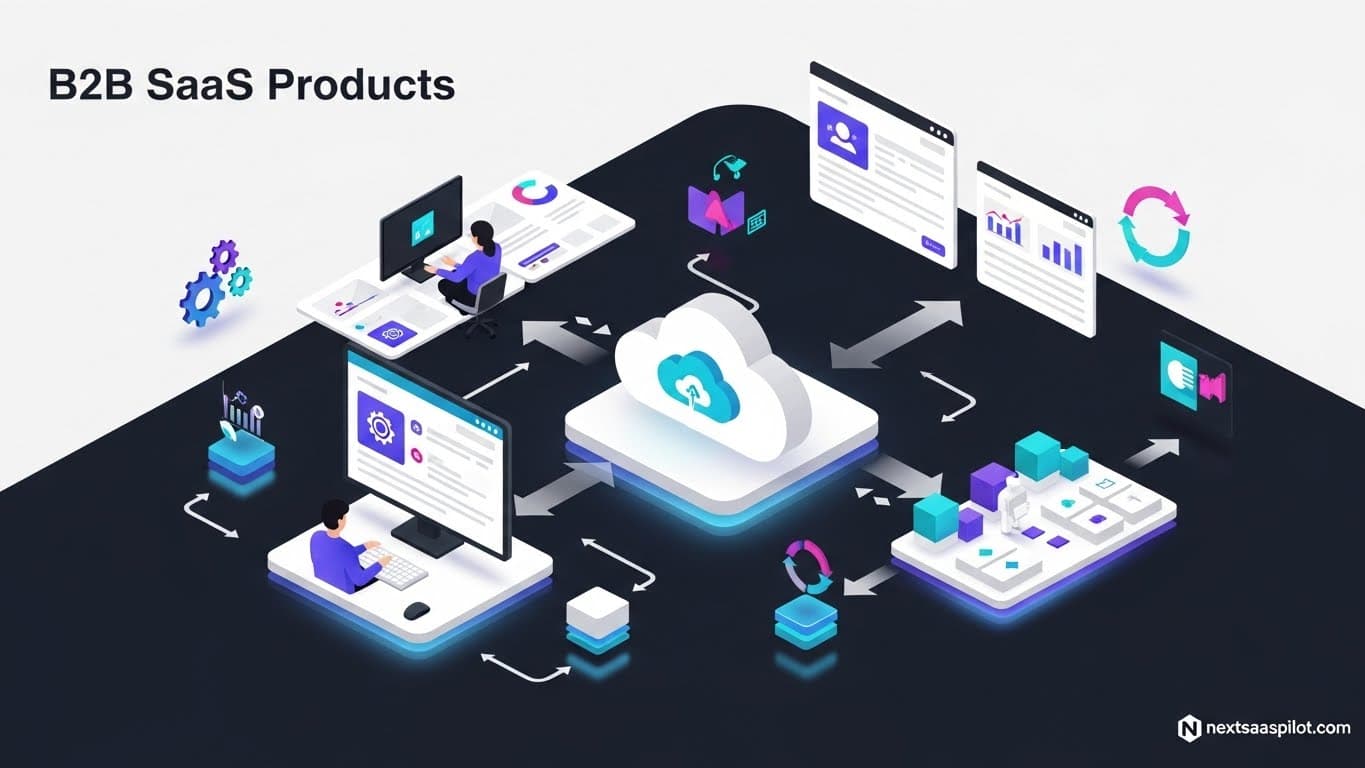
B2B SaaS products have fundamentally shifted from passive tools into active, autonomous agents that drive the modern economy. In 2025, the most successful companies do not just buy software to store data; they invest in platforms that perform work, predict trends, and secure assets automatically. This guide explores the top-tier solutions defining business efficiency today.
What Defines the Best B2B SaaS Products in 2025?
The best B2B SaaS products in 2025 are defined by “Agentic AI” capabilities, seamless integration ecosystems, and rigorous security compliance. Unlike legacy tools that require constant human input, modern platforms proactively automate complex workflows, delivering tangible ROI through labor savings and revenue acceleration rather than just digital storage.
The era of “shelfware”—software bought but never used—is ending. Today, IT buyers demand outcomes.
Key Characteristics of Top Platforms:
- Agentic Workflows: The software doesn’t just wait for a click; it executes tasks (like sending invoices or qualifying leads) autonomously.
- API-First Design: If a tool cannot talk to your CRM or ERP instantly, it creates a data silo.
- Vertical Depth: Generalist tools are losing ground to industry-specific platforms that come pre-configured for niche compliance needs.
I recently advised a manufacturing client who swapped three generic productivity tools for one specialized supply chain platform. They didn’t just save on license fees; they reduced their inventory holding costs by 18% in six weeks. That is the power of choosing the right tool.
Which CRM Platforms Dominate the B2B Market?
Salesforce, HubSpot, and Microsoft Dynamics 365 dominate the B2B CRM market. Salesforce leads in enterprise customization and AI agents, HubSpot wins on user adoption and ease of use for scaling companies, and Dynamics 365 is the preferred choice for organizations already deeply integrated into the Microsoft ecosystem.
1. Salesforce (The Enterprise Standard)
Salesforce remains the heavyweight champion. With the launch of Agentforce, they have moved beyond simple data recording.
- Best For: Large enterprises needing infinite customization.
- The Reality: It is powerful, but it requires a dedicated administrator.
- Link: For a deeper dive into how large organizations utilize these heavy lifters, review our guide on SaaS enterprise software.
2. HubSpot (The User Favorite)
HubSpot has successfully moved upmarket.
- Best For: Companies that want sales and marketing aligned in one database without a painful implementation.
- Adoption: Sales teams actually like using it, which means better data accuracy.
3. Pipedrive (The SMB Specialist)
For smaller teams focused purely on sales velocity, Pipedrive removes the fluff.
- Focus: It is a visual pipeline tool, not a massive database.
To see how these platforms look in action across different industries, check our list of SaaS examples.
What Is the Difference Between B2B SaaS and SAS?
The difference is that B2B SaaS refers to the “Software as a Service” cloud delivery model, while SAS refers to a specific company (Statistical Analysis System) known for advanced analytics. It is a common acronym confusion; one is a method of buying software, and the other is a legacy software provider.
This confusion often trips up new buyers.
Clarifying the Terms:
- SaaS (Software as a Service): The broad model where you rent software via the internet (e.g., Zoom, Slack).
- SAS (Statistical Analysis System): A specific vendor famous for clinical trials and banking fraud detection.
If you are navigating this terminology, it is vital to understand the nuances of SaaS vs SAS. While most modern businesses need B2B SaaS, highly regulated industries like pharma often rely on SAS statistical software for data validation that meets FDA standards.
Furthermore, implementing the latter is complex. Many firms hire specialized SAS consulting firms just to manage that specific infrastructure, whereas B2B SaaS is designed for self-service.
Which Project Management Tools Drive Team Efficiency?
The top project management tools driving efficiency are Monday.com, Asana, and Jira. Monday.com offers a highly visual “Work OS” for general operations, Asana excels at task dependency management for marketing and creative teams, and Jira remains the undisputed standard for software engineering and agile development workflows.
The “all-in-one” trend is huge here. Teams are tired of toggling between apps.
Top 3 Comparisons:
| Feature | Monday.com | Asana | Jira |
| Primary User | Ops & Marketing | Creative & Project Managers | Developers & DevOps |
| Strength | Visual Customization | Task Hierarchies | Agile/Scrum Workflows |
| Learning Curve | Low | Medium | High |
| Best Integration | Excel/Google Sheets | Slack/Teams | GitHub/GitLab |
Real-World Application:
In 2024, many marketing agencies migrated from Trello to Monday.com. Why? Because Trello is great for lists, but Monday.com offers automation—like automatically notifying a client when a task moves to “Done.”
How Are Communication Platforms Evolving?
Communication platforms like Slack and Microsoft Teams are evolving from chat apps into “Digital HQs.” They now serve as the central notification hub for all other B2B apps, allowing users to approve expenses, merge code, or update CRM records directly within the chat interface without switching contexts.
1. Slack (Salesforce)
Since the Salesforce acquisition, Slack has become the command center for sales teams.
- Feature to Watch: “Slack Lists” which attempts to replace lightweight project management tools.
2. Microsoft Teams
If you use Office 365, you use Teams.
- Advantage: It is “free” with the bundle. The video quality and integration with SharePoint make it sticky for corporate environments.
3. Zoom
Zoom has pivoted to become a full communications platform, adding “Zoom Phone” and “Zoom Docs” to compete with Microsoft and Google.
What Are the Best B2B SaaS Tools for Small Business?
The best B2B SaaS tools for small businesses focus on affordability and “suite” functionality, such as Zoho One, Freshworks, and QuickBooks Online. These platforms offer bundled services—combining CRM, accounting, and support—allowing small teams to manage their entire operation without paying for enterprise-grade integrations they do not need.
Small business owners wear every hat. They don’t have a CIO to manage integrations.
Top Picks for SMBs:
- Zoho One: It is arguably the best value in SaaS. For one monthly price, you get 40+ apps running your whole business.
- Gust: For payroll and HR. It is built specifically for modern startups and small businesses.
- Calendly: A simple tool that solves a massive problem—scheduling.
For a comprehensive guide on building a lean stack, read our analysis on SaaS for small business. It breaks down how to scale without overspending.
How Do Security Products Protect B2B Data?
Security products like CrowdStrike, Okta, and Drata protect B2B data by securing endpoints, managing identity access, and automating compliance. In an era of remote work, the “castle and moat” firewall strategy is dead; these tools ensure that every user and device is verified before accessing sensitive company information.
Security is no longer just an IT problem; it is a business continuity requirement.
The “Must-Have” Security Stack:
- Identity (Okta/Microsoft Entra): Ensures the person logging in is actually who they say they are (MFA).
- Endpoint (CrowdStrike/SentinelOne): Protects the actual laptop or mobile device from ransomware.
- Compliance (Drata/Vanta): Automates the evidence gathering for SOC2 and ISO 27001 audits.
If you ignore this layer, you expose yourself to massive SaaS security risks. A single compromised login in a connected SaaS ecosystem can lead to a full data breach.
What Is the Role of “Vertical SaaS” in B2B?
Vertical SaaS plays a critical role by providing industry-specific solutions that generalist platforms cannot match. Unlike horizontal tools (like Slack) that serve everyone, vertical SaaS (like Toast for restaurants or Procore for construction) is purpose-built with the exact workflows, compliance standards, and terminology of a specific niche.
Why Vertical Wins:
- Less Customization: It works out of the box.
- Higher Retention: It becomes the operating system for the business.
Examples:
- Shopify (Retail): While huge, it started as a vertical tool for selling snowboards.
- Clio (Legal): Handles case management and billing specifically for law firms.
- ServiceTitan (Trades): Manages dispatch and invoicing for plumbers and HVAC techs.
For a broader definition of the business models driving these sectors, Business-to-business provides excellent context on the transactional nature of these relationships.
How Do You Select the Right SaaS Vendor?
Selecting the right SaaS vendor involves a three-step process: validating the feature set against your specific use cases (not just marketing claims), verifying security certifications (like SOC2 Type II), and analyzing the “Total Cost of Ownership” which includes implementation time and training costs, not just the license fee.
The Selection Framework:
- The “Must-Have” List: specific features you cannot operate without.
- The Security Audit: If they don’t have SOC2, do not buy them.
- The Exit Strategy: Can you export your data easily if you leave?
Expert Tip:
Always ask for a “Sandbox” environment before signing. Sales demos are scripted; a sandbox lets you break the tool to see how it really works.
Final Thoughts
The best B2B SaaS products are no longer just digital filing cabinets; they are the nervous system of your company. Whether you are looking at a massive ERP or a nimble project management tool, the goal is the same: removing friction.
As you build your stack, remember that integration is king. A mediocre tool that integrates perfectly with your workflow is often better than a perfect tool that stands alone.