
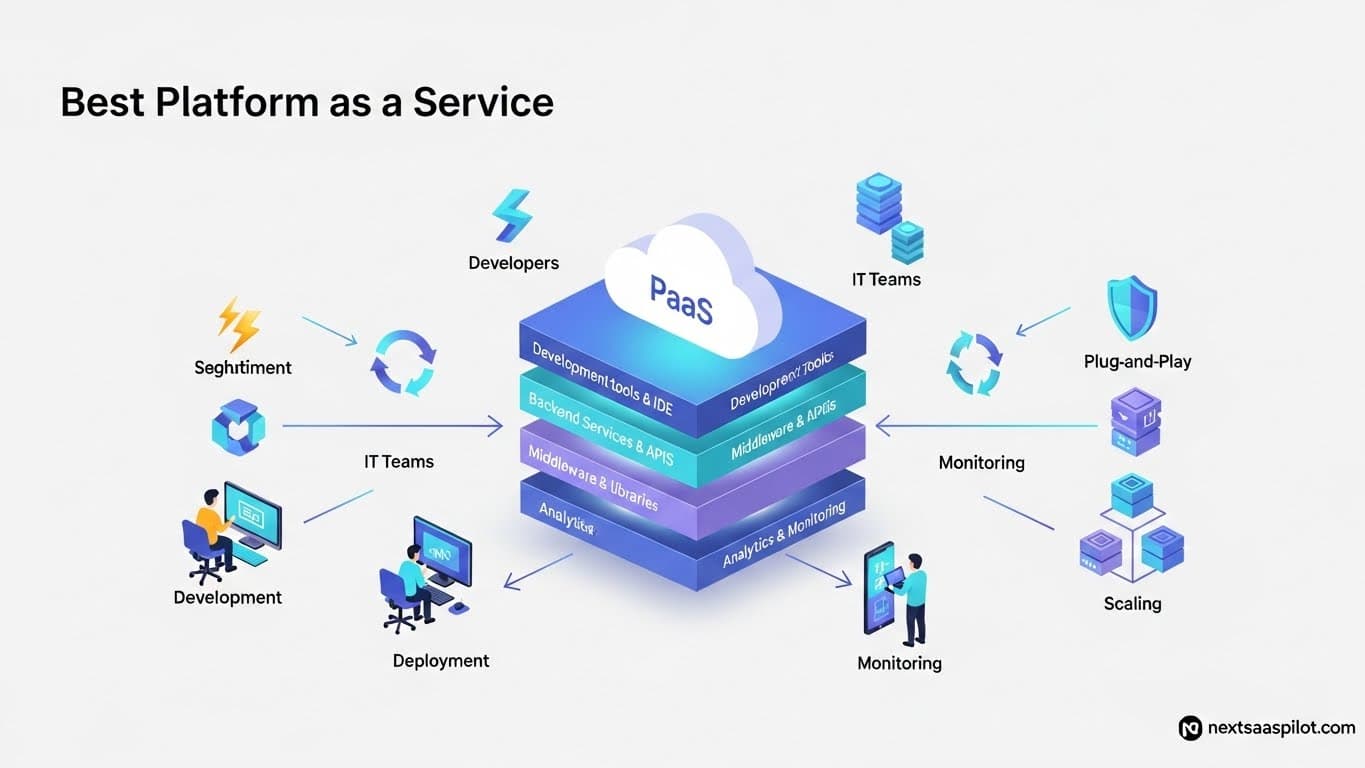
Selecting the best platform as a service is the single most leverageable infrastructure decision a SaaS founder or CTO will make. In the modern cloud economy, the speed at which you deploy code correlates directly with your ability to find product-market fit. PaaS providers remove the “undifferentiated heavy lifting” of server management, allowing engineering teams to focus on business logic rather than Kubernetes configurations.
I have consulted for dozens of startups that burned precious runway hiring DevOps engineers too early, simply to manage a few EC2 instances. Conversely, I have seen lean teams scale to millions in ARR using nothing but Vercel and Render. This guide dissects the top PaaS contenders, evaluating them on cost, scalability, and developer experience (DX) to help you choose the right foundation for your software.
What Is Platform as a Service (PaaS) and Why Do SaaS Startups Need It?
Platform as a Service (PaaS) is a cloud computing model that provides a complete development and deployment environment in the cloud, allowing developers to deliver applications without the complexity of building and maintaining the underlying infrastructure.
For a SaaS startup, time is the only currency that matters. PaaS effectively outsources your sysadmin duties. Instead of configuring Linux kernels, setting up load balancers, and worrying about security patches, you simply push code to a repository, and the platform handles the build, provision, and deployment processes automatically.
This abstraction layer is critical. It allows a team of three developers to operate with the output of a team of ten. By leveraging PaaS, you aren’t just buying hosting; you are buying velocity. This aligns perfectly with the agile methodologies seen in successful saas examples, where iteration speed is the primary driver of success.
How Does PaaS Differ from IaaS and SaaS?
IaaS (Infrastructure as a Service) offers raw computing resources like virtual machines that you must manage, whereas PaaS handles the runtime and operating system for you. SaaS (Software as a Service) is the finished product delivered to the end-user.
Think of the cloud stack as a hierarchy of control versus convenience:
- IaaS (e.g., AWS EC2): You rent the land and build the house. You control everything but manage the plumbing and wiring.
- PaaS (e.g., Heroku, Vercel): You rent a hotel room. The utilities, cleaning, and maintenance are handled for you; you just live there.
- SaaS (e.g., Slack, Salesforce): You visit a conference center. You use the facilities for a specific purpose, but you own nothing.
Understanding this distinction is vital. Many enterprise teams eventually migrate to IaaS for granular control, but for 90% of b2b saas products, starting with PaaS is the financially sound choice.
What Are the Best Platform as a Service Options for Modern SaaS?
The best PaaS options currently dominating the market are Vercel (for frontend/full-stack), Render (for general backend), Heroku (the veteran), and Railway (for rapid prototyping). Each serves a specific architectural niche depending on your tech stack.
Choosing the “best” is subjective to your language and goals. However, based on current industry benchmarks for uptime, support, and ease of use, the leaders are clear.
1. Vercel: The King of Frontend and Serverless
If you are building with Next.js, Vercel is not just a recommendation; it is nearly a requirement for an optimal experience. Vercel creates a “Frontend Cloud” that handles static assets and serverless functions seamlessly.
- Best For: React, Next.js, and Jamstack applications.
- Key Feature: Preview Deployments. Every pull request generates a live URL, which is game-changing for QA and design reviews.
2. Render: The Modern Successor to Heroku
Render has emerged as the top choice for full-stack applications requiring persistent services (like Docker containers) and managed databases without the exorbitant costs of legacy providers.
- Best For: Python, Node.js backends, Go, and Dockerized apps.
- Key Feature: Private Networking. You can connect your web service to your Redis instance securely without exposing ports to the public internet.
3. Heroku: The Veteran Choice
While expensive, Heroku remains the most user-friendly platform with the richest ecosystem of “Add-ons” for logging, caching, and monitoring.
- Best For: Ruby on Rails shops and teams with zero DevOps capacity.
- Key Feature: Heroku Postgres. Their managed database service is arguably the most robust in the PaaS market.
4. Railway: The Infrastructure Canvas
Railway offers a visual interface for infrastructure, allowing you to see how your database connects to your API and your Redis cache.
- Best For: Rapid prototyping and developers who value UI/UX in their tools.
- Key Feature: Template marketplace. You can deploy a full SaaS starter kit in one click.
How Do You Evaluate PaaS Pricing Models?
You must evaluate PaaS pricing based on “usage-based” metrics (bandwidth, build minutes, compute hours) versus “per-seat” costs, while carefully monitoring for the “PaaS Tax”—the premium you pay for convenience over raw infrastructure.
Pricing transparency is often the Achilles’ heel of PaaS providers.
- Vercel/Netlify: Charge heavily for “Pro” seats and bandwidth overages.
- Heroku: Charges for “Dyno” types (compute power).
- Render/Railway: Charge for raw resource consumption (RAM/CPU), which is often fairer for scaling apps.
When taking a saas finance course, you will learn to calculate your Cost of Goods Sold (COGS). If your PaaS bill scales linearly with your user base, it is manageable. If it scales exponentially due to bandwidth spikes, you may need to migrate.
Cost Comparison Table:
| Provider | Free Tier? | Pricing Model | Scalability Cost |
| Vercel | Generous | Per User + Bandwidth | High (Bandwidth is expensive) |
| Render | Limited | Resource-based (RAM/CPU) | Moderate |
| Heroku | No | Dyno Units | High (Enterprise pricing is steep) |
| AWS Elastic Beanstalk | No (Free usage tier) | Pay for underlying EC2 | Low (You pay IaaS rates) |
Is Vercel the Best Choice for Frontend-Heavy SaaS?
Vercel is the superior choice for frontend-heavy and full-stack React/Next.js applications due to its edge network capabilities, automatic image optimization, and “zero-config” deployment workflow that drastically reduces build times.
Vercel has redefined the developer experience. By caching content at the Edge (servers located close to the user), they ensure your SaaS feels instant regardless of where your customer is located. This contributes significantly to a positive saas experience meaning higher retention rates.
However, Vercel functions are ephemeral (serverless). If your SaaS requires long-running tasks (like processing a 1GB video file), Vercel will time out. In this scenario, you would need a hybrid approach, perhaps using Vercel for the frontend and Render for the background workers.
Does Heroku Still Hold Up for Backend Development?
While Heroku is no longer the cheapest option, it remains a viable contender for backend development due to its mature ecosystem, rock-solid managed PostgreSQL, and the “Heroku CI” pipeline that simplifies testing.
Many developers claim “Heroku is dead” because they removed their free tier. This is a mistake. For a funded B2B startup, paying $500/month to Heroku to avoid hiring a $150k/year DevOps engineer is excellent math.
Heroku’s stability is its selling point. It powers massive saas enterprise software platforms like Salesforce (which owns it). If reliability is your north star, Heroku is still a top-tier contender.
Why Are Render and Railway Gaining Popularity?
Render and Railway are gaining market share because they offer the ease of use of Heroku at a price point closer to raw AWS, along with modern features like native Docker support and automatic infrastructure-as-code generation.
These platforms represent “PaaS 2.0.” They were built in the container era.
- Docker Native: Unlike Heroku, which uses “Buildpacks” (though it supports Docker), Render expects containers. This means if it runs on your laptop, it runs on Render.
- Mono-repo Support: They handle complex repository structures better than legacy PaaS providers.
For a startup navigating the complex saas implementation phase, these tools offer the flexibility to pivot your tech stack without migrating your hosting provider.
What Are the Security Implications of Using a PaaS?
Using a PaaS generally improves security for startups by offloading OS patching and network hardening to the vendor, but it introduces “Vendor Risk” where you rely on the platform’s compliance certifications (SOC 2, HIPAA) rather than your own.
Security is a shared responsibility.
- The PaaS Provider: Secures the physical data center, the network, and the operating system.
- You: Secure your application code and user data.
If you are selling to enterprise clients, they will ask for your security posture. Using a major PaaS like AWS Elastic Beanstalk or Heroku Shield allows you to piggyback on their certifications. This is often highlighted in any major saas industry report as a key factor in vendor selection.
When Should You Transition from PaaS to Kubernetes (IaaS)?
You should only transition from PaaS to Kubernetes (IaaS) when your cloud bill exceeds the cost of a dedicated DevOps team, or when you require granular control over networking and compliance that a managed platform cannot provide.
This is known as the “Eject Button.”
Most startups never need to eject. However, if you reach “Unicorn” scale, the “PaaS Tax” (the markup you pay for convenience) can amount to millions of dollars.
- Scenario A: You spend $2,000/month on Render. Stay on PaaS.
- Scenario B: You spend $50,000/month on Render. It is time to hire a Kubernetes expert and migrate to AWS EKS to slash that bill by 40%.
Integrating PaaS into Your CI/CD Pipeline
The best PaaS options integrate directly with GitHub or GitLab, triggering automatic builds and deployments upon every commit, which enforces a robust Continuous Integration/Continuous Deployment (CI/CD) culture within your engineering team.
This automation acts as a quality gate.
- Developer pushes code.
- PaaS detects change.
- PaaS runs tests.
- If Pass: Deploy to staging.
- If Fail: Reject deploy and notify developer.
This workflow prevents bugs from reaching production and is the heartbeat of modern software delivery.
Conclusion
The best platform as a Service is not the one with the most features; it is the one that gets out of your way.
- Choose Vercel if you are building a Next.js/React frontend.
- Choose Render if you need a robust backend with Docker support.
- Choose Heroku if you have a Ruby/Rails team and budget is not a concern.
- Choose Railway if you are prototyping and love visual infrastructure.
Your infrastructure decisions today dictate your velocity tomorrow. Start simple. Leverage the abstraction. Build your product, not your server rack.