
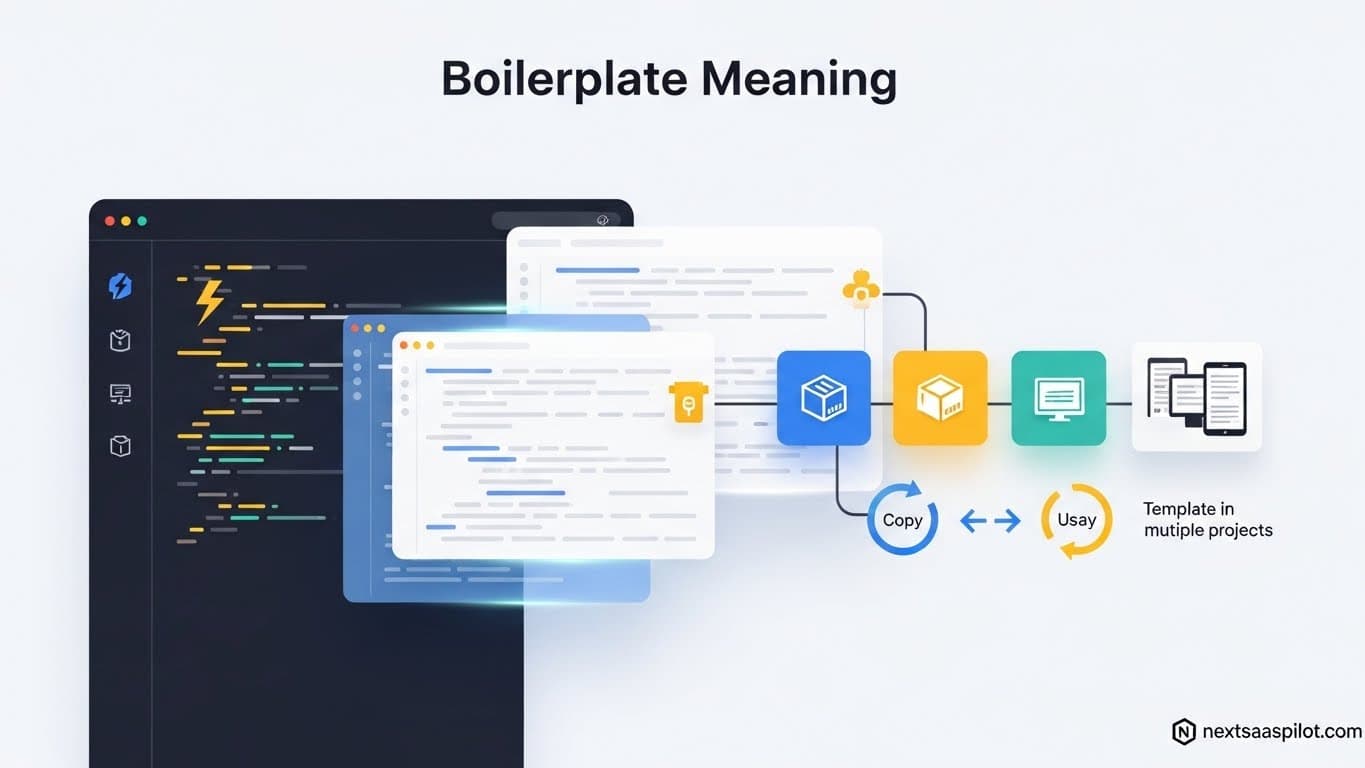
The boilerplate refers to standardized, reusable blocks of text or code that can be integrated into various projects or documents with minimal modification. You’ll find boilerplate in legal contracts, software development, and everyday business documentation. Its purpose is to provide a solid baseline, saving time while ensuring consistency and quality.
Boilerplate isn’t just about copying and pasting—it’s a strategic method for streamlining complex tasks. For example, a lawyer might rely on trusted boilerplate clauses when drafting agreements, just as a developer might leverage a Next.js SaaS template to kickstart an application. Throughout this article, you’ll see how boilerplate is used across different fields, tracing its impact from history to its key role in today’s projects.
Where Did the Term “Boilerplate” Come From?
The word “boilerplate” dates to the late 19th-century newspaper industry. Printing syndicates would create their syndicated columns and ads as durable steel plates—these resembled the metal plates used in steam boilers, which led to the name “boiler plates.”
Newspapers nationwide received these plates and could slot them directly into their printing forms, enabling rapid production of large-scale, standardized content. This usage expanded over time—from journalism to legal, business, and finally, into software. If you want to dive deeper into the tech perspective, boilerplate code.
The importance of boilerplate remains clear: it provides a foundation that speeds up processes, preserves consistency, and reduces repetitive work across industries. This impact is especially evident in modern software development, where teams rely on reliable structures to build and scale their applications efficiently. From the printing press, its usage expanded into law, business, and eventually, the world of software development.
What Does Boilerplate Mean in Software Development?
In software development, “boilerplate code” refers to sections of code that are included in many places with little to no alteration. This code is often essential for getting a program or application running, but doesn’t add unique functionality. It’s similar to the basic plumbing every house needs before you personalize the space.
For instance, when starting a new project with a framework like Next.js, developers often use a Next.js SaaS template that provides a pre-configured set of files and folders. This initial setup is the boilerplate—it covers routing, server configuration, and the basic file structure, so you can focus on building new features, not repeating standard tasks. Guides such as Next.js Build and Next.js Authentication help extend these foundations for faster launches.
Common examples of boilerplate code include:
- Initial project setup: Default files, folders, and configuration settings in a new project.
- Class and method declarations: Standard syntax used to define functions or objects in a programming language.
- API connection code: Reusable code for authentication and data fetching across endpoints.
- HTML document structure: The
,, and other fundamental tags at the heart of every webpage.
Why Is Boilerplate So Common in Frameworks Like Next.js?
Frameworks like Next.js use boilerplate to give developers a structured, ready-to-go starting point. This pre-packaged setup includes default folder structures, a built-in development server, and optimized build configurations, enforcing current best practices from the beginning.
This approach can transform developer productivity. Instead of setting up a project from scratch, you can use a trusted Next.js SaaS template or follow a Next.js Build guide, and get a full-featured application skeleton ready to customize. Whether you’re launching a landing page or a complete e-commerce platform, quality boilerplate ensures you have a solid foundation—and can quickly add in features like authentication when needed.
What Does Boilerplate Mean in Legal Agreements?
In the legal world, boilerplate refers to the standardized clauses found in contracts and other legal documents. These provisions cover common legal matters and are often located at the end of an agreement. While they might seem like generic fine print, they are critical for defining the legal relationship between the parties.
Lawyers rely on these clauses to protect their clients from common risks and ensure the contract is enforceable. Because these provisions have been tested in court over many years, they provide a level of legal certainty.
Ultimately, the use of boilerplate in legal agreements offers consistency, predictability, and a strong foundation that both parties can trust.
Examples of common boilerplate clauses include:
- Governing Law: Specifies which jurisdiction’s laws will be used to interpret the contract.
- Force Majeure: Excuses a party from liability if they cannot perform their contractual obligations due to unforeseen events (like a natural disaster).
- Arbitration Clause: Requires the parties to resolve disputes through arbitration instead of going to court.
- Severability: States that if one part of the contract is found to be unenforceable, the rest of the contract remains valid.
How Does Boilerplate Differ From Templates or Skeleton Code?
While the terms are often used interchangeably, there are important differences between boilerplate, templates, and skeleton code.
- Boilerplate: This is foundational code or text that’s copied and pasted as a starting point. It’s generally a complete, working piece you adjust for your specific needs. For example, a robust Next.js application starter kit with authentication and database setup serves as useful boilerplate. For further detail on whether Next.js is a framework or library, see this in-depth overview.
- Template: A template acts as a fill-in-the-blank outline, providing structure but leaving important sections empty for you to complete. For instance, a project proposal template might offer headings like “Project Goals” and “Timeline,” but you fill in the specifics.
- Skeleton Code: Skeleton code offers only the bare-minimum structure needed for a program or component to function—just the scaffolding, with little working logic. This lets a developer build out complex logic atop the basics.
Below, you’ll find a simple comparison to help clarify:
| Feature | Boilerplate | Template | Skeleton Code |
|---|---|---|---|
| Completeness | Mostly complete and functional | A structured outline with blanks | Minimal outline, not functional |
| Purpose | To provide a ready-made foundation | To guide content creation | To provide an architectural scaffold |
| Example | A full Next.js starter project | A “Contact Us” form template | A basic class definition |
If you’re exploring different approaches, check out a list of useful Next.js alternatives and browse this external guide comparing software development tools for a broader perspective.
When to Use Boilerplate and When to Avoid It
Boilerplate is a powerful tool, but it’s not always the right choice. Knowing when to use it can save you from future headaches.
You should use boilerplate when:
- You need to build quickly. Startups and teams on tight deadlines benefit from not having to build everything from scratch.
- Consistency is key. In large organizations, boilerplates ensure all projects adhere to the same standards and best practices.
- The task is repetitive. For common functions like user authentication or API setups, a boilerplate eliminates redundant work.
You should avoid boilerplate when:
- The project is highly unique. If your project has very specific requirements, a boilerplate might introduce unnecessary code (bloat) that you have to remove.
- You need maximum flexibility. Some boilerplates are highly opinionated and can be difficult to customize beyond their intended use.
- You are learning. If you are trying to understand a new technology, building from scratch is often a better way to learn than starting with a pre-made solution.
The Value of Boilerplate
The core boilerplate meaning is tied to efficiency and standardization. In any professional field, some tasks are performed repeatedly. Boilerplate captures the solutions to these common problems in a reusable format.
By handling the repetitive parts of a project it frees up professionals to focus their energy on what truly matters: creating unique value. For a developer, that means building innovative features. For a lawyer, it means negotiating the key terms of a deal. In a world that demands speed and reliability, boilerplate is a simple yet powerful tool for getting the job done right.