
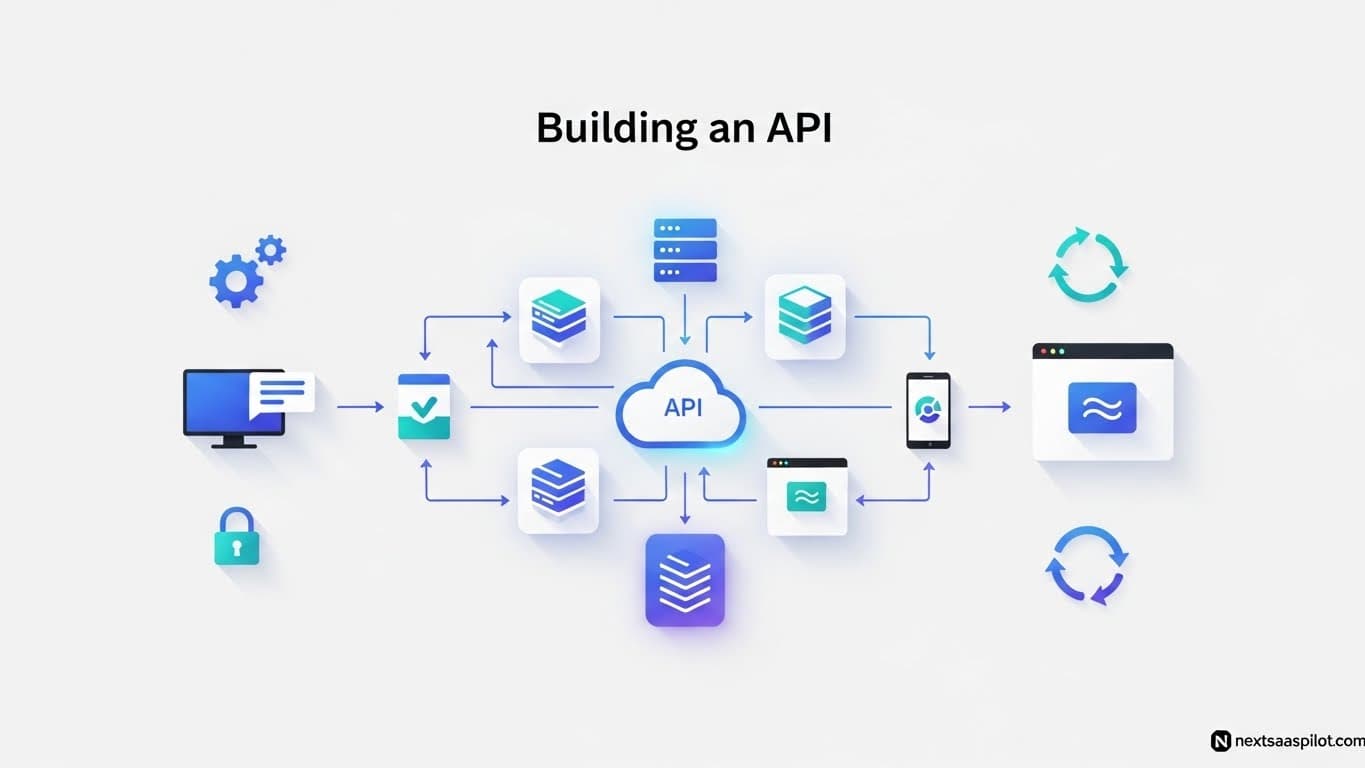
Building an api (Application Programming Interface) is the decisive step that transforms a standalone SaaS tool into a scalable platform ecosystem. In the modern software economy, your product’s value is often defined not just by its features, but by how well it connects with the rest of a customer’s tech stack.
I have advised CTOs who treated their API as an afterthought, only to realize competitors were winning deals simply because they offered better integration capabilities. An API is not just a technical endpoint; it is a business development channel that runs on code. This guide covers the strategy, design, security, and monetization tactics required to launch a world-class API.
What Is a Web API in the Context of SaaS?
A Web API is a set of protocols and rules that allows different software applications to communicate, enabling your SaaS product to exchange data securely with external systems like CRMs, billing engines, or custom client dashboards.
Think of your SaaS product as a restaurant. The kitchen is your database and logic. The dining room is your user interface (UI). The API is the drive-through window. It allows customers (other software) to order food (data) without ever entering the building.
In technical terms, it exposes specific “endpoints” (URLs) that accept requests and return responses, usually in JSON format. This allows developers to build custom workflows on top of your data, effectively turning your product into a building block for their own applications.
Why Should You Prioritize Building an API?
Building an API increases customer retention (stickiness), opens new revenue streams through partnerships, and allows third-party developers to build features you do not have the resources to build yourself.
If a customer integrates your software with their internal ERP system, they are statistically less likely to churn. Ripping out an integrated tool is painful.
Furthermore, APIs enable the “platform effect.” Look at successful saas companies like Stripe or Twilio. They didn’t just build a UI; they built an API-first business. By offering an API, you allow your product to exist in workflows you never imagined, effectively outsourcing innovation to your user base.
REST vs. GraphQL: Which Architecture Should You Choose?
REST is the industry standard for public SaaS APIs due to its predictability and cacheability, while GraphQL offers flexibility for complex data fetching but introduces higher complexity in caching and rate limiting.
The choice depends on your users.
- REST (Representational State Transfer): Uses standard HTTP methods (GET, POST, PUT, DELETE). It is rigid but easy to understand. Most b2b saas products use REST because enterprise IT teams are familiar with it.
- GraphQL: Allows the client to ask for exactly the data they need. It reduces “over-fetching” but requires a smarter backend.
Comparison: REST vs. GraphQL
| Feature | REST | GraphQL |
| Structure | Multiple Endpoints (e.g., /users, /posts) | Single Endpoint (e.g., /graphql) |
| Data Fetching | Fixed structure (Over/Under-fetching) | Exact data requested |
| Caching | Easy (HTTP standard) | Difficult (Requires custom logic) |
| Learning Curve | Low | Medium |
| Best For | Public APIs, Enterprise Integration | Internal Front-ends, Complex Data |
How Do You Design Intuitive API Endpoints?
Effective API design relies on resource-oriented URLs, standard HTTP status codes, and consistent naming conventions (nouns, not verbs) to ensure developers can intuitively understand how to interact with your system without constantly checking the documentation.
A well-designed API explains itself.
- Bad:
POST /createNewUser(RPC style) - Good:
POST /users(REST style)
Use standard status codes to communicate results:
- 200 OK: Success.
- 201 Created: Record created.
- 400 Bad Request: The user sent bad data.
- 401 Unauthorized: Who are you?
- 403 Forbidden: You are logged in, but you can’t do that.
- 429 Too Many Requests: Slow down.
Consistency reduces the cognitive load for the developer. If you use camelCase for one field, do not use snake_case for another.
How Do You Secure Your SaaS API?
You must secure your API using robust authentication standards like OAuth 2.0 for user delegation and API Keys for server-to-server communication, while enforcing strict Rate Limiting to prevent abuse and Denial of Service (DoS) attacks.
Security is paramount. If your API is the drive-through, you need a gatekeeper.
- API Keys: A long string (e.g.,
sk_live_...). Simple, but risky if leaked. - OAuth 2.0: The gold standard. It allows a user to grant a third-party app access to their data without sharing their password.
You must also implement saas application management principles regarding scope. Does an API key have “Read-Only” access or “Admin” access? Always follow the Principle of Least Privilege.
Why Is Documentation the Most Critical Feature?
Documentation is the user interface for developers; without clear, interactive examples and a “Try It Now” sandbox, even the most powerful API will fail to gain adoption because developers will abandon it for an easier alternative.
I cannot stress this enough: The best API is the best-documented API.
Stripe became a billion-dollar company largely because their documentation was beautiful.
Documentation Checklist:
- Quick Start Guide: “Hello World” in 5 minutes.
- Authentication: Exactly where to put the key (Header vs. Query param).
- Code Samples: Provide snippets in Python, Node.js, and Curl.
- Error Codes: Explain what went wrong and how to fix it.
This directly impacts the saas experience meaning for technical stakeholders. If they enjoy using your API, they become internal champions for your product.
How to Monetize Your API?
Monetizing an API involves choosing between direct revenue models like “Pay-As-You-Go” (metered usage) or indirect models where the API is a value-add included in higher-tier subscription plans to drive upsells.
- Direct Monetization: You charge per call. (e.g., Twilio charges per SMS sent). This requires a robust billing engine.
- Indirect Monetization: “Upgrade to the Enterprise Plan to unlock API access.” This is common in saas enterprise software.
If you choose direct monetization, understanding the saas finance course principles of unit economics is vital. You must ensure the cost of serving an API call is significantly lower than the price you charge.
Handling Versioning and Breaking Changes
You must implement a versioning strategy (e.g., /v1/users) from day one to ensure that when you make breaking changes to the API structure, existing integrations continue to function without crashing your customers’ applications.
Software evolves. You will eventually need to rename a field or change a data type.
- URI Versioning:
api.yoursite.com/v1/resource - Header Versioning:
Accept: application/vnd.yoursite.v1+json
Never break backward compatibility in a live version. If you introduce v2, you must maintain v1 for a sunset period (usually 6-12 months) to give developers time to migrate.
Tech Stack and Monitoring
Choose a tech stack that offers strong support for asynchronous processing and JSON handling, such as Node.js (Express/NestJS) or Go (Gin), and utilize an API Gateway to manage traffic, rate limits, and authentication centralized.
Do not build authentication logic in every microservice. Use an API Gateway (like Kong or Tyk) or a cloud provider (AWS API Gateway). It sits in front of your services and handles the ID checks, rate limits, and routing.
Additionally, you must monitor API performance metrics like latency and error rates. Tools like Datadog or specialized API monitoring tools are essential. If an endpoint usually takes 200ms and suddenly spikes to 2000ms, you need an alert immediately.
The Theoretical Foundation of Web APIs
For a deeper technical understanding of the protocols that underpin modern SaaS integration, referencing the standard definitions is helpful. The concept of a programmable web interface has evolved significantly from simple RPC calls to the complex REST and GraphQL architectures we use today. You can read more about the history and standards in Web API.
Conclusion
Building an api is not just an engineering task; it is a product launch. It requires the same level of care, design, and support as your main web interface.
By treating your API as a first-class citizen, you transform your SaaS from a walled garden into a connected hub. This connectivity creates a defensive moat, increases valuation, and ultimately delivers superior value to your customers. Look at the top saas examples in the market; almost every single one offers a robust, well-documented API. That is not a coincidence.