
Deciding between caas vs paas is one of the most pivotal infrastructure choices a CTO or lead architect will make. This decision dictates your deployment velocity, your monthly cloud bill, and the level of control you maintain over your application’s environment.
I have audited dozens of SaaS infrastructures, ranging from seed-stage startups to post-IPO giants. A common pattern emerges: early-stage companies often over-engineer with CaaS (Kubernetes) when they should be using PaaS, while scaling companies bleed money on PaaS when they should have migrated to CaaS. Understanding the nuance between these models is critical for aligning your technology stack with your business goals.
What Is the Core Difference Between CaaS and PaaS?
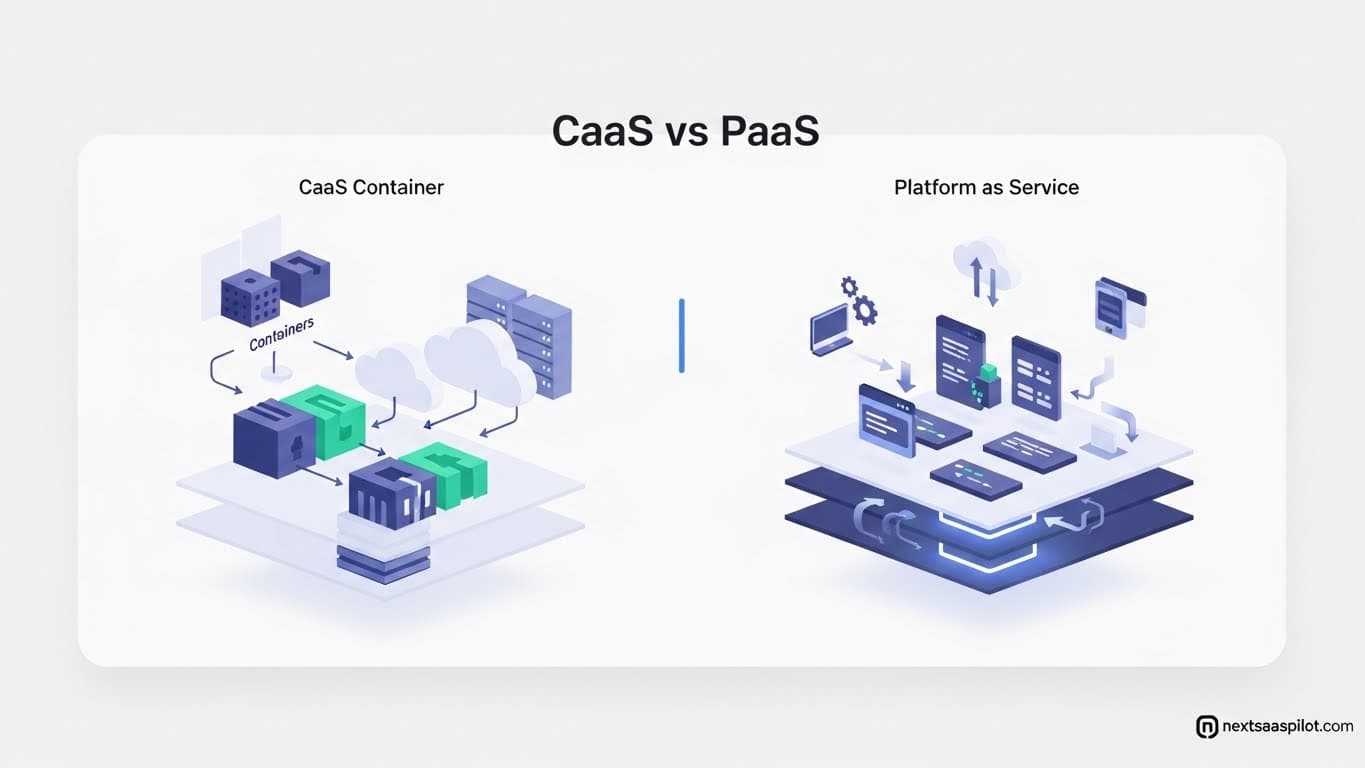
PaaS (Platform as a Service) abstracts away the operating system and runtime management, allowing you to focus strictly on code deployment. CaaS (Containers as a Service) provides an orchestration layer for containers, offering higher portability and granular control over configuration but requiring more management.
Think of it this way: PaaS is like renting a furnished hotel room. You bring your clothes (code), and everything else is managed for you. You can’t knock down walls or change the plumbing. CaaS is like renting a customizable office space. You get the shell and utilities, but you decide how to arrange the desks (containers) and manage the internal workflow.
In the context of saas architecture, this choice determines whether your engineering team spends time building features or managing infrastructure.
What Is Platform as a Service (PaaS)?
PaaS is a cloud computing model where a third-party provider delivers hardware and software tools—usually those needed for application development—to users over the internet. Examples include Heroku, Vercel, AWS Elastic Beanstalk, and Google App Engine.
In a PaaS environment, the “NoOps” philosophy prevails. You connect your GitHub repository, push a commit, and the platform handles the build process, provisioning, load balancing, and scaling automatically.
Key Characteristics of PaaS:
- High Abstraction: You don’t see the servers.
- Language Specific: Often optimized for specific runtimes (Node.js, Python, Go).
- Vendor Lock-in: High reliance on the provider’s proprietary tools.
For a startup validating a saas business model, PaaS is usually the correct starting point. It allows you to iterate rapidly without hiring a DevOps engineer.
What Is Containers as a Service (CaaS)?
CaaS is a cloud service model that allows users to upload, organize, run, scale, and manage containers by using container-based virtualization. It sits between IaaS (Infrastructure as a Service) and PaaS. The industry standard here is Kubernetes (K8s), offered via managed services like AWS EKS, Google GKE, or Azure AKS.
CaaS gives you the portability of Docker containers with the automated orchestration of the cloud. Unlike PaaS, CaaS does not care what is inside the container. It just runs it.
Key Characteristics of CaaS:
- Portability: If it runs in Docker, it runs on CaaS.
- Orchestration: Handles complex microservices communication.
- Configurability: You control the networking, storage, and resource limits explicitly.
This model is essential when you move toward complex cloud application management, where you need to run background workers, Redis caches, and API services in a tightly coordinated mesh.
CaaS vs PaaS: A Detailed Comparison Table
To make an informed decision, you must compare the operational realities of both models. The table below outlines the trade-offs regarding cost, control, and complexity.
| Feature | PaaS (Platform as a Service) | CaaS (Containers as a Service) |
| Primary Unit | Code / Repository | Container Image (Docker) |
| Management Level | Application Code Only | Containers & Orchestration |
| Scalability | Auto-scaling (often reactive) | Granular Auto-scaling (predictive) |
| Cost | Higher per compute unit | Lower per compute unit |
| Setup Time | Minutes | Days/Weeks |
| Vendor Lock-in | High | Low (Containers are portable) |
| Skill Requirement | Developer | DevOps / SRE |
When Should You Choose PaaS for Your SaaS?
Choose PaaS when your primary goal is speed to market and your team lacks dedicated DevOps resources; it is ideal for monolithic applications, MVPs, and standard web services that fit within standard constraints.
If you are bootstrapping and your saas revenue model relies on getting the first 100 customers quickly, use PaaS. I recently worked with a founder who spent three weeks setting up a Kubernetes cluster for a simple To-Do app. That was three weeks of lost sales.
Ideal Use Cases for PaaS:
- Early Stage Startups: Validation phase.
- Simple APIs: Standard REST/GraphQL endpoints.
- Frontend Hosting: Static sites (Vercel/Netlify).
- Freelance Projects: Low maintenance requirements.
When Is CaaS the Better Architectural Choice?
Switch to CaaS when your application requires microservices orchestration, complex networking, specific compliance configurations, or when the “PaaS Premium” becomes too expensive at scale.
As your saas subscription model grows, you will likely hit a ceiling with PaaS. Perhaps you need to install a specific system library that Heroku doesn’t support, or you need to network a legacy database with a modern API securely.
Ideal Use Cases for CaaS:
- Microservices: Managing 10+ interacting services.
- High Compliance: Fintech/Healthtech needing strict VPC isolation.
- Cost Optimization: High-traffic apps where raw compute is cheaper than PaaS metering.
- Hybrid Cloud: Running workloads across AWS and on-premise.
Cost Analysis: Is PaaS Really More Expensive?
PaaS generally has a higher markup on raw compute resources compared to CaaS, but CaaS introduces “hidden costs” in the form of engineering salaries and maintenance hours required to manage the complexity.
This is the classic “Build vs. Buy” debate.
- PaaS: You pay a premium to the cloud provider (e.g., AWS) to manage the ops.
- CaaS: You pay a lower rate to the cloud provider, but you pay a salary to a DevOps engineer to manage the cluster.
A robust saas financial model should account for this. If you are spending $500/month on Vercel (PaaS), it is cheaper than hiring a $150,000/year engineer to manage Kubernetes (CaaS). However, if your AWS bill hits $20,000/month, the savings from optimizing via CaaS can justify the hire.
How Do These Models Impact Scalability?
PaaS scales by spinning up more instances of your application based on simple metrics like CPU load, whereas CaaS allows for multi-dimensional scaling, including scaling the underlying cluster nodes and packing containers efficiently to maximize resource utilization.
In a subscription based software model, uptime is everything.
- PaaS Scaling: often “reactive.” Traffic spikes -> Platform notices -> Platform adds instance. There can be a lag.
- CaaS Scaling: Highly tunable. You can set rules like “If the queue depth exceeds 100 jobs, add 5 containers instantly.”
The “XaaS” Evolution: Where Do They Fit?
Both PaaS and CaaS fall under the broader umbrella of “Everything as a Service” (XaaS), representing different layers of abstraction in the cloud stack; understanding what is xaas helps you visualize how these components stack on top of IaaS (Infrastructure as a Service).
- IaaS: The metal (EC2).
- CaaS: The orchestration (EKS).
- PaaS: The runtime (Elastic Beanstalk).
- SaaS: The software (Salesforce).
For real-world context, look at iaas paas y saas ejemplos to see how companies mix and match these layers.
Security Implications: Which Is Safer?
PaaS offers a “shared responsibility” model where the provider patches the OS and runtime, reducing your attack surface; CaaS requires you to secure the container images and the orchestration configuration, giving you more control but more liability.
In a PaaS, if there is a vulnerability in the underlying Linux kernel, Amazon or Google patches it. You might not even know.
In CaaS, you are responsible for scanning your Docker images for vulnerabilities. If you configure your Kubernetes Role-Based Access Control (RBAC) poorly, you could expose your entire cluster.
For a saas organizational structure that includes a dedicated security team, CaaS is preferred because you can implement strict Zero Trust networking policies that PaaS often doesn’t allow.
The Migration Path: From PaaS to CaaS
Successful startups often begin on PaaS to validate product-market fit and later migrate to CaaS (Kubernetes) once the product matures and cost-optimization becomes a priority.
This transition is a natural lifecycle event. Do not feel pressured to start with the end-game architecture.
- Phase 1 (MVP): Deploy on Vercel/Heroku (PaaS). Focus on user feedback.
- Phase 2 (Growth): Containerize the application using Docker (Prep for CaaS).
- Phase 3 (Scale): Deploy a managed Kubernetes cluster (CaaS) and migrate traffic gradually.
Final Verdict
The battle of caas vs paas is not about one being better than the other; it is about matching the infrastructure complexity to your current business stage.
- Choose PaaS if: You are a small team, pre-revenue, or building a standard web app. Your goal is velocity.
- Choose CaaS if: You are post-Series A, have complex microservices, or need to optimize a massive cloud bill. Your goal is control and efficiency.
Your architecture should empower your business, not constrain it. Start simple, ship fast, and evolve your infrastructure only when the pain of the current solution outweighs the cost of the migration. For more details on cloud computing categories, Platform as a Service.