
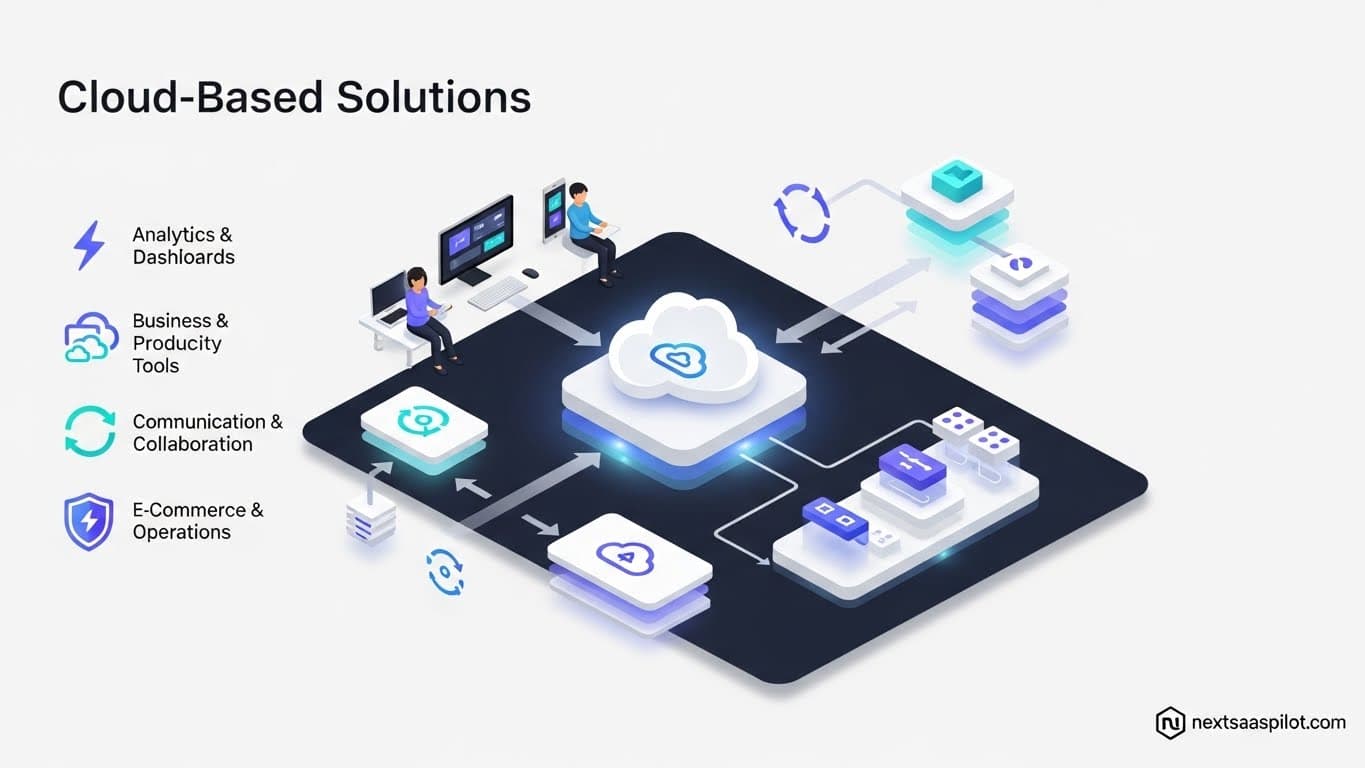
Cloud based solutions have evolved from a technological alternative into the fundamental operating system of the modern SaaS economy. In 2025, building a software company without leveraging the cloud is akin to building a factory without electricity. It creates an unnecessary ceiling on growth, speed, and innovation.
For founders and CTOs, the challenge is no longer convincing stakeholders to move to the cloud; it is selecting the right architecture to maximize efficiency and minimize technical debt. Whether you are scaling a fintech unicorn or bootstrapping a niche micro-SaaS, your cloud strategy dictates your survival.
This guide provides a comprehensive analysis of the cloud ecosystem, offering a strategic roadmap for leveraging these tools to build resilient, scalable, and profitable software.
What Are Cloud Based Solutions?
Cloud based solutions are on-demand computing resources—including servers, storage, databases, and software—delivered over the internet. Instead of buying and maintaining physical data centers, companies rent these resources from providers like AWS or Azure, paying only for what they use. This model enables instant scalability and global accessibility.
At its core, the cloud is about abstraction. You abstract away the hardware so you can focus on the code.
The Three Service Models:
- IaaS (Infrastructure as a Service): Renting the raw servers and networking (e.g., Amazon EC2).
- PaaS (Platform as a Service): Renting the development environment (e.g., Heroku).
- SaaS (Software as a Service): Renting the finished application (e.g., Salesforce).
For a deeper understanding of the application layer specifically, refer to our guide on cloud based applications.
Why Are Cloud Solutions Critical for SaaS Growth?
Cloud solutions are critical for SaaS growth because they provide “elasticity,” allowing infrastructure to expand or contract automatically based on real-time user demand. This prevents service outages during traffic spikes and eliminates the financial risk of over-provisioning hardware, converting heavy capital expenditures into predictable operating expenses.
In the pre-cloud era, if your startup went viral, your servers crashed, and you died. Today, the cloud scales with you.
Strategic Benefits:
- Speed to Market: Developers can spin up environments in minutes, not months.
- Global Reach: Deploy your app to data centers in Tokyo, London, and New York with one click.
- Resilience: Built-in redundancy ensures that if one server fails, another takes over instantly.
This scalability is the engine behind the modern cloud based business model, where agility is the primary competitive advantage.
How Do You Choose the Right Cloud Architecture?
Choose the right cloud architecture by evaluating your specific needs for control versus convenience. Startups typically favor PaaS (Platform as a Service) for rapid development speed, while mature enterprises often migrate to IaaS (Infrastructure as a Service) or hybrid models to gain granular control over security, compliance, and cost optimization.
The decision often comes down to the “Build vs. Buy” mentality.
Architecture Decision Matrix:
| Feature | Serverless / PaaS | Virtual Machines / IaaS |
| Setup Time | Instant | Hours/Days |
| Maintenance | Zero (Vendor managed) | High (You patch the OS) |
| Scalability | Auto-magic | Requires configuration |
| Cost | Pay per function execution | Pay per hour (even if idle) |
| Best For | MVPs, Microservices | Legacy Apps, Custom Kernels |
For a detailed breakdown of the platforms available, review our analysis of cloud application platforms.
What Is the Role of Multi-Tenancy in Cloud Solutions?
Multi-tenancy is a cloud architecture where a single instance of a software application serves multiple customers (tenants) simultaneously. This approach maximizes resource efficiency and profitability for SaaS vendors, as they only need to maintain and update one codebase for their entire user base, rather than managing individual servers for each client.
Multi-tenancy is the economic secret sauce of SaaS.
The Efficiency Factor:
Imagine a hotel. It is cheaper to build one building with 100 rooms (Multi-tenant) than to build 100 separate cottages (Single-tenant).
- Shared Resources: All tenants share the database and compute power.
- Logical Isolation: Strict code ensures Tenant A cannot see Tenant B’s data.
However, implementing this correctly is difficult. A poor saas tenant architecture can lead to the “Noisy Neighbor” effect, where one heavy user slows down the app for everyone else.
How Do Cloud Solutions Enable Integration?
Cloud solutions enable integration through APIs (Application Programming Interfaces) and iPaaS (Integration Platform as a Service) tools, allowing disparate software systems to exchange data in real-time. This connectivity creates a cohesive ecosystem where a CRM, accounting tool, and email platform function as a single unit, eliminating data silos.
In 2025, no SaaS tool is an island. Your software must talk to the rest of the stack.
The Rise of iPaaS:
Tools like Zapier or Make act as the “glue” of the internet. They allow non-technical users to connect apps.
- Example: When a new lead enters the CRM, create a Slack notification and add them to the email newsletter.
For technical definitions on how these systems connect, Cloud-based integration offers excellent background.
How Do SaaS and Cloud Computing Work Together?
SaaS and cloud computing work together as the product and the factory. Cloud computing provides the underlying infrastructure (servers, networking, storage), while SaaS is the software product delivered to the end-user over that infrastructure. SaaS companies are the primary consumers of cloud computing resources.
It is a symbiotic relationship.
- The Cloud Provider (AWS): Maintains the data center security, power, and cooling.
- The SaaS Vendor (You): Builds the application logic and user interface.
This relationship allows SaaS founders to focus entirely on solving customer problems rather than managing hardware. For more on this dynamic, read our guide on SaaS and cloud computing.
What Are the Security Risks of Cloud Solutions?
The security risks of cloud solutions center on the “Shared Responsibility Model,” where the provider secures the infrastructure, but the customer must secure their data and access points. Common risks include misconfigured storage buckets, weak identity management (passwords), and insecure APIs, all of which can lead to massive data breaches.
The “Shared Responsibility” Breakdown:
- Provider Responsibility: Protecting the hardware from physical intrusion.
- Your Responsibility: Encrypting customer data and enforcing Multi-Factor Authentication (MFA).
Most cloud breaches are not the fault of Amazon or Microsoft; they are the fault of a developer leaving a digital door unlocked.
How Does the Cloud Democratize Tech for Small Business?
The cloud democratizes tech for small businesses by lowering the barrier to entry, allowing small teams to access enterprise-grade tools like AI analytics and global CRMs for a low monthly fee. This levels the playing field, enabling startups to compete with established corporations without the need for a dedicated IT department.
This is the “David vs. Goliath” enabler.
The SMB Stack:
- Communication: Slack/Teams.
- Finance: QuickBooks/Xero.
- Storage: Drive/Dropbox.
By utilizing specific cloud applications for small business, a team of three can operate with the same data intelligence as a team of 300.
What Is the Difference Between Cloud Solutions and SAS Databases?
The difference is that Cloud Solutions refer to general computing resources and applications accessed over the internet, while SAS (Statistical Analysis System) is a specific proprietary software suite for advanced analytics. While SAS databases can be hosted in the cloud to leverage computing power, they are distinct specialized tools used primarily for data science.
Do not confuse the delivery method with the tool.
- Cloud Solution: The method of access (e.g., SaaS).
- SAS Database: The tool for deep statistical modeling.
In 2025, many organizations are migrating their legacy sas database workloads to the cloud to speed up processing times for complex queries.
Future Trends: AI and the Cloud
Future trends in cloud solutions are dominated by the integration of Generative AI and “Edge Computing.” Cloud providers are embedding AI chips (GPUs) directly into their data centers to power autonomous agents, while Edge Computing moves processing power closer to the user to reduce latency for real-time applications like IoT and gaming.
The cloud is getting smarter and faster.
- AI-Native Cloud: Infrastructure optimized specifically for training Large Language Models (LLMs).
- Green Cloud: A massive push toward carbon-neutral data centers to meet ESG goals.
Final Thoughts on the Cloud Strategy
Adopting cloud based solutions is not just an IT decision; it is a business survival strategy. It provides the agility to pivot, the scalability to grow, and the efficiency to remain profitable.
For SaaS leaders, the goal is to build a “Composable Enterprise”—selecting the best-of-breed cloud tools and stitching them together to create a unique value engine.