
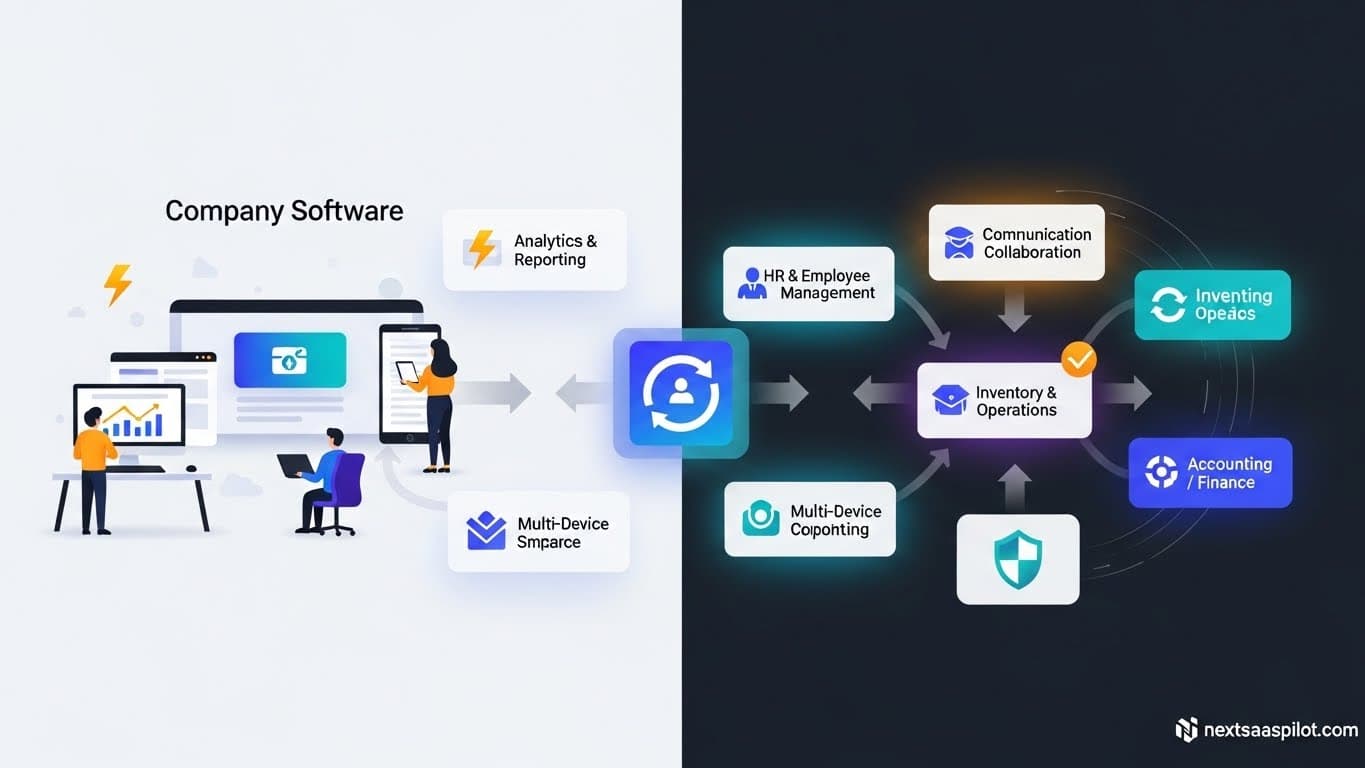
Navigating the landscape of company softwares is no longer just an IT procurement task; it is a fundamental component of business strategy. In 2025, the “tech stack” is the operating system of the modern enterprise. The difference between a market leader and a laggard often comes down to the software architecture that powers their operations, sales, and talent management.
I have advised C-suite executives on digital transformation for over a decade, witnessing the shift from clunky, on-premise installations to agile, AI-driven SaaS ecosystems. Today, the best company software solutions do not just solve isolated problems; they talk to each other, predict outcomes using generative AI, and scale effortlessly on the cloud. This guide provides a definitive analysis of the top platforms, infrastructure choices, and integration strategies defining the corporate world this year.
What Are Modern Company Softwares and Why Do They Matter?
Modern company softwares are cloud-based (SaaS) applications that automate business processes, centralize data, and enable remote collaboration, acting as the “nervous system” of an organization. They differ from legacy tools by prioritizing API-first connectivity, AI integration, and subscription-based scalability.
In the past, software was a capital asset—something you bought once and depreciated over five years. Today, it is an operational expense that evolves weekly. The shift to SaaS means that your competitors are constantly getting faster and smarter because their tools are automatically updating.
If your organization is still relying on siloed, legacy systems that require a VPN to access, you are bleeding efficiency. The modern stack is composable. It allows you to swap out a CRM or an HR tool without bringing the whole company to a halt. This agility is the primary ROI of adopting top-tier company softwares.
How Has the Landscape Shifted from On-Premise to SaaS?
The landscape has shifted from monolithic, on-premise servers requiring heavy maintenance to decentralized SaaS platforms that offer lower upfront costs, rapid deployment, and automatic updates. This transition has democratized access to enterprise-grade tools for businesses of all sizes.
Ten years ago, implementing an ERP system like SAP or Oracle took 18 months and a team of consultants. Today, a NetSuite or Workday implementation can happen in a fraction of the time with significantly lower risk.
This shift is driven by the cloud. We have moved from “owning” software to “subscribing” to outcomes. This model aligns the vendor’s incentives with yours: if the software stops delivering value, you churn. To see real-world case studies of this transition, review our deep dive into saas examples across different industries.
What Are the Essential Categories of Business Software?
The essential categories of business software include Customer Relationship Management (CRM) for revenue, Enterprise Resource Planning (ERP) for operations, Human Capital Management (HCM) for talent, and Project Management tools for execution.
While niche tools exist for everything, these four pillars form the foundation of any scalable enterprise.
- CRM (Revenue Engine): Managing the customer lifecycle from lead to renewal.
- ERP (The Brain): Managing financials, supply chain, and inventory.
- HCM/HRIS (The People): Managing payroll, benefits, and performance.
- Collaboration (The Glue): Tools like Slack or Teams that keep information flowing.
Choosing the leaders in these categories ensures stability. You don’t want to bet your financial records on an unproven beta product.
Which CRM Platforms Drive Revenue Growth?
Salesforce remains the enterprise standard for CRM due to its immense customization and “Customer 360” ecosystem, while HubSpot has dominated the mid-market by offering a more user-friendly, integrated marketing and sales platform.
The battle for the CRM market is fierce.
- Salesforce: It is more than a tool; it is a platform. With the acquisition of Slack and Tableau, Salesforce aims to be the single source of truth for everything. Their new “Agentforce” AI agents are redefining how automated support works.
- HubSpot: Originally a marketing tool, HubSpot’s CRM is now robust enough for most enterprises. It wins on usability. Teams actually like using HubSpot, which means better data entry and more accurate forecasting.
For specialized industries, vertical CRMs (like Veeva for Pharma) are also gaining traction, but for general business, the duopoly of Salesforce and HubSpot prevails.
Top Project Management Tools for Operational Efficiency
Monday.com, Asana, and Jira are the leading project management tools, offering distinct advantages: Monday.com for visual workflows, Asana for general task collaboration, and Jira for engineering and agile software development.
Operational efficiency is about visibility. If you can’t see who is working on what, you are managing by intuition, not data.
- Monday.com: Acts as a “Work OS.” It is highly colorful, visual, and flexible. Marketing and creative teams thrive here.
- Jira (Atlassian): The standard for developers. It connects code commits to tasks, providing end-to-end traceability for software shipping.
- Smartsheet: Popular in legacy enterprise environments that are transitioning away from Excel but still love the spreadsheet interface.
For a broader list of productivity tools that integrate with these platforms, check our guide on the best saas tools.
The Best Cloud Platforms for Infrastructure
AWS, Microsoft Azure, and Google Cloud Platform (GCP) are the undisputed leaders in cloud infrastructure, providing the raw compute, storage, and networking power required to run modern SaaS applications securely and at scale.
While these are “Infrastructure as a Service” (IaaS) providers, they are the foundation upon which all other company softwares run.
- AWS: The pioneer and market leader. Best for breadth of services.
- Microsoft Azure: The choice for enterprises already locked into the Microsoft ecosystem.
- Google Cloud: Often preferred for data analytics, AI workloads, and Kubernetes management.
Understanding the underlying infrastructure is vital for compliance and latency. For a detailed breakdown of these providers, refer to our analysis of cloud application saas providers. Additionally, seeing a full cloud applications list can help you visualize the sheer scale of the ecosystem.
How to Choose the Right Platform-as-a-Service (PaaS)?
Choose a Platform-as-a-Service (PaaS) like Vercel or Heroku if your primary goal is developer velocity and reducing DevOps overhead, as these platforms abstract away server management to let teams focus purely on code.
For many SaaS companies, managing raw AWS EC2 instances is a waste of resources. PaaS allows you to deploy complex applications with a simple git push.
- Vercel: The gold standard for frontend frameworks like Next.js.
- Heroku: The veteran PaaS, still excellent for Ruby and Python backends.
- Render: A modern, cost-effective alternative to Heroku.
Making the wrong choice here can lead to “DevOps debt,” where your most expensive engineers spend all day configuring firewalls instead of building features. Read our guide on the best platform as a service to make an informed decision.
The Role of APIs in Connecting Company Softwares
APIs (Application Programming Interfaces) are the connectors that allow disparate software systems to share data in real-time, transforming a collection of isolated tools into a cohesive, automated ecosystem.
In 2025, if a software doesn’t have an API, do not buy it. Data silos kill productivity. You need your CRM to talk to your Email Marketing tool, which needs to talk to your Billing system.
- Internal APIs: Connect your own microservices.
- External APIs: Allow you to push/pull data from vendors like Stripe or Twilio.
Building a robust API strategy is how you future-proof your stack. Learn more about the technical requirements in our guide on building an api.
Marketing Through Partners: The Ecosystem Play
Leading software companies leverage partner ecosystems and app marketplaces to extend their functionality, allowing third-party developers and agencies to build integrations that drive mutual growth and customer retention.
Look at the Salesforce AppExchange or the Shopify App Store. These aren’t just features; they are moats. When evaluating company softwares, check their partner ecosystem.
- Does it have a pre-built integration for your accounting software?
- Are there certified agencies that can help you implement it?
If the answer is no, you will be stuck paying for custom development. Leveraging partners is a key growth lever discussed in market through partners saas.
Security and Compliance in Enterprise Software
Security compliance (SOC 2, GDPR, HIPAA) is a non-negotiable requirement for enterprise software, requiring vendors to provide features like Single Sign-On (SSO), audit logs, and role-based access control (RBAC).
The “consumerization of IT” has led to users picking tools they like (Product-Led Growth), but IT departments must enforce security. Top-tier software solutions offer “Enterprise Plans” specifically to unlock these security features.
- SSO: Employees log in with one identity (Okta/Google).
- Data Residency: Ensuring data stays within the EU or US borders.
Never adopt a tool that cannot meet your compliance standards, regardless of how good the UI is.
Future Trends: AI and Automation in Business Tools
The future of business software lies in Generative AI agents that act as co-pilots, automating complex workflows like writing emails, analyzing data, and generating code, shifting software from a passive tool to an active participant.
We are seeing this with Microsoft Copilot, Salesforce Einstein, and Notion AI. The software doesn’t just store data; it interprets it.
- Customer Support: AI bots solving 80% of tickets.
- Sales: AI analyzing calls to suggest coaching tips.
- Legal: AI reviewing contracts for risks.
In 2025, the question isn’t “Does it have AI?” but “Is the AI useful?”
Conclusion
Selecting the right company softwares is about architectural fit. You are building a digital building.
- Foundation: AWS/Azure.
- Structure: Salesforce/NetSuite.
- Utilities: Slack/Zoom.
- Decor: Monday.com/Notion.
Don’t just buy tools; build a stack that scales. Prioritize connectivity, security, and user experience to ensure your team actually uses the investments you make.