
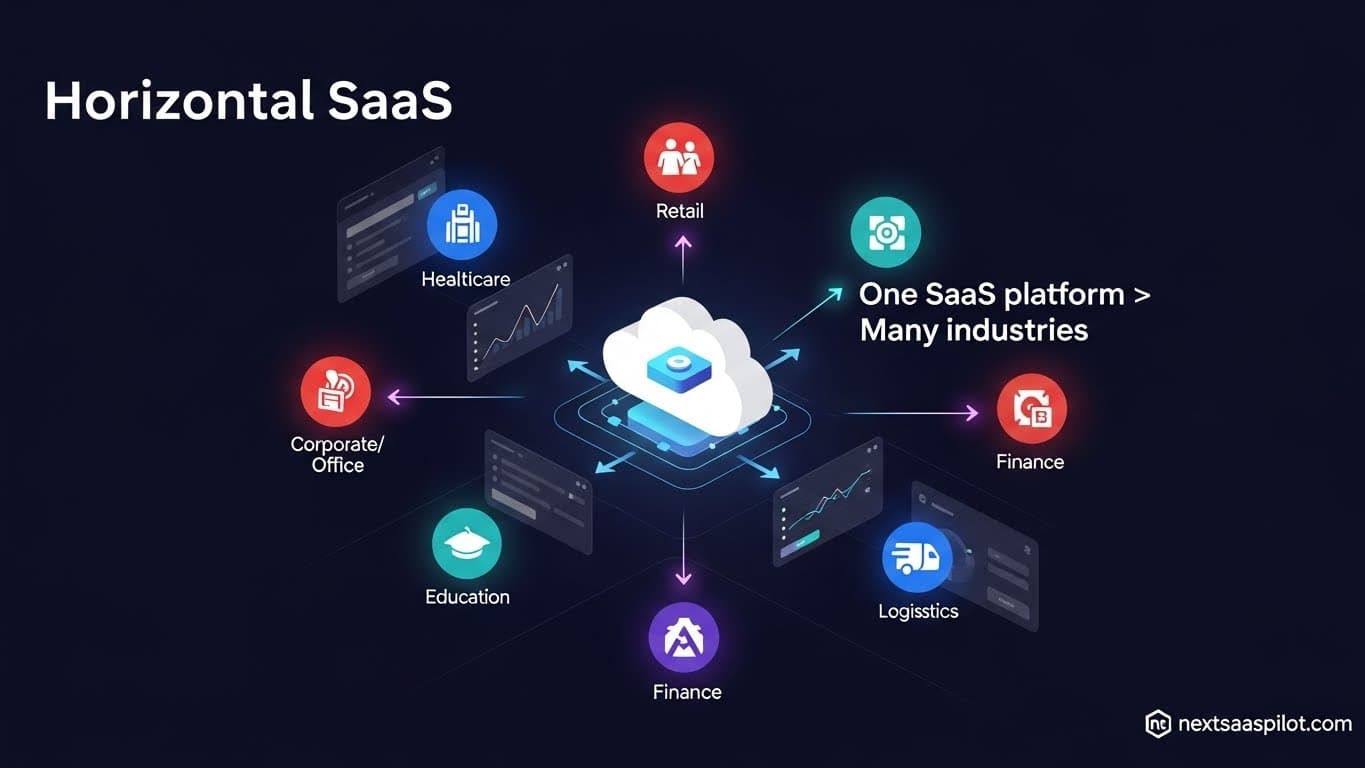
Horizontal SaaS is the digital backbone of the modern economy. While some software is built for specific niches—like a CRM for dentists or an ERP for construction—Horizontal SaaS is designed to serve everyone. It creates the “operating system” that allows a marketing agency in New York and a logistics firm in Tokyo to perform the same fundamental tasks: emailing, accounting, and collaboration.
In 2025, the Horizontal SaaS market is not just growing; it is evolving into an “autonomous” layer where AI agents perform the work that humans used to manage.
This guide breaks down the definition, strategic value, and future of this massive market segment.
What Is Horizontal SaaS?
Horizontal SaaS is a category of cloud-based software that solves a specific business problem common to nearly all industries, rather than targeting a specific market vertical. These solutions—such as Slack for communication or QuickBooks for accounting—are “industry-agnostic,” meaning they provide broad utility to retail, healthcare, finance, and tech companies alike.
To understand Horizontal SaaS, think of it as a utility like electricity. Every business needs electricity to run its lights, regardless of whether they sell burgers or build rockets. Similarly, every business needs to send emails, manage payroll, and track sales leads.
Core Characteristics:
- Broad Total Addressable Market (TAM): Since they sell to everyone, the potential revenue ceiling is massive.
- Generalist Features: The tools are designed to be “good enough” for 80% of users, rather than perfect for one specific niche.
- Lower Cost: Economies of scale allow these vendors to offer lower prices than specialized competitors.
Historically, this model replaced the old concept of IT as a service, where companies had to build custom internal tools for basic functions. Now, they simply rent the best-in-class solution.
How Does Horizontal SaaS Differ from Vertical SaaS?
The difference lies in scope and specialization: Horizontal SaaS solves a single problem for many industries (e.g., “Billing”), while Vertical SaaS solves many problems for a single industry (e.g., “Restaurant Management”). Horizontal tools offer breadth and integration, while Vertical tools offer depth and industry-specific compliance.
This is the classic “Inch wide, mile deep” (Vertical) vs. “Mile wide, inch deep” (Horizontal) distinction.
Comparison Table:
| Feature | Horizontal SaaS | Vertical SaaS |
| Target Audience | Everyone (Industry Agnostic) | Niche (Industry Specific) |
| Market Size | Massive (Global) | Restricted (Niche TAM) |
| Sales & Marketing | High Volume, Low Touch | Low Volume, High Touch |
| Customization | Low (One size fits most) | High (Tailored workflows) |
| Examples | Salesforce, Zoom, Dropbox | Toast (Food), Veeva (Pharma) |
In the context of SaaS vs SAS, Horizontal SaaS represents the broad, user-friendly tools we use daily, whereas SAS (Statistical Analysis System) often behaves more like a specialized, heavy-duty vertical tool for data scientists in regulated industries.
What Are the Top Horizontal SaaS Examples in 2025?
The top Horizontal SaaS examples in 2025 are Salesforce (CRM), Microsoft 365 (Productivity), Slack (Communication), and HubSpot (Marketing). These platforms have evolved from simple tools into massive ecosystems, allowing third-party developers to build specialized “plugins” on top of their horizontal infrastructure.
These giants act as the “sun” in the SaaS solar system—everything else orbits them.
1. Customer Relationship Management (CRM): Salesforce
Salesforce is the ultimate horizontal play. Whether you are a non-profit or a bank, you need to track relationships.
- Evolution: It has moved beyond just a database to become a PaaS (Platform as a Service), allowing companies to build custom apps on top of it.
2. Communication: Slack / Microsoft Teams
These tools replaced the internal memo.
- Impact: They standardized how humans talk to machines. In 2025, most “ChatOps” (running code via chat) happens here.
3. HR & Finance: Workday / QuickBooks
Every company has employees, and every company pays taxes.
- Scale: These tools are often the first SaaS for small business purchase a founder makes.
For a more exhaustive list of these players, you can review our curated SaaS examples.
What Are the Key Benefits of Using Horizontal SaaS?
The key benefits of using Horizontal SaaS are maturity, integration, and cost-efficiency. Because these platforms serve millions of users, they are battle-tested, have thousands of pre-built integrations, and offer competitive pricing due to economies of scale. They allow businesses to adopt “best practices” instantly without reinventing the wheel.
1. The “Lego Block” Advantage
Because Horizontal SaaS tools are popular, they all talk to each other. You can connect your Gmail (Horizontal) to your Trello (Horizontal) to your Slack (Horizontal) with one click. Vertical tools often struggle to match this level of connectivity.
2. Lower Training Costs
It is easier to hire someone who already knows how to use Microsoft Excel or Salesforce than it is to train them on a niche, proprietary system. This standardization is why many professionals seek a SaaS certification—it makes them employable anywhere.
3. Rapid Deployment
Unlike the heavy lift of SaaS vs on-premise installations, Horizontal SaaS can usually be deployed in minutes. You don’t need to build a server; you just swipe a credit card.
What Are the Disadvantages and Security Risks?
The disadvantages of Horizontal SaaS include a lack of specialized features for niche industries and a high risk of “SaaS Sprawl,” where companies accumulate duplicate tools. Security risks are also amplified; because these platforms are widely used, they are prime targets for “Supply Chain Attacks” and identity phishing campaigns.
1. The “Master of None” Problem
Horizontal tools are generic by design.
- Example: A generic project management tool like Asana is great for marketing, but terrible for construction managers who need to track blueprints and permits. This forces companies to “hack” the tool to make it work.
2. Security at Scale
When everyone uses the same software, a single vulnerability affects everyone.
- The Identity Risk: Hackers know that if they crack a Microsoft 365 login, they likely get access to the company’s email, files, and chat. This centralization of risk is one of the major SaaS security risks facing modern CISOs.
3. Competition and Noise
The Horizontal market is brutal. There are 500+ project management apps. For buyers, this leads to decision paralysis.
How Is AI Transforming the Horizontal SaaS Market?
AI is transforming the Horizontal SaaS market by shifting the value proposition from “productivity” to “autonomy.” In 2025, Horizontal platforms are embedding generative AI agents that do not just help users work faster, but actively perform tasks—like drafting emails, reconciling expenses, or scheduling meetings—without human intervention.
We are witnessing the birth of “Service-as-Software.”
The “Copilot” Layer:
Tools like Microsoft Copilot and Salesforce Einstein are horizontal AI layers. They sit on top of your data and answer questions.
- Impact: This threatens the SAS consulting model for basic analytics. Why hire a consultant to write a SQL query when the Horizontal SaaS AI can do it for you in plain English?
The Commoditization of Logic:
As AI becomes better at coding and writing, the “feature gap” between competitors narrows. Horizontal SaaS companies are now competing on data gravity—whoever holds the most customer data wins the AI race.
Should You Choose Horizontal or Vertical SaaS?
You should choose Horizontal SaaS for core, non-differentiating business functions like email, HR, and general accounting where standardization is a benefit. You should choose Vertical SaaS for your “core competency” workflows—such as patient management for a hospital or inventory tracking for a manufacturer—where industry-specific compliance and depth are required.
The Hybrid Stack Strategy:
Most successful companies use a mix.
- Horizontal Base: Use Slack, Zoom, and NetSuite for the foundation.
- Vertical Spikes: Use SAS statistical software for your specific data science needs or Procore for your construction projects.
Final Thoughts
Horizontal SaaS is the infrastructure of the internet economy. While it may lack the flashy specialization of its vertical cousins, it provides the stable, scalable foundation that allows modern businesses to exist.
In 2025, the smartest companies are not choosing between Horizontal and Vertical; they are learning how to integrate them into a single, automated machine.