
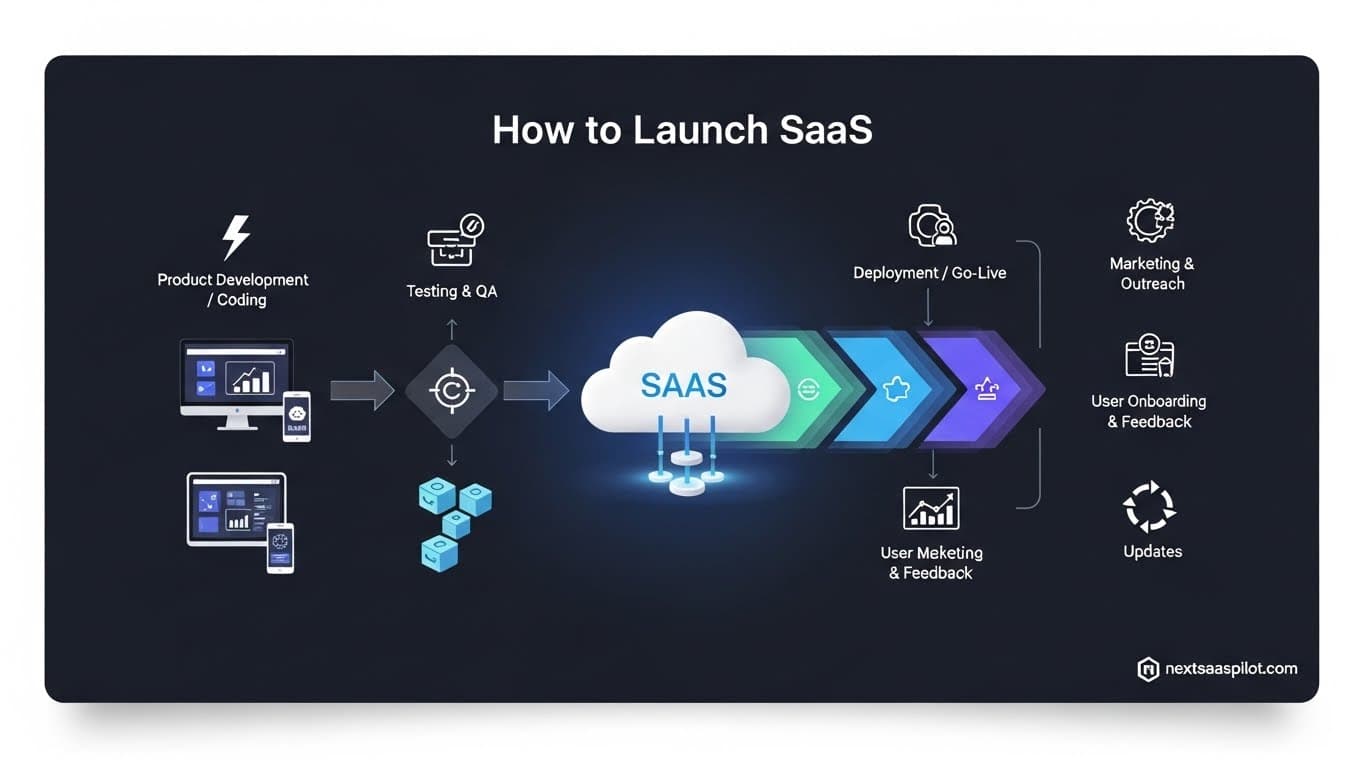
Learning how to launch SaaS products successfully separates profitable businesses from expensive hobbies. In 2025, the barrier to entry is low, but the barrier to scale is incredibly high. You need a battle-tested roadmap that prioritizes validation over code and revenue over vanity metrics.
This guide cuts through the noise. It provides a definitive, chronological framework for taking your software idea from a napkin sketch to a revenue-generating platform. Whether you are a non-technical solo founder or a venture-backed team, the physics of a successful launch remain the same.
What Is the Absolute First Step in Launching a SaaS?
The absolute first step in launching a SaaS is validation, not coding. Before writing a single line of code, you must verify that a market exists willing to pay for your solution. This involves conducting customer interviews, running “smoke tests” with landing pages, and securing pre-sales or letters of intent.
I have seen founders spend $50,000 building a product only to realize nobody wanted it. Do not make that mistake. The goal of the first phase is to prove you are solving a “bleeding neck” problem—a problem so acute that customers are desperate for a fix.
The Validation Checklist:
- The Mom Test: Talk to potential customers without pitching them. Ask about their current workflow. If they don’t complain about the problem you are trying to solve, it’s not a real problem.
- The “Smoke Test”: Build a simple landing page describing the product. Run $100 of ads to it. If people click “Buy” or “Join Waitlist,” you have a signal.
- Pre-Sales: Can you get 10 people to pay you $50 for a lifetime discount before the product exists? Money is the only validation that counts.
How Do You Build a Minimum Viable Product (MVP)?
You build a Minimum Viable Product (MVP) by identifying the single core feature that solves the user’s primary pain point and stripping away all non-essential functionality. The MVP should be functional, stable, and solve one problem exceptionally well, rather than trying to solve ten problems poorly.
The definition of an MVP has evolved. In 2025, “Minimum” does not mean “Broken.” It means “Focused.”
Scoping the Build:
When you map out your SaaS MVP, use the “Pain vs. Frequency” matrix. Build features that address high-pain problems that occur frequently.
- Essential: User Authentication, Core Workflow, Billing Integration.
- Defer: Advanced Analytics, Dark Mode, Referral Systems, API Integrations (unless core).
Anecdote from the Trenches:
I worked with a project management tool that delayed launch by six months to build a “Chat” feature. When they finally launched, users ignored the chat entirely; they just wanted the Gantt chart. That six months of burn was wasted. Focus on the Gantt chart.
Should You Use No-Code or Custom Development?
You should use No-Code tools if you need to launch quickly (under 8 weeks) with a limited budget to validate a concept. Custom development is necessary if your application requires complex proprietary algorithms, high-frequency data processing, or deep integration with legacy systems that No-Code platforms cannot handle.
The rise of no-code SaaS has democratized software. Platforms like Bubble, Webflow, and FlutterFlow allow you to build robust applications without hiring a $150/hour engineer.
Decision Matrix: No-Code vs. Code
| Feature | No-Code (Bubble/Webflow) | Custom Code (React/Node/Python) |
| Speed to Market | Very Fast (Weeks) | Slow (Months) |
| Cost | Low ($50-$500/mo) | High ($10k – $100k+) |
| Scalability | Limited (10k-50k records) | Infinite (Depends on Architecture) |
| IP Ownership | Vendor Lock-in Risks | 100% Owned |
| Best For | B2B CRUD Apps, Marketplaces | AI, Fintech, High-Performance Tools |
If you choose custom development, ensure you understand the fundamentals of SaaS platform development to avoid accumulating massive technical debt early on.
How to Choose the Right Tech Stack for Your Launch?
Choose a tech stack based on developer availability and community support rather than hype. For most web-based SaaS, the MERN stack (MongoDB, Express, React, Node.js) offers the best balance of flexibility and speed. For data-heavy or AI applications, a Python-based backend (Django or FastAPI) is the industry standard.
Don’t let your developers talk you into using a new, obscure language just because it’s “cool.” You need stability.
Standard Architectures:
- Frontend: React or Vue.js (Great for interactive dashboards).
- Backend: Node.js (Fast I/O) or Python (Great for logic/AI).
- Database: PostgreSQL (Structured data) or MongoDB (Flexible data).
- Hosting: AWS (Enterprise) or Vercel/Supabase (Speed for Startups).
Reviewing a comprehensive SaaS tech stack guide is critical before writing the first line of code. Changing your database halfway through is a nightmare you want to avoid.
How Do You Build a Pre-Launch Marketing Strategy?
Build a pre-launch marketing strategy by creating a “Waitlist” landing page that incentivizes viral sharing and documenting your “Building in Public” journey on social media. The goal is to gather an email list of at least 500-1,000 interested users who act as your beta testers and initial revenue source on day one.
Marketing begins the day you start coding, not the day you finish.
The “Building in Public” Strategy:
Share your wins and losses on LinkedIn or X (Twitter).
- Post: “We just struggled with Stripe integration for 3 days. Here is how we fixed it.”
- Result: Other developers and potential users trust you more because you are transparent.
The Viral Waitlist:
Use tools like Viral Loops.
- User signs up for early access.
- User is told: “You are #500 in line. Refer 3 friends to jump to #10.”
- This gamification drives free traffic.
What Are the Components of a High-Converting Launch Site?
A high-converting launch site must have a clear value proposition above the fold, social proof (testimonials or logos), transparent pricing, and a single, distinct Call to Action (CTA). The design should be clean and fast, prioritizing “skimmability” over dense text blocks to ensure visitors understand the product within five seconds.
Your website is your best sales rep. It works 24/7.
The 5-Second Rule:
When a user lands on your site, they must answer three questions in 5 seconds:
- What is it?
- Who is it for?
- Why do I need it?
If your headline is vague (e.g., “Empowering the Future of Work”), you will lose them. Be specific (e.g., “Project Management for Remote Design Teams”).
For visual examples, check SaaS website inspiration to see how unicorns structure their landing pages.
Soft Launch vs. Hard Launch: Which Is Better?
A Soft Launch (Beta) is better for testing stability and gathering feedback from a small group without public pressure. A Hard Launch (Public) is better for generating massive buzz, PR, and a spike in user acquisition once the product is polished. Most successful SaaS companies do a soft launch for 1-3 months before a hard launch.
The Soft Launch (The “Quiet” Phase):
- Invite 50 people from your waitlist.
- Watch them use the app via screen sharing.
- Fix the bugs they find.
- Goal: Retention. Do they come back?
The Hard Launch (The “Loud” Phase):
- Product Hunt launch.
- Press releases.
- Email blasts to the full list.
- Goal: Acquisition. Get as many eyeballs as possible.
How Do You Execute a Product Hunt Launch?
Execute a Product Hunt launch by preparing your assets (video, screenshots, first comment) weeks in advance and engaging a “Hunter” with a large following to post your product. On launch day, you must engage with every comment in real-time and drive traffic from your email list to the Product Hunt page within the first four hours to trend.
Product Hunt is the Super Bowl for SaaS startups.
The 24-Hour Battle Plan:
- 12:01 AM PST: Launch goes live.
- First 4 Hours: Email your waitlist. Ask them to support the launch (do not ask for “upvotes” directly, as this violates PH rules; ask for “feedback”).
- The Comment Section: Have your maker comment ready. Explain why you built this.
- Social Push: Post on LinkedIn/Twitter/IndieHackers linking to the launch.
If you hit #1 Product of the Day, expect 5,000+ unique visitors. Ensure your server can handle the load.
What Legal and Compliance Steps Are Mandatory?
Mandatory legal steps include incorporating your business (typically as a Delaware C-Corp for US startups), drafting Terms of Service and Privacy Policies, and ensuring compliance with data protection laws like GDPR and CCPA. If you handle payments, you must comply with PCI standards, usually handled via a processor like Stripe.
Do not ignore the boring stuff. It protects you from lawsuits.
The “Stripe Atlas” Route:
Services like Stripe Atlas or Clerky can incorporate your company, issue stock to founders, and set up your bank account for a flat fee (usually ~$500). This saves thousands in legal fees.
Data Privacy:
If you have a single user in Europe, you are subject to GDPR. You need a cookie banner and a mechanism to delete user data upon request.
For a broader view on the corporate structure, refer to our guide on how to start a software company.
How Do You Price Your SaaS for Launch?
Price your SaaS for launch using “Value-Based Pricing” rather than “Cost-Plus,” ensuring the price reflects the ROI the customer receives. It is generally better to launch with a “Founder’s Deal” (e.g., 50% off for life for the first 100 users) to reduce friction and reward early adopters for tolerating bugs.
Common Pricing Models:
- Freemium: Good for viral tools (Zoom, Slack). Hard to monetize early.
- Free Trial: Good for B2B. 14 days to prove value.
- Reverse Trial: Give them the Pro plan for 14 days, then downgrade them to Free if they don’t pay. This has high conversion rates.
The Psychology of $99 vs $19:
It is often harder to sell a $19 product than a $99 product. Low prices signal low value. If you solve a business problem, charge a business price.
What Is the Role of Customer Onboarding?
Customer onboarding is the critical process that guides new users to their “Aha!” moment—the point where they realize the value of your software. Effective onboarding uses interactive walkthroughs, checklists, and empty states populated with sample data to prevent users from churning due to confusion.
Churn happens in the first 72 hours. If a user signs up and sees a blank dashboard, they leave.
Onboarding Tactics:
- The Checklist: “3 steps to set up your account.” Humans love completing lists.
- Sample Data: Don’t show an empty CRM. Show a CRM filled with dummy leads so they see how it looks.
- Personal outreach: For the first 50 customers, the founder should email them personally. “Hey, I saw you signed up. Need help setting up?”
How Do You Transition from Launch to Growth?
Transition from launch to growth by shifting focus from “getting anyone” to “getting the right ones” (Ideal Customer Profile). You must implement rigorous analytics to track unit economics like Customer Acquisition Cost (CAC) and Lifetime Value (LTV), and iterate on product features based on retention data.
The launch is just the starting gun. The race is long.
The Feedback Loop:
- Measure: Use tools like Mixpanel or June.so to see what features are used.
- Talk: Interview users who churned. Why did they leave?
- Iterate: Push code updates every week.
Understanding the SaaS lifecycle helps you navigate the “Trough of Sorrow”—the quiet period after the launch hype dies down, where the real business building happens.
Final Thoughts on the Launch
Learning how to launch SaaS is a repeatable skill. It is not magic; it is a sequence of logical steps executed with intensity.
Don’t wait for perfection. Validation beats assumption. Sales beat code. And momentum beats everything.