
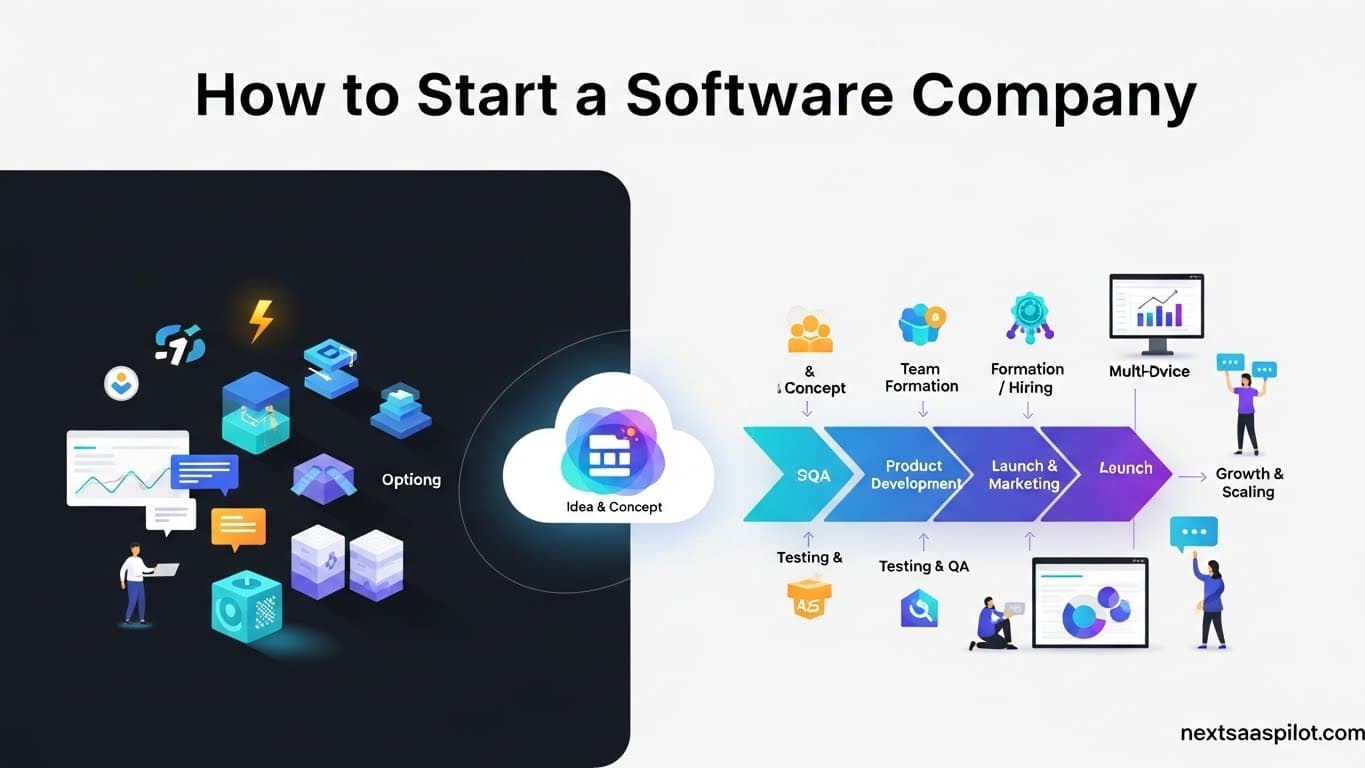
Learning how to start a software company is the modern equivalent of the gold rush, but instead of pickaxes, you need logic, empathy, and resilience. In 2026, the barrier to entry for building software has never been lower, yet the barrier to building a profitable business has never been higher. The market is crowded, customers are discerning, and the technology landscape shifts daily.
To succeed, you must stop thinking like a coder and start thinking like a founder. You are not just writing lines of code; you are architecting a value engine. Whether you are a solo bootstrapper or seeking venture capital, the fundamentals of validation, execution, and scaling remain the immutable laws of physics in this industry.
This guide is your blueprint. It moves beyond generic advice to provide a granular, step-by-step roadmap for building a software empire from absolute zero.
Phase 1: Ideation and ruthless Validation
The first step in learning how to start a software company is not building; it is invalidating your assumptions. Most startups fail not because they couldn’t build the product, but because they built a product nobody wanted. You must fall in love with the problem, not your solution.
I have watched brilliant engineers spend 18 months building a masterpiece in a vacuum, only to launch to crickets. Do not be that founder.
The “Hair on Fire” Problem
You are looking for a problem so acute that users are currently trying to hack together a solution using Excel spreadsheets, email threads, or pen and paper.
- B2B Opportunity: Look for expensive, manual workflows in unsexy industries (e.g., logistics, waste management, dental compliance).
- B2C Opportunity: Look for friction in daily habits (e.g., personal finance, habit tracking, remote connection).
The Validation Gauntlet
Before writing a single line of code, execute these three steps:
- Customer Interviews: Talk to 50 potential users. Do not pitch them. Ask: “Tell me about the last time you encountered [Problem X]. How much did it cost you?”
- The Smoke Test: Spin up a simple landing page explaining the value proposition. Run $100 of LinkedIn or Google Ads. If people don’t click “Join Waitlist,” your messaging or idea is wrong.
- Pre-Sales: The ultimate validation is a credit card. Can you get 5 people to pay you a deposit for a product that doesn’t exist yet?
For a deeper dive into structuring this early phase, reviewing strategies on how to launch SaaS will help you set the stage for a successful market entry before you even have a product.
Phase 2: Defining the Business Model
Once you have a validated problem, you must define how you will capture value. Will you be a subscription-based SaaS, a transactional marketplace, or a usage-based platform? Your business model dictates your engineering architecture and your sales strategy.
In 2026, the default model is SaaS (Software as a Service), but within that, there are nuances.
Pricing Strategy as a Feature
Pricing is not math; it is psychology.
- Freemium: Good for viral, horizontal tools (e.g., Slack). High server costs, low conversion rates.
- Free Trial: Good for B2B. detailed testing period (14-30 days) to prove ROI.
- Enterprise Sales: High-touch, high-ticket. No prices on the website; “Contact Sales.”
If you are targeting the enterprise, you must understand the SaaS lifecycle—enterprise clients expect long sales cycles, strict security compliance, and dedicated support, which changes your burn rate calculations significantly.
Phase 3: Building the Minimum Viable Product (MVP)
Building the MVP is about speed and focus. You are not building the vision in your head; you are building the smallest possible tool that solves the core pain point for your first set of customers. The goal is to enter the feedback loop as quickly as possible.
The Scope Hammer
Ruthlessly cut features. If a feature is “nice to have,” it is a distraction.
- Yes: Core workflow, User Authentication, Payments.
- No: Dark mode, Referral system, Fancy animations, AI integration (unless it’s the core product).
For a detailed breakdown on scoping this phase, our guide on the SaaS MVP provides a framework for deciding what stays and what goes.
No-Code vs. Custom Code
This is the biggest decision you will make in Phase 3.
- No-Code: Use tools like Bubble or FlutterFlow if your logic is standard (marketplaces, directories). It is 10x faster and cheaper. Read more about no-code SaaS to see if it fits your use case.
- Custom Code: Use React/Node/Python if you have proprietary algorithms or need high-performance data processing.
Choosing the Tech Stack
If you go the custom code route, choose boring technology.
- Frontend: React.js (Next.js).
- Backend: Node.js or Python (Django).
- Database: PostgreSQL.
- Hosting: AWS or Vercel.
Do not experiment with new, unproven languages for your business foundation. Refer to the SaaS tech stack guide to see what successful unicorns are using today.
Phase 4: Legal and Financial Structure
You cannot build a skyscraper on a swamp. You need a solid legal entity to protect your intellectual property, issue stock to co-founders, and accept payments. Ignoring this step is the fastest way to kill your company before it starts.
For a broader definition of what constitutes this type of entity, Software Company offers context on the industry standards.
The Checklist
- Incorporation: In the US, a Delaware C-Corp is the standard if you ever plan to raise Venture Capital. Services like Stripe Atlas make this easy.
- IP Assignment: Ensure every founder and contractor signs an agreement assigning their code to the company. If they don’t, they own the code, not the company.
- Banking: Set up a dedicated business bank account. Never mix personal and business funds (this is called “piercing the corporate veil” and exposes you to liability).
- Compliance: If you handle data, you need a Privacy Policy and Terms of Service. If you have EU customers, you need GDPR compliance.
Phase 5: Designing the User Experience
Your software might work, but if it is ugly or confusing, nobody will use it. In 2026, consumer-grade design is expected even in B2B enterprise tools. Your design builds trust before your code delivers value.
The “Time to Value” Metric
Your interface should guide the user to their first “win” in under 5 minutes.
- Onboarding: Use progress bars and tooltips.
- Empty States: Don’t show blank tables; show sample data.
If you are not a designer, look for patterns. You don’t need to invent a new UI; you need to use familiar patterns that users already understand. Browse SaaS website inspiration to see how market leaders structure their dashboards and landing pages.
Phase 6: Development and Project Management
Ideas are cheap; execution is everything. Managing the development process requires discipline. You need a methodology to keep the team focused and shipping code every week.
Agile and Sprints
Don’t try to build the whole thing at once (Waterfall). Break work into 2-week chunks (Sprints).
- Monday: Plan the work.
- Daily: Standup meetings (15 mins) to unblock issues.
- Friday: Demo the progress.
Whether you are managing a co-founder or hiring an external SaaS development company, the principles of software project management are the glue that holds the product together. Without it, you will experience “scope creep” that delays your launch by months.
Phase 7: Go-to-Market (GTM) Strategy
“Build it and they will come” is a lie. You need a distribution strategy. The best product doesn’t win; the best-known product wins. Your GTM strategy depends on your price point.
The Flywheel Effect
- Low Price ($10-$50/mo): You need Marketing. Content marketing (SEO), viral loops, and paid ads.
- High Price ($10k+/yr): You need Sales. Cold calling, LinkedIn outreach, and demos.
Launch Tactics
- Waitlist: Build hype before you have a product.
- Beta Cohorts: Onboard users in batches to fix bugs.
- Public Launch: Product Hunt, Hacker News, and press releases.
Phase 8: Scaling and Platform Evolution
Once you have traction ($1M+ ARR), the game changes. You stop building features and start building a platform. This means opening your API, creating an ecosystem, and allowing third-party developers to build on top of you.
This is the transition from a tool to a platform in software development.
- Integration: Connecting with Salesforce, Slack, and Zapier.
- Security: Getting SOC 2 Type II certified to close enterprise deals.
- Architecture: Moving from a monolith to microservices to handle scale.
For a detailed technical roadmap on this evolution, review SaaS platform development strategies that prepare you for high-volume growth.
Final Thoughts
Learning how to start a software company is a journey of solving one problem after another. It is grueling, stressful, and incredibly rewarding.
Start small. Validate early. Build fast. And never stop listening to your customers. The code is just the vehicle; the value is the destination.