
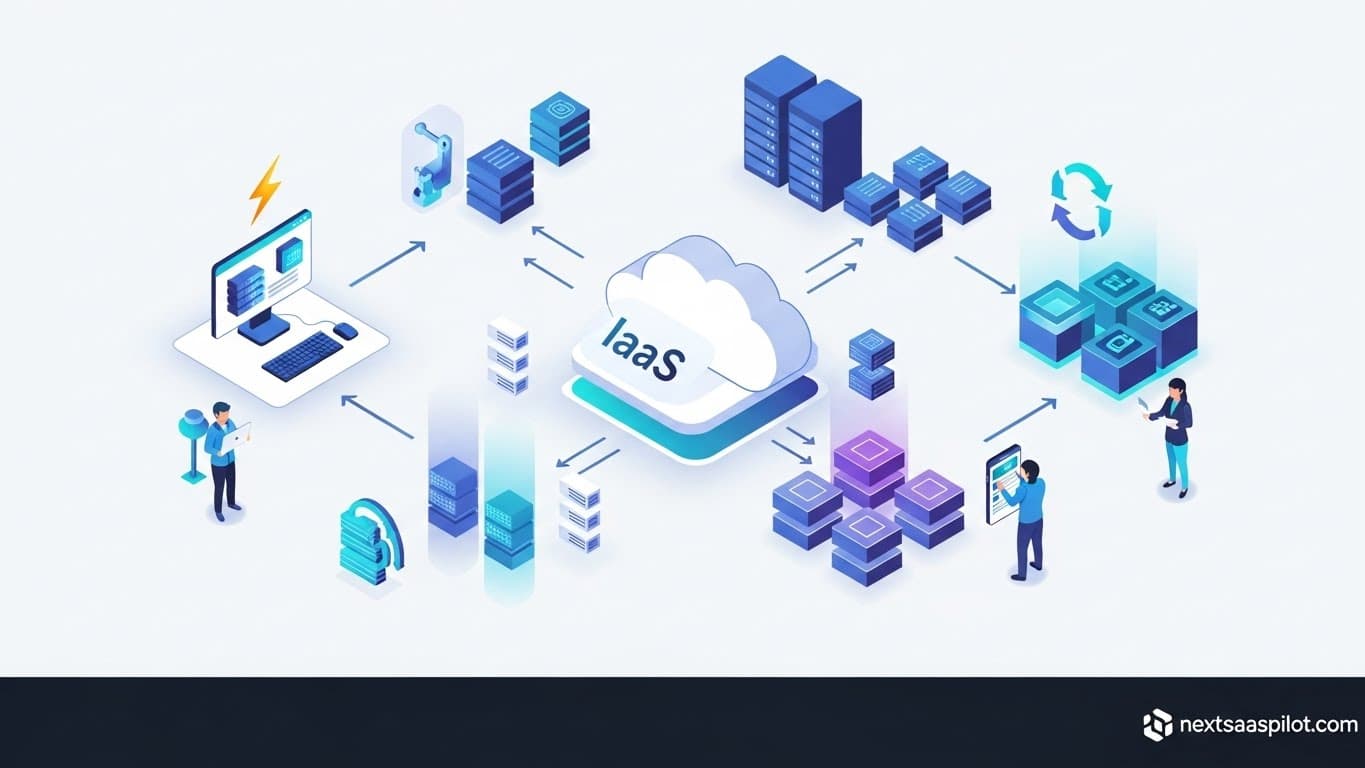
The Infrastructure as a Service (IaaS) landscape in 2025 has shifted from a simple “land grab” for storage and compute to a specialized battleground for AI supremacy and data sovereignty. For CTOs and architects, the decision is no longer just “AWS vs. Azure”—it is about which provider can support trillion-parameter model training, guarantee 99.999% uptime during regional failures, and meet strict EU or APAC compliance standards without latency.
This guide analyzes the top IaaS providers of 2025, moving beyond brochure features to examine their reliability records, AI silicon capabilities, and true costs for enterprise workloads.
Who Are the “Big Three” IaaS Providers in 2025?
The “Big Three” IaaS providers—Amazon Web Services (AWS), Microsoft Azure, and Google Cloud Platform (GCP)—collectively control over 65% of the global infrastructure market. AWS leads in maturity and service breadth, Azure dominates in enterprise hybrid environments, and Google Cloud is the preferred choice for high-performance AI and data analytics workloads.
While their core commodity services (like virtual machines and object storage) are similar, their strategic value propositions have diverged significantly in 2025.
- Amazon Web Services (AWS): Remains the “operating system of the internet.” In 2025, their focus shifted to vertical integration with custom silicon. Their Trainium2 chips and Graviton4 processors offer price-performance ratios that generic Intel/AMD instances cannot match, specifically for scale-out workloads.
- Microsoft Azure: Is the fortress for the Fortune 500. Their massive advantage is the “hybrid benefit”—allowing companies to seamlessly extend their on-premise Windows Server and SQL Server licenses to the cloud.
- Google Cloud (GCP): Has cemented itself as the “AI Cloud.” With the widespread availability of TPU v6 pods in 2025, they offer the fastest training times for large language models, attracting AI-native startups and research labs.
Market Share Snapshot (2025 Est.):
| Provider | Market Share | Primary Strength | Key 2025 differentiator |
| AWS | ~32% | Reliability & Breadth | Custom Silicon (Trainium/Inferentia) |
| Azure | ~23% | Enterprise Integration | OpenAI Service & Hybrid Support |
| Google Cloud | ~12% | AI & Data Analytics | TPU v6 & BigQuery Integration |
How Does Reliability Differ Between Providers?
Reliability varies by architecture, but all major providers face systemic risks. In late 2025, reliability conversations shifted from “uptime” to “blast radius” management. AWS focuses on regional isolation to prevent cascading failures, while Google utilizes a global fiber network to reroute traffic instantly, though software update errors remain a vulnerability for all.
Understanding reliability requires looking at failure patterns, not just SLAs.
- The “US-EAST-1” Lesson: In October 2025, a DNS resolution failure in AWS’s us-east-1 region cascaded to DynamoDB, taking down major consumer apps for six hours. The lesson? “Region redundancy” is not optional. If your disaster recovery plan relies on a single region, you do not have a disaster recovery plan.
- Google’s Automation Risk: A June 2025 outage in Google Cloud was traced back to a valid automated update that contained a logic error, affecting global identity services. Google’s centralized control plane is efficient but can be a single point of failure if an update is bad.
- Azure’s Capacity Constraints: Azure has occasionally faced capacity limits in popular regions (like Western Europe) due to massive AI cluster reservations, leading to “allocation failures” for lower-tier VMs during peak times.
Which Niche Providers Are Disrupting the Market?
Niche IaaS providers like Oracle Cloud (OCI), IBM Cloud, and specialized GPU clouds (like Lambda) are disrupting the market by focusing on specific high-value workloads. Oracle wins on price-performance for databases, IBM dominates in regulated financial sectors, and GPU clouds offer raw compute for AI training at 30-50% lower cost than hyperscalers.
You don’t always need a hyperscaler. Sometimes, a specialist is better.
- Oracle Cloud Infrastructure (OCI):
- The “Zettascale” Win: In 2025, Oracle launched their Zettascale AI clusters, capable of networking over 100,000 GPUs. This attracted massive AI labs that needed raw throughput without the “tax” of AWS networking fees.
- Database Gravity: For companies running massive Oracle ERPs, OCI is the only logical home due to performance tuning that is impossible on AWS or Azure.
- IBM Cloud:
- The Regulated Fortress: IBM has doubled down on their “Financial Services Cloud.” They pre-configure controls for banking compliance (checking hundreds of regulatory boxes out of the box), which is why major banks like BNP Paribas use them for core ledgers.
- Lambda / CoreWeave:
- The AI Boutiques: These providers sell one thing: NVIDIA H100/Blackwell GPUs. They don’t have complex IAM or hundreds of services. They just give you raw compute fast and cheap.
What Is “Sovereign Cloud” and Why Does It Matter?
Sovereign cloud refers to cloud infrastructure that ensures data residency and operational control remain within a specific national jurisdiction, preventing foreign access (e.g., via the US CLOUD Act). It matters critically for European and APAC organizations in 2025 that must comply with strict privacy laws like GDPR and new national security mandates.
This is the biggest trend in non-US markets.
- Europe’s Approach: Partnerships like Bleu (Microsoft + Orange/Capgemini in France) and S3NS (Google + Thales) allow companies to use Azure or GCP technology, but the data centers are operated entirely by European citizens, and encryption keys are held by European entities.
- Why it matters: If you are a German healthcare provider, you legally may not be able to put patient data in a standard US-owned data center. A Sovereign Cloud solves this by contractually and technically air-gapping the management.
How Are AI Workloads Changing IaaS Pricing?
AI workloads are driving IaaS pricing toward “reserved capacity” and “consumption-based” models for accelerators. Due to the scarcity of high-end GPUs, providers are forcing long-term commitments (1-3 years) for AI clusters, while simultaneously lowering prices for standard CPU compute to stay competitive against ARM-based alternatives.
The economics of the cloud are bifurcating:
- Commodity Compute (Web Servers): Prices are dropping. AWS Graviton and Azure Cobalt chips offer 20-30% better price-performance.
- Premium Compute (AI Training): Prices are high and rigid. To get a cluster of H100s or GB200s, you often need to sign a “take-or-pay” contract, regardless of whether you use the chips 24/7.
Strategy Tip: Use “Spot Instances” for training checkpoints or fault-tolerant inference to save up to 90%, but never rely on them for the core training run.
Summary of Leading Providers (2025 Edition)
| Provider | Best Use Case | 2025 Flagship Feature | Primary Risk |
| AWS | General Purpose / Startups | Trainium2 Chips | Complexity / Cost visibility |
| Azure | Enterprise / Hybrid | OpenAI Service | Vulnerability targeting |
| Google Cloud | AI / Big Data | TPU v6 Pods | Support quality |
| Oracle (OCI) | Databases / AI Training | Zettascale Clusters | Smaller ecosystem |
| IBM Cloud | Regulated Industries | Fin. Services Controls | Legacy perception |
Final Thoughts on Selection
Selecting an IaaS cloud service provider in 2025 is a decision about your company’s DNA. If you are an engineering-led team building the next LLM, Google’s TPU pods are your playground. If you are a bank migrating a 30-year-old ledger, IBM or Azure is your safe harbor.
Don’t just buy “cloud.” Buy the specific infrastructure that matches your workload’s unique physics.
For a broader technical overview of the service model itself, Infrastructure as a Service provides excellent background on the virtualization technology that powers these clouds.