
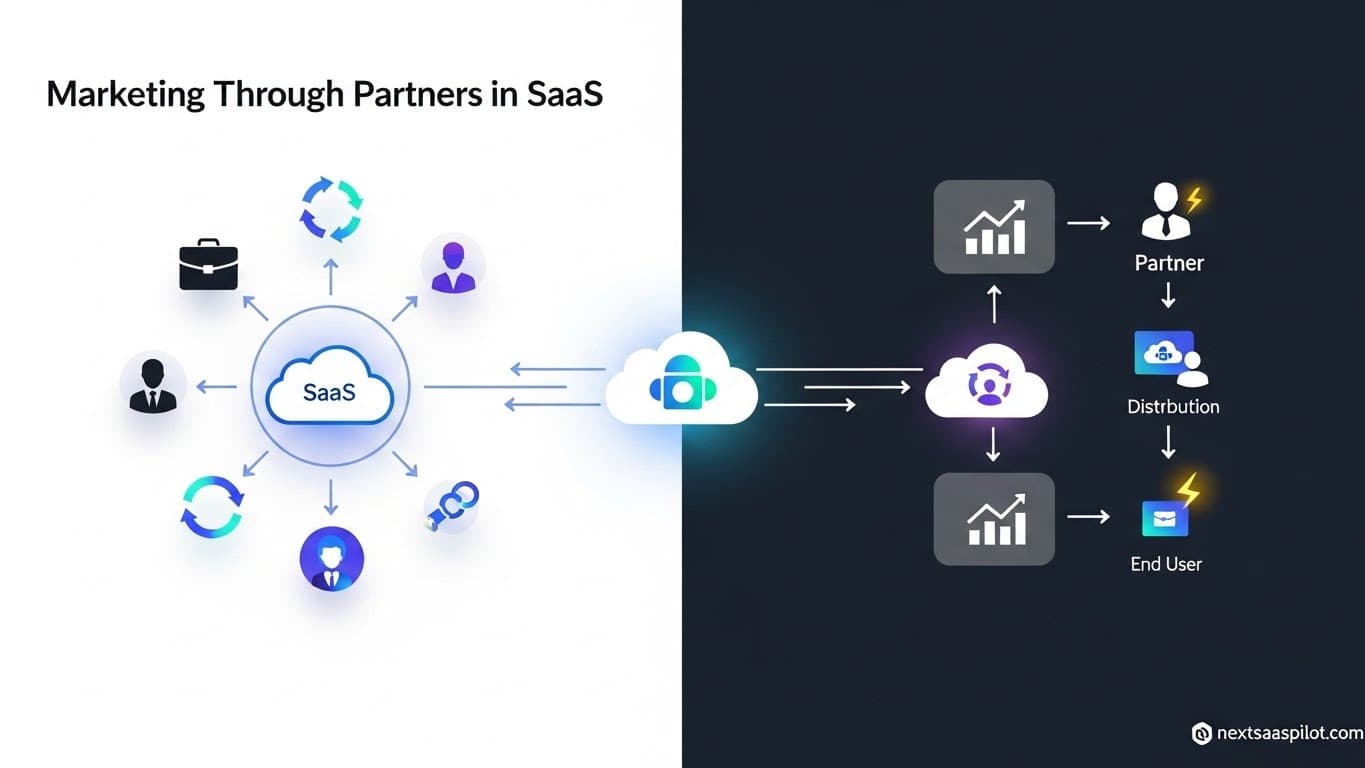
Deciding to market through partners saas channels is often the turning point where a startup transitions from linear growth to exponential scale. In an era where Customer Acquisition Cost (CAC) is skyrocketing and paid ads are becoming less effective, partner ecosystems offer a high-trust, lower-cost alternative to traditional direct sales.
I have advised B2B revenue leaders who were skeptical about giving away 20-30% of their revenue to partners, only to realize later that 30% of something massive is better than 100% of nothing. Partnerships allow you to borrow the trust, audience, and authority of established players. This guide is your blueprint for building, managing, and scaling a partner program that acts as a secondary revenue engine for your business.
What Is SaaS Partner Marketing?
SaaS partner marketing is a strategic collaboration where a software vendor leverages third-party entities—such as agencies, resellers, or other tech companies—to promote, sell, and distribute their product to a broader audience.
Instead of hiring more sales reps (a direct cost), you recruit partners who already have relationships with your ideal customers. It is the difference between hunting for your own food and getting invited to a feast.
In the saas companies ecosystem, trust is the ultimate currency. A cold email from your sales team is an annoyance; a recommendation from a trusted consultant is a solution. By marketing through partners, you transfer that trust to your brand instantly.
Why Should You Market Through Partners in SaaS?
Marketing through partners reduces Customer Acquisition Cost (CAC), accelerates market penetration, and increases Customer Lifetime Value (LTV) by attaching your product to trusted advisors and complementary technologies.
If you look at the most successful saas examples like Salesforce, HubSpot, or Shopify, you will notice they all have massive partner ecosystems. They realized early on that they could not hire enough sales reps to cover the entire globe.
Key Benefits:
- Scalability: You can recruit 100 partners faster than you can hire 100 salespeople.
- Reach: Partners have access to markets and verticals you do not understand.
- Retention: Customers who buy through partners churn less because they have local support.
What Are the Different Types of SaaS Partner Models?
The four main partner models are Affiliate Partners (referral links), Resellers (direct sales), Integration Partners (tech connections), and Agency Partners (implementation services), each serving a distinct role in the revenue cycle.
Choosing the right model depends on your product complexity and price point.
- Affiliate/Referral: Low touch. They send traffic; you pay for leads/sales. Best for low-cost, self-serve tools.
- Value-Added Resellers (VARs): High touch. They buy your software, add services, and sell it to the end client. Common in saas enterprise software.
- Integration/Tech Partners: You build a connection with another software (e.g., “We integrate with Slack”). You swap leads.
- Agency/Service Partners: They implement your software for the client. They drive adoption.
Understanding these distinctions is critical when evaluating b2b saas products strategy.
How Do You Build a Partner Program from Scratch?
To build a partner program, you must first define your Ideal Partner Profile (IPP), create a compelling commission structure, build a partner portal for asset sharing, and hire a dedicated Partner Manager to oversee relationships.
Do not launch a program without a plan. I have seen companies put up a “Partners” page and wait for magic. It never happens. You need infrastructure.
- Legal: A clear partner agreement.
- Financial: An automated way to pay commissions.
- Technical: A method to track leads (PRM software).
This setup phase is a crucial part of saas implementation for your go-to-market strategy.
How to Choose the Right Partners for Your SaaS?
Select partners who share your Ideal Customer Profile (ICP) but are not direct competitors, possess high technical competence, and demonstrate an active willingness to co-market your solution.
Quality beats quantity. One engaged partner is worth fifty inactive ones. Look for “adjacency.” If you sell email marketing software, your ideal partner is a digital marketing agency or a CRM consultant. They are already talking to your buyer about related problems.
When vetting, check their saas industry report standing. Are they respected? Do they have a track record?
The Role of Integration Partnerships
Integration partnerships create a “sticky” product ecosystem where data flows seamlessly between tools, reducing churn and allowing you to tap into the user base of larger, established platforms.
This is arguably the most powerful form of partnership today. If your tool integrates perfectly with a major platform, you can list it on their marketplace. This moves you from being a standalone tool to being part of a saap software (Software as a Platform) strategy.
- Example: A small accounting tool builds a QuickBooks integration. Suddenly, millions of QuickBooks users can discover them inside the app store.
How to Enable Your Partners for Success?
Partner enablement involves providing comprehensive training, co-branded marketing assets, sales scripts, and dedicated support channels to ensure your partners can sell your product as effectively as your internal team.
You cannot just sign a partner and walk away. You must teach them how to sell your product.
- Certification: Create an academy. Teach them the software.
- Co-Marketing: Run webinars together. Write guest blog posts.
- Battle Cards: Give them cheat sheets comparing you to competitors.
This investment improves the overall saas experience meaning for the end customer, as they receive knowledgeable service from the partner.
Partner Commission Models: What Works Best?
The most effective commission models are recurring revenue share (20-30% for the life of the customer) for retention-focused programs, or high one-time bounties (CPA) for volume-focused affiliate programs.
Your incentive structure dictates behavior.
- Recurring Revenue Share: Aligns the partner with retention. They want the customer to stay happy so the checks keep coming. Ideally suited for a saas finance course discussion on long-term cash flow.
- One-Time Bounty: Good for quick customer acquisition but offers no incentive for the partner to help with retention.
Avoiding Channel Conflict
Channel conflict occurs when your direct sales team competes with your partners for the same lead; prevent this by implementing strict “Deal Registration” rules where partners lock in leads for a set period.
Nothing kills a program faster than a partner bringing you a lead, only for your internal sales rep to steal it to hit their quota. You must establish “Rules of Engagement.”
- Deal Reg: If a partner registers a lead in your portal, your sales team backs off.
- Double Comp: In some early-stage companies, you pay both the partner and the sales rep to encourage collaboration.
Measuring Success: Key Partner Metrics
Track Partner-Sourced Revenue, Active Partner Rate (percentage of partners who sold recently), and Deal Velocity to measure the health and ROI of your channel program.
Vanity metrics like “Total Signups” are useless if they don’t convert.
- Partner Sourced ARR: How much revenue came purely from partners?
- Partner Influenced ARR: How many deals did partners help close (even if they didn’t source them)?
These metrics justify the budget for saas application management tools needed to run the program.
The Future: Ecosystem-Led Growth
Ecosystem-led growth expands beyond simple referrals into a holistic network where your product, your partners, and your customers’ data interact to create value greater than the sum of its parts.
We are moving from “Partner Channels” to “Ecosystems.” It mirrors the complexity of modern Supply Chain Management but for digital value. Companies are now hiring “Chief Ecosystem Officers.” It’s about mapping your tool to the entire stack of the customer.
Conclusion
To market through partners saas effectively is to admit that you cannot reach everyone alone. It is a maturity milestone. By building a program that treats partners as an extension of your team—rewarding them, training them, and protecting them—you unlock a multiplier effect on your revenue.
Start small. Recruit five high-quality partners. Make them successful. Then, use their success stories to recruit the next fifty.