
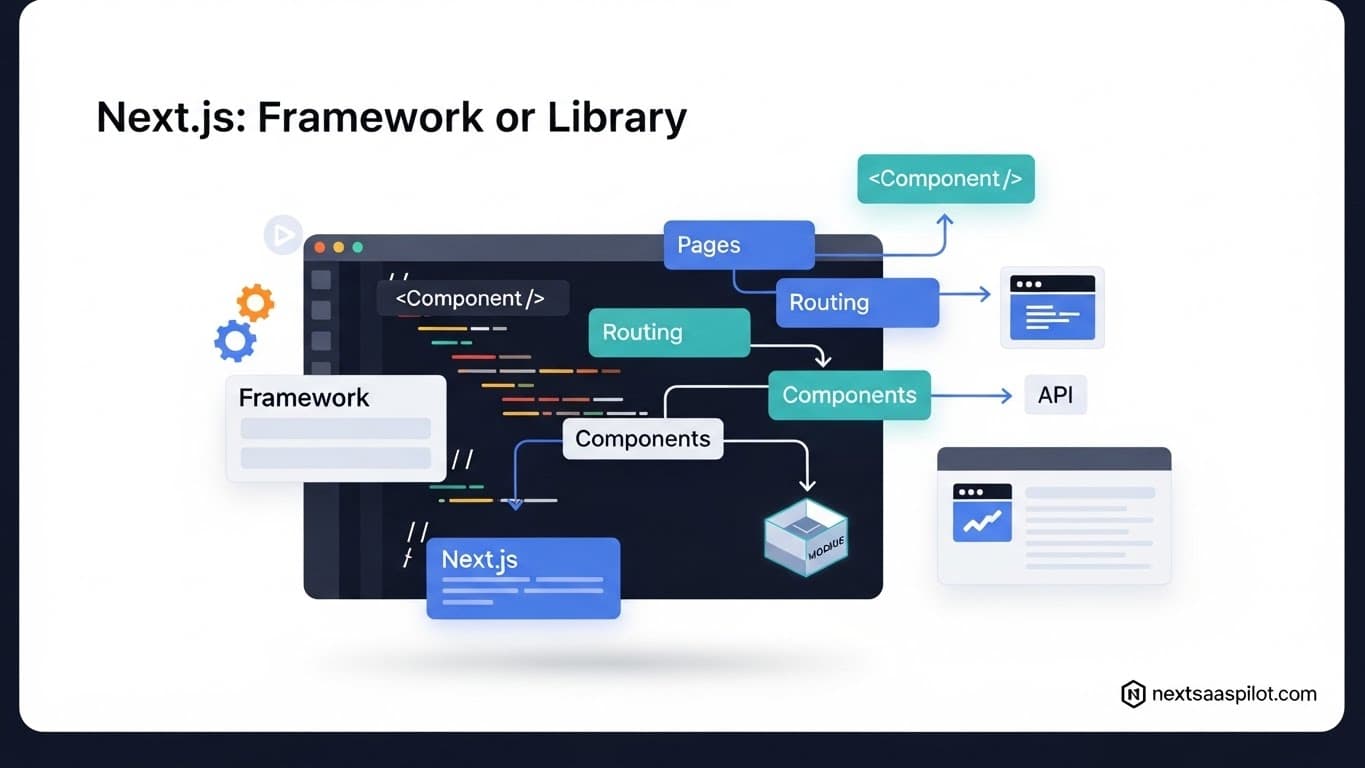
Deciding whether you need a next js framework or library solution determines how you build your entire web architecture. Next.js is definitively a framework, built on top of the React library. While React handles the user interface components, Next.js provides the structure, routing, and server-side capabilities required for production-ready applications.
If you are building a modern web application, understanding this distinction saves you hours of configuration time. Let’s break down exactly why this distinction exists and how it impacts your development workflow.
What Is the Core Difference Between a Framework and a Library?
A library offers specific functionality you call when needed, leaving you in control, whereas a framework calls your code, dictating the architecture and flow. This concept is known as Inversion of Control (IoC). A library is like buying furniture for a house; a framework is buying the house itself.
When you use a library, you are the general contractor. You decide where the code goes, how the folder structure looks, and which third-party packages to install for routing or state management. You control the application flow.
In contrast, a framework makes these decisions for you. It provides a skeleton. You fill in the blanks with your code. The framework says, “Put your pages here,” and “Name your configuration file this.” This reduces decision fatigue and standardizes projects across teams.
Is React a Framework or a Library?
React is officially a library because it focuses solely on the view layer (UI components) and does not mandate routing, data fetching, or project structure. Developers must choose external tools for these tasks to build a full application.
React describes itself as “a JavaScript library for building user interfaces.” It does one thing exceptionally well: it renders HTML based on state. It does not care how you handle HTTP requests. It does not care how you move between pages.
Because React is unopinionated, you often have to stitch together a stack. You might grab React Router for navigation, Redux for state, and Webpack for bundling. This freedom is powerful but requires significant setup. This is where concepts like js development become complex for beginners—there are too many moving parts to manage manually.
Is Next.js a Framework or a Library?
Next.js is a full-stack React framework that handles configuration, routing, server-side rendering, and build optimization out of the box. You follow its rules, such as file-system routing, to build production-ready applications without manual setup.
Next.js takes React and wraps it in a complete infrastructure. When you run a create next app command, you aren’t just getting a UI library. You get:
- File-system based routing: No need to configure a router.
- Server-Side Rendering (SSR): Pages render on the server for better SEO.
- Static Site Generation (SSG): Pre-render pages at build time.
- API Routes: Build backend endpoints in the same project.
It dictates the structure. If you place a file in the pages directory, it becomes a route. That is the framework behavior in action.
What Is Inversion of Control in Next.js?
Inversion of Control (IoC) means the tool calls your code, not the other way around; in Next.js, you place files in specific folders like pages or app, and the framework automatically routes them without manual configuration.
In a standard React app, you write code to tell the browser, “If the URL is /about, show the About component.” You are in control.
In Next.js, you simply create about.js inside the pages folder. Next.js detects this file and creates the route for you. You didn’t write the routing logic; Next.js did. It called your component when the URL matched.
This is the defining characteristic of a framework. It imposes a workflow. This might seem restrictive, but it boosts productivity. It removes the need for boilerplate meaning manual setups that plague standard React projects.
Comparison: Next.js vs. React
Next.js provides a complete structural standard, while React provides UI flexibility. The table below highlights why Next.js is categorized as a framework and React as a library.
| Feature | React (Library) | Next.js (Framework) |
| Routing | External (e.g., React Router) | Built-in (File-system based) |
| Rendering | Client-side (CSR) mostly | SSR, SSG, and ISR supported |
| Backend | None (Frontend only) | API Routes (Serverless functions) |
| Opinionated | No (You choose the stack) | Yes (Follows specific patterns) |
| Setup | Manual (Webpack/Babel) | Zero-config (Rust-based compiler) |
Why Do Developers Confuse the Two?
Confusion arises because Next.js uses React components, so the syntax feels identical even though Next.js acts as the architectural shell holding those React library components together.
You import React in your Next.js files. You write JSX. Hooks like useState and useEffect work exactly the same way. Because the syntax feels identical, new developers often assume they are the same type of tool.
Think of it this way: React is the engine. Next.js is the car. You need the engine to power the car, but the car provides the chassis, wheels, and steering. You cannot drive an engine down the highway, just as you cannot easily ship a complex, SEO-heavy app with raw React without building a framework around it yourself.
When Should You Use a Framework Like Next.js?
Choose Next.js when you need SEO performance, static site generation, or server-side rendering, as it is ideal for SaaS platforms, e-commerce sites, and dashboards where speed and structured scalability are non-negotiable.
If you are building a dashboard next js template, using the framework saves weeks of development time. You get optimized images, font optimization, and code splitting automatically.
Projects that benefit most include:
- Public facing marketing sites: SEO is crucial here.
- E-commerce stores: Fast load times increase conversion.
- Large SaaS applications: Structure helps large teams collaborate.
- Content platforms: SSG serves content instantly.
If you are building a simple internal tool behind a login screen where SEO does not matter, raw React might suffice. But for anything production-grade, the framework benefits outweigh the learning curve.
How Does Next.js Handle Data Fetching?
Next.js offers specific methods like getServerSideProps and getStaticProps to fetch data before the page loads, allowing you to render content on the server and send fully formed HTML to the browser.
In a React library setup, you usually fetch data inside a useEffect hook. This means the user sees a loading spinner while the browser downloads the script, executes it, requests data, and finally renders.
Next.js eliminates that wait. By pre-fetching data on the server, the user sees content immediately. This is a core “framework” feature—it controls when and how data enters your application.
Using a nextjs saas template leverages these data fetching methods to provide a snappy user experience right out of the box.
Does Using a Framework Limit Flexibility?
Frameworks impose constraints to prevent technical debt, so while you lose the freedom to structure folders however you want, you gain stability, easier upgrades, and a community standard.
When you hire a developer for a React project, you have to explain your custom routing and folder structure. When you hire a developer for a Next.js project, they already know where everything is.
Constraints breed creativity. Instead of wasting time debating which router to use, you focus on the business logic. You focus on your boilerplate agreement template logic or your unique value proposition.
The Evolution of the “Meta-Framework”
Next.js is often called a “Meta-Framework” because it is a framework built on top of a library, combining the component model of React with the architectural robustness of a server-side framework.
The industry is shifting toward this model. We see it with Remix (for React), Nuxt (for Vue), and SvelteKit (for Svelte). The consensus is clear: libraries are great for UI, but frameworks are necessary for apps.
This evolution solves the “configuration hell” that JavaScript developers faced for years. We no longer spend days setting up Webpack. We trust the framework to handle the heavy lifting.
Final Thoughts
The debate between framework and library is not just about semantics; it is about the problems you want to solve. React, the library, gives you the tools to paint a picture. Next.js, the framework, gives you the gallery to display it in.
For 90% of modern web projects, the structure provided by Next.js is a necessity, not a luxury. It handles the hard parts of web development—caching, routing, and rendering—so you can focus on building a great product. If you are looking to scale, optimize for search engines, and maintain a clean code base, adopting the Next.js framework is the logical step forward.