
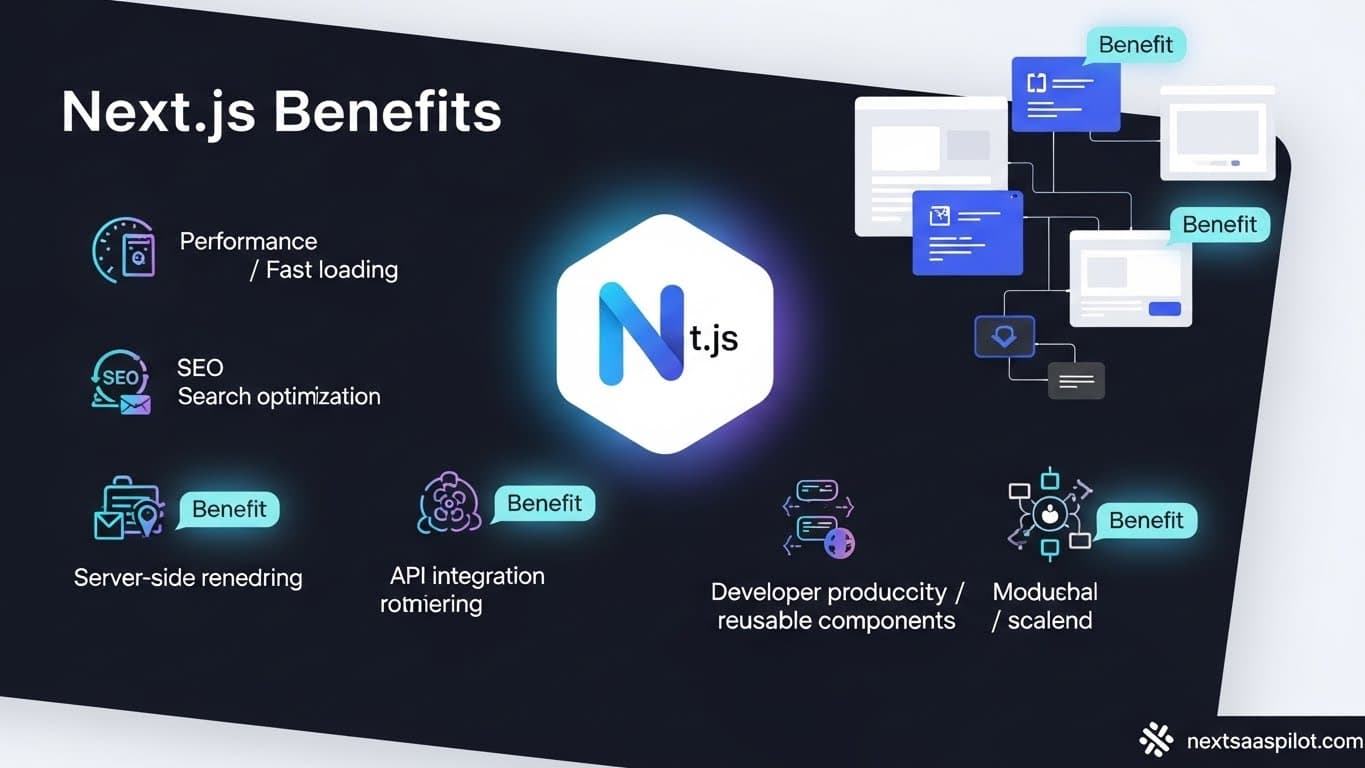
Understanding the core nextjs benefits is essential for any technical leader deciding on a stack for their new SaaS product. In the high-stakes world of software as a service, your technology choice dictates your speed to market, your SEO ranking, and your long-term scalability. Next.js has graduated from being just a React framework to becoming the industry standard for web infrastructure.
I have watched countless startups struggle with “analysis paralysis” when choosing a tech stack. They often over-engineer their backend or choose a frontend framework that creates SEO nightmares. Next.js solves these specific business problems by offering a hybrid environment where performance and developer experience coexist. Let’s explore why this framework is the engine behind the fastest-growing SaaS companies today.
Why Is Next.js the Preferred Framework for Modern SaaS?
Next.js provides a unified architecture that handles both the user interface and the server-side logic, eliminating the need for separate backend repositories. This “batteries-included” approach enables teams to ship features faster by providing built-in routing, rendering optimization, and API handling without complex configuration.
When you build a SaaS, you are usually building two things: a marketing site to acquire customers and a dashboard to retain them. In a traditional setup, you might use WordPress for the marketing site and React for the app. This splits your codebase and your team.
With Next.js, you build both in the same repo. Your marketing pages use Static Site Generation (SSG) for blazing speed, while your dashboard uses Server-Side Rendering (SSR) for dynamic data. This consolidation reduces technical debt and simplifies your CI/CD pipeline. Using a nextjs saas template allows you to leverage this unified structure from day one, saving weeks of setup time.
How Does Server-Side Rendering Improve SaaS SEO?
Server-Side Rendering (SSR) generates the full HTML of a page on the server before sending it to the browser, ensuring that search engine bots can crawl and index your content immediately. This contrasts with client-side rendering, where bots often see a blank page while waiting for JavaScript to load.
If your SaaS relies on organic search traffic—for example, programmatic SEO pages for “Best X for Y” or public-facing user profiles—SSR is non-negotiable. I have seen SaaS companies switch from a standard Create React App (CRA) to Next.js and see their indexation rate jump by 300% in a week.
Google claims it can crawl JavaScript, but it takes resources and time. HTML is instant. By serving pre-rendered HTML, you are handing Google exactly what it wants on a silver platter. This is a massive competitive advantage over competitors stuck in “loading spinner hell.”
What Impact Does Static Site Generation Have on Performance?
Static Site Generation (SSG) pre-builds pages at compile time, allowing them to be served from a Content Delivery Network (CDN) instantly without hitting your database. This results in near-zero latency for users, drastically improving Core Web Vitals and reducing server load.
For a SaaS, your documentation, blog, and pricing pages rarely change. There is no reason to query a database every time a user visits your “About Us” page.
Next.js allows you to designate these pages as static. When a user requests them, they get a cached file from an edge server near them. This architecture is not just fast; it is cheap. You aren’t paying for compute time on every page view.
If you are using a next js website template, this behavior is usually configured out of the box, ensuring your marketing funnel is as slippery (fast) as possible.
Can Next.js Simplify Backend Development?
Next.js allows you to write server-side code directly alongside your frontend code using API Routes and Server Actions, effectively removing the need for a separate Express or Python backend for many applications. You can query databases, handle authentication, and process payments within the same project.
This benefit is often understated. In the past, adding a feature meant:
- Backend dev writes an endpoint.
- Frontend dev waits for the endpoint.
- Frontend dev connects to the endpoint.
- Both debug CORS errors.
With Next.js, one developer writes the function to fetch data and the component to display it in the same file (using Server Components). The feedback loop is instant. You don’t have to worry about synchronizing types between two repos because everything is TypeScript.
How Does Image Optimization Reduce Hosting Costs?
The built-in next/image component automatically resizes, compresses, and converts images to modern formats like WebP or AVIF based on the user’s device. This prevents large image files from slowing down page loads and significantly reduces the bandwidth bandwidth costs associated with hosting media.
SaaS landing pages are often heavy on screenshots and graphics. If you serve a 4MB PNG to a mobile user, they will bounce. Manually optimizing these assets is a chore.
Next.js handles this on the fly. You simply use the
Does Next.js Support Scalable Architecture?
Next.js is designed to be serverless-first, meaning it can automatically scale up to handle traffic spikes and scale down to zero during idle periods. This elasticity ensures your application remains stable during product launches or viral marketing campaigns without manual server provisioning.
When you deploy Next.js to a platform like Vercel or AWS Amplify, every page and API route becomes a serverless function. If 10,000 users hit your site at once, the infrastructure spins up 10,000 instances to handle the requests.
This allows you to start small with zero overhead. You don’t need a DevOps engineer managing Kubernetes clusters. As you grow, you can adopt more complex patterns, perhaps incorporating next.js react native strategies to expand your platform to mobile without abandoning your scalable backend logic.
Comparison: Next.js vs. Standard React (SPA)
The table below highlights the operational differences between a standard Single Page Application (SPA) and a Next.js application.
| Feature | Standard React (CRA/Vite) | Next.js |
| Rendering | Client-Side Only | SSR, SSG, ISR, Client-Side |
| SEO | Difficult (requires workarounds) | Excellent (Native support) |
| Routing | External library (React Router) | Built-in (File-system based) |
| Backend | Requires separate server | Built-in API Routes |
| Performance | Slower initial load | Instant initial load |
| Image Opt | Manual configuration | Built-in Automatic |
How Do Recent Updates Enhance Developer Velocity?
The introduction of the App Router and React Server Components in the latest Next.js versions significantly reduces the amount of JavaScript sent to the client, improving load times and simplifying data fetching logic. Developers can now write async/await code directly in components.
Keeping up with the latest next version allows you to delete code. You no longer need useEffect hooks to fetch data. You no longer need Redux for simple server state.
This reduction in boilerplate code means fewer bugs. It also means your bundle size—the amount of JavaScript the browser has to download—is smaller. A smaller bundle parses faster, which improves interactivity. This is crucial when you are layering in complex UI interactions using Next.js page transitions and animation libraries.
Is Next.js Secure for Enterprise Applications?
Next.js offers enterprise-grade security by allowing sensitive logic and environment variables to run exclusively on the server, ensuring they are never exposed to the client-side browser. Additionally, middleware functions provide a centralized layer to enforce authentication and headers across the entire application.
In a pure client-side React app, your logic lives in the user’s browser. A savvy user can inspect the code. In Next.js, your API routes and Server Actions are black boxes to the user.
You can implement a next js provider pattern to manage session state securely, ensuring that protected routes are verified on the server before any UI is rendered. This prevents the “flash of protected content” vulnerability common in SPAs.
The “Hidden” Benefit: Ecosystem and Talent
The popularity of Next.js ensures a massive pool of hireable talent and a rich ecosystem of compatible libraries, meaning you can easily find developers and tools to solve almost any problem. It effectively standardizes the “React Stack” for professional development.
If you choose a niche framework, hiring is hard. If you choose Next.js, any React developer can become productive within a week.
Furthermore, the component ecosystem is vast. Whether you need a next js ui library for rapid prototyping or complex data grid components, they are all built to be compatible with Next.js.
Conclusion
The nextjs benefits go beyond code; they impact the bottom line. By choosing Next.js, you are choosing a framework that prioritizes the user experience through speed and the developer experience through simplicity.
For SaaS founders, it bridges the gap between a hacked-together prototype and a scalable enterprise platform. You get the SEO you need to get found, the performance you need to convert, and the architecture you need to grow. In the modern web landscape, Next.js is not just a framework; it is a competitive advantage.