
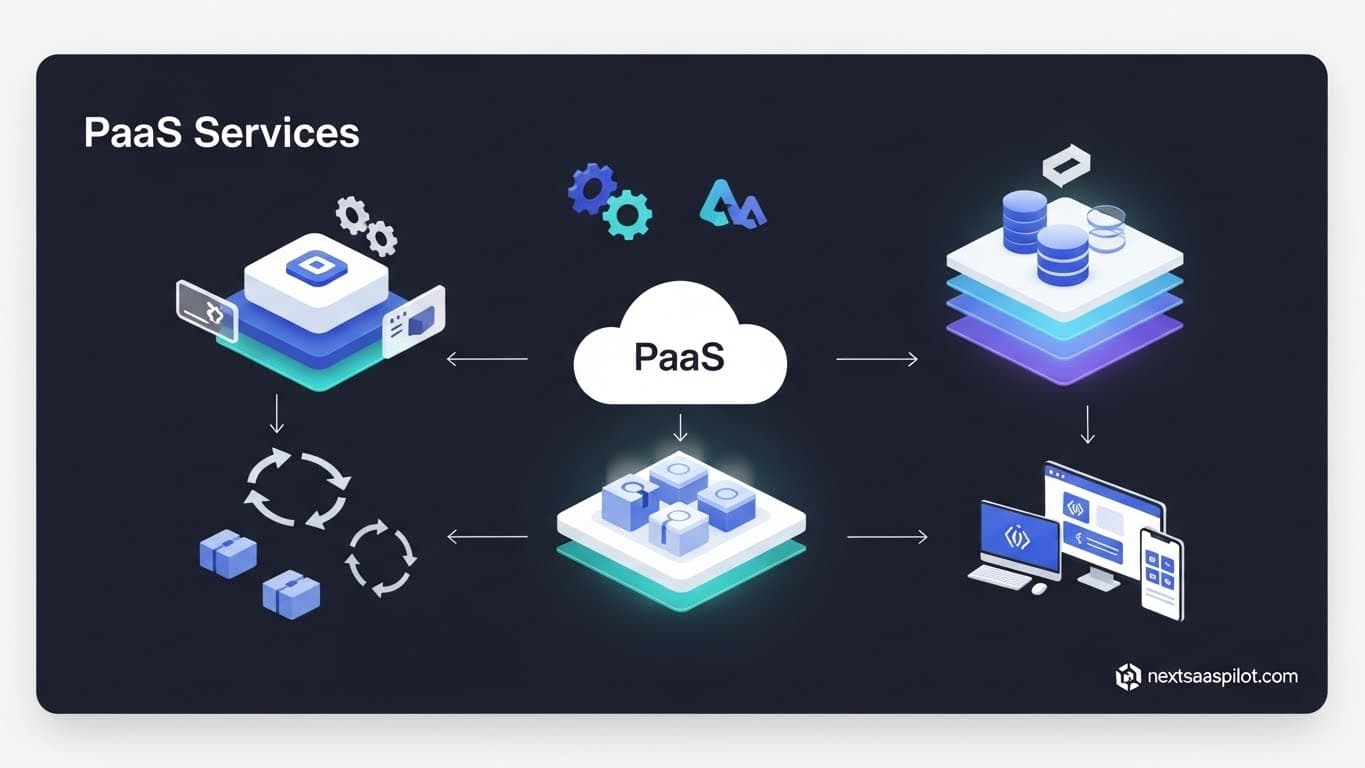
PaaS services are the foundational layer of the modern cloud economy, providing the essential framework developers use to build custom applications without managing hardware. While SaaS delivers the final software to the user, PaaS provides the tools, database management, and operating systems required to create it. This guide explores the architecture, strategic value, and technical integration of Platform as a Service.
What Are PaaS Services in Cloud Computing?
PaaS services (Platform as a Service) are cloud-based environments that allow developers to build, test, and deploy applications by abstracting the underlying infrastructure. They sit between IaaS and SaaS, offering pre-configured hardware and software tools over the internet. This removes the complexity of maintaining physical servers or installing operating systems manually.
To truly grasp the value of PaaS, consider the logistical friction of traditional development. In the past, launching a web application required purchasing physical servers, configuring networks, and manually patching operating systems. It was slow, expensive, and prone to error.
PaaS eliminates this friction. It acts like a fully equipped workshop. You bring the materials (code) and the blueprints (logic), while the provider supplies the power tools, workbench, and safety systems.
Core Capabilities of PaaS:
- Development Frameworks: Built-in software components that reduce coding time.
- Scalability: Resources that expand automatically based on user demand.
- Web Services: Integration for security, directories, and workflows.
- Database Management: Automated backups and maintenance for SQL and NoSQL data.
Market analysis suggests that utilizing PaaS solutions can reduce application development timelines by significant margins, allowing companies to pivot quickly in competitive markets.
How Do PaaS and SaaS Work Together?
PaaS and SaaS work together as the backend engine and the frontend product. Developers use PaaS environments to write and host the code that end-users eventually access as SaaS. While the SaaS application solves a specific problem for the customer, the PaaS layer ensures that the application remains online, secure, and scalable.
The relationship is symbiotic. When you use a web-based project management tool, you are interacting with SaaS. However, that tool is running on a PaaS infrastructure that manages the traffic and data storage.
The Integration Workflow:
- Coding: Developers write the application logic using PaaS tools.
- CI/CD Pipelines: Automated testing and deployment happen within the platform.
- Hosting: The code goes live on the provider’s managed servers.
- Access: The end-user logs into the SaaS product via their browser.
Looking at successful SaaS examples, nearly all of them rely on this architecture to push updates frequently. If a bug is found, the PaaS allows the developer to fix and redeploy it in minutes without taking the site offline.
What Are the Best Cloud Application Providers for PaaS?
The best cloud application providers for PaaS are the industry giants: Amazon Web Services (AWS), Microsoft Azure, and Google Cloud Platform (GCP). These providers offer the most robust global networks, security certifications, and language support. Choosing the right one depends on your team’s preferred coding languages and existing infrastructure.
Selecting a provider is a strategic decision that impacts your long-term roadmap. A comprehensive cloud applications list reveals that while features overlap, ecosystems differ.
Provider Breakdown:
- AWS Elastic Beanstalk: Known for flexibility and deep integration with the vast AWS service catalog. It is a top choice for general-purpose web applications.
- Google App Engine: ideal for applications that need to handle massive spikes in traffic or heavy data analytics. It pioneered the “serverless” concept.
- Microsoft Azure App Service: The preferred choice for enterprise environments heavily invested in the .NET framework and Windows Server architecture.
Beyond these giants, niche cloud application SaaS providers offer specialized platforms for industries with strict compliance needs, such as healthcare or government services.
How Does PaaS Simplify Building an API?
PaaS simplifies building an API by automating the complex networking configuration required to handle HTTP requests and data transfer. It provides built-in API gateways that manage authentication, rate limiting, and routing, allowing developers to focus entirely on defining data endpoints rather than server maintenance.
Building an API (Application Programming Interface) manually involves configuring load balancers, firewalls, and reverse proxies. PaaS handles this configuration automatically.
API Development Benefits:
- Traffic Management: Automatically routes requests to the healthiest server instances.
- Versioning: Allows you to deploy API v2 while keeping API v1 live for legacy users.
- Security: Implements standard protocols like OAuth and SSL/TLS with simple toggles.
I once managed a project where migrating to a PaaS solution reduced our API deployment time from two days to fifteen minutes. The automation of the network layer was the primary factor.
Why Do Enterprise Software Companies Prefer PaaS?
Enterprise software companies prefer PaaS because it offers guaranteed Service Level Agreements (SLAs), compliance certifications (like SOC2), and enterprise-grade security. Large organizations prioritize risk mitigation, and PaaS vendors provide a secure, governed environment that meets strict corporate standards.
In the world of SaaS enterprise software, data breaches are catastrophic. Building on a trusted PaaS leverages the vendor’s multi-billion dollar security investment.
Enterprise Features:
- Identity Management: Seamless integration with corporate Single Sign-On (SSO) systems.
- Virtual Private Clouds (VPC): Isolating resources from the public internet for maximum security.
- Audit Logs: Detailed records of who accessed the system and when.
Many SaaS companies explicitly market their use of top-tier PaaS providers to gain trust with banking and healthcare clients.
How Do You Handle SaaS Application Management on PaaS?
Handling SaaS application management on PaaS involves using the platform’s integrated dashboards to monitor application health, analyze logs, and manage resource allocation. These tools allow administrators to see real-time performance metrics and automate responses to issues like high latency or server errors.
Effective SaaS application management relies on visibility. You cannot fix what you cannot see.
Key Management Tools:
- Application Performance Monitoring (APM): Tracks the speed of individual code functions.
- Distributed Tracing: Follows a user request across multiple microservices to pinpoint bottlenecks.
- Auto-Scaling Rules: Defines when to add more servers based on CPU or memory usage.
What Is SAAP Software and How Does It Differ?
SAAP software (Software as a Product) creates a distinction where the customer buys a perpetual license to own the software, unlike the rental model of SaaS. However, PaaS bridges this gap by allowing customers to host their purchased SAAP software on a managed cloud environment, combining ownership with cloud convenience.
While SaaS is the dominant model, SAAP software remains vital for organizations that require total data sovereignty.
The Deployment Model:
- SaaS: The vendor hosts the software and data.
- SAAP on PaaS: The customer buys the code and installs it on their own private PaaS instance. This gives them the scaling benefits of the cloud without giving up control of their data.
What Are Public SaaS Companies Doing with PaaS?
Public SaaS companies utilize PaaS to achieve the massive scale and reliability required by shareholders and millions of users. They leverage the global infrastructure of PaaS providers to deploy content across multiple regions, ensuring low latency and disaster recovery capabilities that would be too expensive to build independently.
Public SaaS companies operate under intense scrutiny. PaaS allows them to focus their engineering talent on product innovation rather than server maintenance.
Strategic Advantages:
- Global Reach: Deploying an app to a server in Tokyo takes the same effort as deploying to Virginia.
- Disaster Recovery: If one data center fails, the PaaS automatically redirects traffic to another region.
- Cost Efficiency: Converting fixed capital expenses (data centers) into variable operating expenses.
Is PaaS Cost-Effective for Startups?
PaaS is cost-effective for startups because it uses a pay-as-you-go pricing model, eliminating the need for large upfront investments in hardware. Startups pay only for the compute resources they use, allowing them to allocate limited funds toward product development and customer acquisition.
For a new company, cash flow is oxygen. PaaS aligns costs with growth. You pay $50 a month when you have 100 users, and you only pay $5,000 a month when you have enough revenue to support it.
Startup Optimization Strategies:
- Serverless Functions: Pay only when code runs, not for idle server time.
- Dev/Test Environments: Automate the shutdown of non-production servers during nights and weekends.
- Resource Caps: Set hard limits to prevent accidental overspending.
Future Trends in PaaS and External Resources
The future of PaaS is shifting toward AI-integrated development and serverless architectures. Platforms are increasingly using machine learning to optimize code performance and predict scaling needs automatically. This evolution aims to make the underlying infrastructure completely invisible to the developer.
As these technologies mature, the line between writing code and deploying it will vanish. The platform will handle everything from security patching to performance tuning without human intervention.
For further reading on the technical definitions and history of these computing models, the Platform as a Service page provides a detailed academic overview. Additionally, the Cloud Native Computing Foundation offers excellent resources on the open-source technologies driving modern platform engineering.
Final Thoughts on the PaaS Ecosystem
PaaS services have fundamentally changed how software is built and delivered. They provide the speed, security, and scalability that modern businesses demand. Whether you are browsing a cloud applications list to find a new tool or actively building an API for your next startup, the platform layer is where the magic happens.
By abstracting the complexity of the cloud, PaaS empowers creators to focus on solving problems rather than managing servers.