
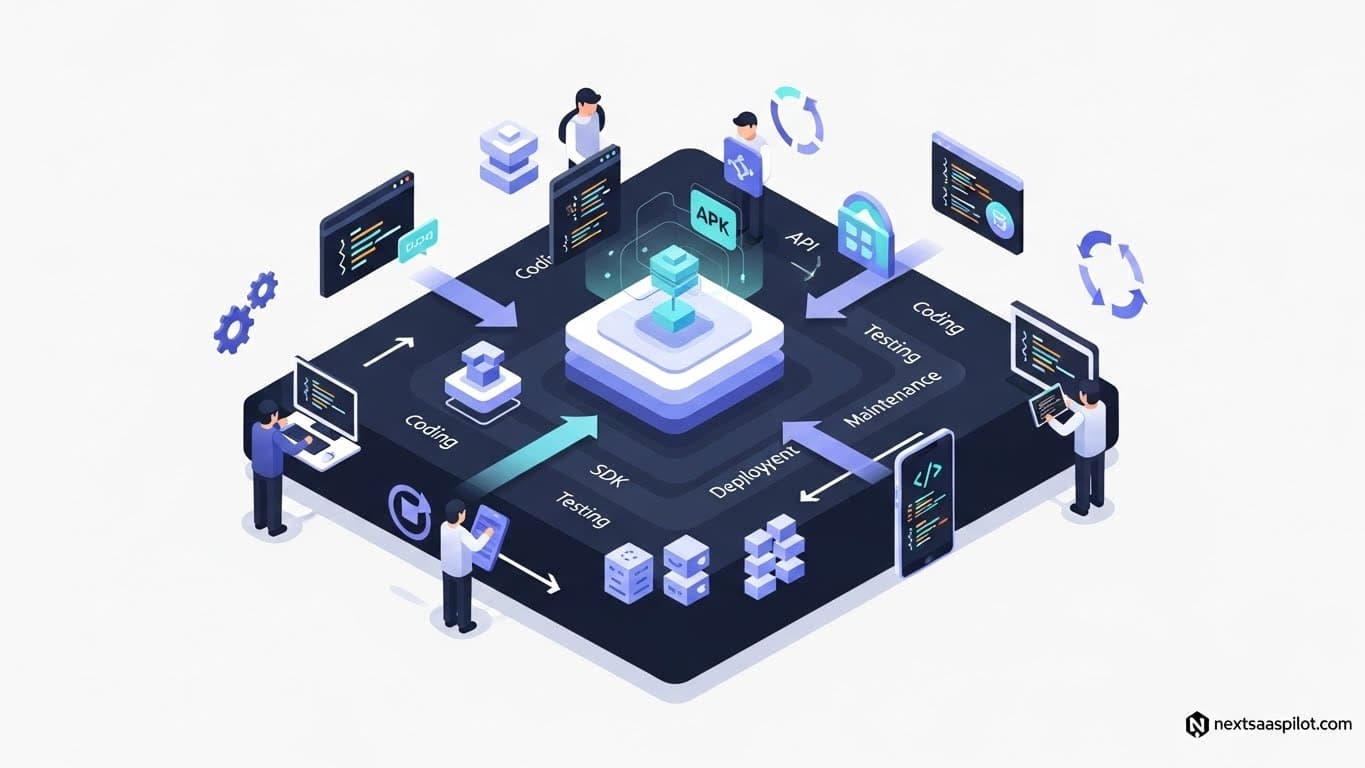
Understanding the concept of a platform in software development is essential for navigating the modern tech landscape. It is no longer just about hardware or operating systems; it is about creating ecosystems where value is created by the connection of users, developers, and data.
In 2025, the distinction between a standalone “tool” and a true “platform” determines a company’s valuation, scalability, and survival. If you are building software, you are either building a platform or you are just a feature on someone else’s. This guide dissects the layers of platform architecture, strategy, and execution.
What Is a Platform in Software Development?
A platform in software development is a foundational hardware or software architecture that acts as a base upon which other applications, processes, or technologies are developed and run. Unlike a standalone application, a platform provides a set of standards, APIs, and tools that allow third-party developers to build new capabilities on top of it.
The term is notoriously slippery because it evolves with technology. In the 1990s, “platform” meant Windows or Mac. In the 2000s, it meant the Web. Today, it encompasses everything from Cloud Infrastructure (AWS) to SaaS platform development ecosystems like Salesforce or Shopify.
The Core Criteria of a Platform:
- Extensibility: Can others build on it?
- Governance: Are there rules (APIs/SDKs) for interaction?
- Ecosystem: Does it connect distinct groups (e.g., app developers and users)?
I once advised a founder who claimed he was building a “platform” simply because his app had a lot of features. I had to correct him: “If I cannot build a plugin for your app that does something you didn’t think of, you don’t have a platform; you have a large product.”
For a foundational definition, Computing platform offers excellent historical context on how this term originated from physical hardware stages.
How Does a Product Differ from a Platform?
A product differs from a platform in its consumption and creation of value. A product is a standalone tool consumed by end-users to solve a specific problem, whereas a platform is an infrastructure that enables external developers to create new solutions, thereby generating value that exceeds the original creator’s inputs.
This distinction is famously summarized by the “Bill Gates Line.” Legend has it that Bill Gates once corrected a Facebook executive who called Facebook a platform, stating: “A platform is when the economic value of everybody that uses it exceeds the value of the company that creates it.”
Comparison: Product vs. Platform
| Feature | Software Product | Software Platform |
| Primary Goal | Solve a specific user problem. | Enable others to solve problems. |
| Value Creation | Linear (Feature additions). | Exponential (Network effects). |
| Users | End Consumers. | Consumers + 3rd Party Developers. |
| Connectivity | Closed / Limited Integrations. | Open APIs / SDKs / Marketplace. |
| Example | A To-Do List App. | The iOS App Store. |
Founders often struggle with how to start a software company because they try to build a platform on day one. Successful platforms almost always start as exceptional products that eventually open up their architecture.
What Are the Different Types of Software Platforms?
The different types of software platforms include Computing Platforms (hardware/OS), Utility Platforms (Search/Cloud), Application Platforms (SaaS ecosystems), and Internal Developer Platforms (IDPs). Each type serves a different layer of the technology stack, ranging from the physical chips processing code to the high-level interfaces used by business teams.
Understanding these layers helps you identify where your project fits in the ecosystem.
1. Computing Platforms (The Foundation)
This is the bedrock. It includes the hardware architecture (like ARM or x86) and the Operating System (Linux, Windows, Android). Without this layer, no code runs.
2. Utility & Cloud Platforms
These provide the “plumbing” of the internet.
- IaaS/PaaS: AWS, Google Cloud, and Azure. They provide the servers and runtime environments.
- Search/Social: Google Search and Facebook are platforms for information distribution.
3. Application Platforms (SaaS Ecosystems)
This is the most relevant category for modern business.
- Salesforce: Started as a CRM, became a platform via the AppExchange.
- Shopify: Started as an e-commerce tool, became a platform via its App Store.
- These align closely with SaaS lifecycle maturity; you eventually evolve into an application platform to reduce churn.
4. Internal Developer Platforms (IDPs)
A rising trend in 2025. This is a platform built by a company’s Ops team for their own developers to self-serve infrastructure. It standardizes how code is deployed within an organization.
What Is the Role of APIs in Platform Architecture?
The role of APIs (Application Programming Interfaces) in platform architecture is to serve as the contract and connective tissue between the platform and external developers. APIs define exactly what data and functions are accessible to third parties, ensuring that the platform remains secure and stable while allowing unlimited innovation on the periphery.
If the database is the brain, the API is the nervous system.
Why APIs Make the Platform:
- Standardization: An API forces you to document your logic.
- Decoupling: It allows the frontend (UI) to change without breaking the backend logic.
- Scale: You can have 1,000 partners hitting your API simultaneously, something you couldn’t manage with manual partnerships.
When designing a SaaS tech stack, prioritizing an “API-First” approach is critical. If you build the UI first and try to slap an API on later, you will fail. The API is the product.
How Do Internal Developer Platforms (IDPs) Improve Efficiency?
Internal Developer Platforms (IDPs) improve efficiency by abstracting complex infrastructure tasks into a self-service portal, allowing developers to spin up environments, databases, and deployments without waiting for the Operations team. This reduces “ticket ops,” minimizes configuration drift, and allows engineers to focus on writing code rather than managing servers.
In the world of software project management, the IDP is the ultimate efficiency unlock.
The “Golden Path”:
An IDP provides a “Golden Path”—a pre-approved way to deploy code.
- Without IDP: Developer asks Ops for a server -> Ops creates ticket -> 3 days later, server is ready.
- With IDP: Developer clicks “Deploy” in the internal portal -> Platform automates the setup via Kubernetes -> Ready in 5 minutes.
This concept is central to “Platform Engineering,” a discipline that has overtaken traditional DevOps in many enterprises.
What Is the Strategic Value of Network Effects?
The strategic value of network effects lies in the self-reinforcing cycle where every new user or developer adds value to all existing users, creating a defensive moat that is nearly impossible for competitors to breach. Platforms leverage these effects to lower customer acquisition costs and increase retention, as users become locked into the ecosystem’s utility.
Two-Sided Network Effects:
- Side A (Users): Join because there are lots of apps/plugins.
- Side B (Developers): Build apps because there are lots of users.
Think of the Apple App Store. You buy an iPhone because it has the best apps. Developers build for iPhone because it has the most paying users. This cycle is the holy grail of SaaS development company strategy. Once the flywheel starts spinning, it runs itself.
How Do You Transition from Product to Platform?
You transition from product to platform by opening your architecture to third parties, typically starting with public APIs and evolving into a marketplace. This process requires a shift in mindset from “hoarding value” to “distributing value,” encouraging partners to build features that you may have otherwise built yourself.
This is a dangerous pivot. If you do it too early, you have no users to attract developers. If you do it too late, competitors may have already captured the ecosystem.
The Transition Roadmap:
- The Hook: Build a killer single-player product (The MVP). See SaaS MVP for strategies here.
- The API: Open up read/write access for power users.
- The Integration: Build the first 5-10 integrations yourself to prove it works.
- The Marketplace: Launch a directory where partners can list their extensions.
Case Study: Slack
Slack didn’t launch as a platform. It launched as a chat tool. Once they reached critical mass, they opened the API. Suddenly, you could pull Jira tickets and GitHub commits into Slack. That integration layer is what killed HipChat.
What Are the Risks of Platform Dependency?
The risks of platform dependency, often called “platform risk,” occur when a business is built entirely on top of another company’s infrastructure (e.g., a Zynga game on Facebook), leaving it vulnerable to sudden API changes, fee hikes, or being banned. While building on a platform offers instant distribution, it grants the host control over your business’s economics and survival.
The “Sherlocked” Effect:
Apple famously introduces features in iOS that render popular third-party apps obsolete (a phenomenon called “Sherlocking”).
- Example: A flashlight app was a huge business in 2009. Apple added a flashlight button to the Control Center. The app business died overnight.
When looking for SaaS website inspiration and business models, be wary of ideas that are merely “features” of a larger platform like Twitter/X or LinkedIn. If they cut off API access, your revenue hits zero.
How Does Multi-Tenancy Impact Platform Architecture?
Multi-tenancy impacts platform architecture by requiring strict logical isolation of data so that a single software instance can serve multiple customers (tenants) securely. This architecture drives cost efficiency and scalability but necessitates complex engineering in database design and security to prevent data leakage between tenants.
In a true SaaS platform, everyone runs on the same code.
The Architecture Challenge:
- Siloed: Separate database for every client. Secure, but hard to maintain.
- Pooled: Shared database with a
TenantIDcolumn. Efficient, but risky if code is buggy.
This architectural decision is the first thing a SaaS development company will ask you to make.
What Is the Future of Platforms in 2025?
The future of platforms in 2025 involves the integration of “Agentic AI,” where the platform does not just provide tools but actively performs work through autonomous agents. We are moving from “Application Platforms” (hosting apps) to “Intelligence Platforms” (hosting reasoning), where the API interface becomes conversational rather than code-based.
We are seeing the rise of the “AI Operating System.”
- Instead of clicking buttons in a CRM platform, you will tell the platform’s AI agent: “Find me all leads in Chicago and email them.”
- The platform then orchestrates the underlying API calls to execute the task.
Final Thoughts
Understanding the “platform” in software development is about understanding leverage. A product adds; a platform multiplies.
Whether you are an engineer building an Internal Developer Platform to speed up your team, or a founder trying to turn your SaaS into the next App Store, the principles are the same: Build a strong foundation, open the doors, and let others build the castle on top of it.