
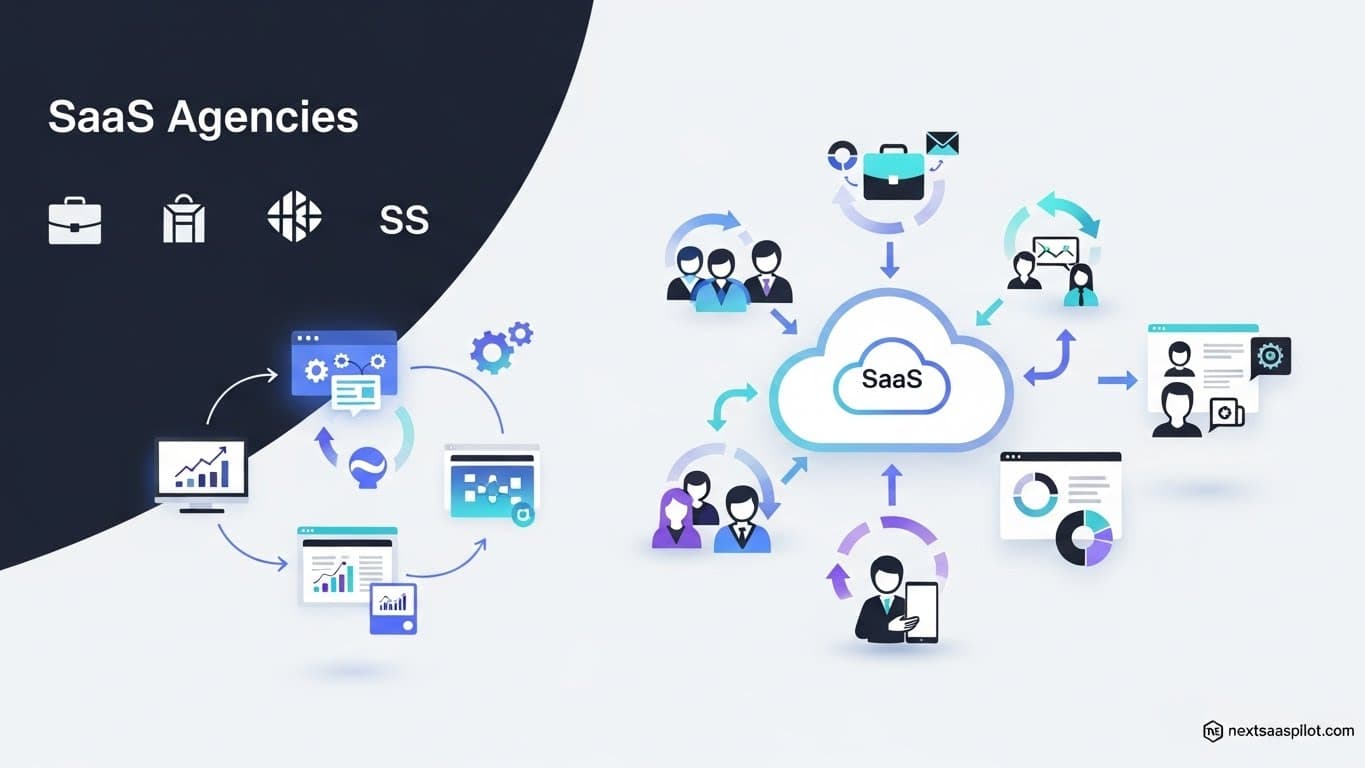
SaaS agencies are specialized firms that accelerate growth for software companies by providing expert marketing strategies or technical development capabilities. In 2025, these partners are no longer just vendors; they are strategic extensions of your team, bridging the gap between “product-market fit” and “market dominance.”
For founders and CROs, the choice of agency often dictates the speed of execution. This guide ranks the top players in both marketing and development, providing a clear roadmap for selecting the right partner to scale your recurring revenue.
What Defines a Top SaaS Agency in 2025?
A top SaaS agency is defined by its vertical specialization, data-driven “revenue operations” (RevOps) focus, and ability to execute outcome-based strategies. Whether for marketing or development, the best agencies in 2025 prioritize “time-to-value,” leveraging AI agents and proprietary frameworks to deliver measurable ARR growth rather than just vanity metrics.
The days of the “generalist digital agency” are over. If an agency claims they can market a local bakery and your enterprise ERP software, run away. The mechanics of B2B SaaS—Customer Acquisition Cost (CAC), Lifetime Value (LTV), and Churn—require a partner who speaks the language of subscription economics.
Key Characteristics:
- Metric Obsession: They don’t report on “traffic”; they report on “Qualified Pipeline” and “MRR.”
- Tech Stack Mastery: They are certified experts in tools like HubSpot, Salesforce, or AWS.
- Agile Velocity: They work in sprints, matching the rapid release cycles of modern software teams.
Top SaaS Marketing Agencies to Scale Growth
Top SaaS marketing agencies include Single Grain, Kalungi, and Refine Labs, which specialize in full-funnel growth strategies ranging from SEO to Demand Generation. These agencies distinguish themselves by moving beyond lead quantity to focus on “pipeline quality,” ensuring that marketing efforts directly contribute to revenue reduction and lower CAC.
Marketing for software is unique. You aren’t selling a physical good; you are selling a promise of future utility. This requires a mix of education, trust-building, and technical authority.
Leading Marketing Partners:
- Single Grain: Known for their “Leveling Up” philosophy.
- Best For: High-growth scale-ups needing rapid SEO and Paid Media execution.
- Key Strength: They own the “smarketing” alignment, ensuring leads actually close.
- Kalungi: The “Full-Service” B2B Specialist.
- Best For: Early-stage companies that need an “outsourced CMO” and marketing team in a box.
- Key Strength: Pay-for-performance models that align their fees with your growth.
- Refine Labs: The Demand Gen revolutionaries.
- Best For: Enterprise SaaS companies tired of the “lead hamster wheel.”
- Key Strength: “Dark Social” attribution—tracking the word-of-mouth revenue that software misses.
Agency Comparison Table:
| Agency | Core Focus | Pricing Model | Best For |
| Single Grain | SEO & Paid Media | Retainer ($10k+) | Scaling B2B/B2C SaaS |
| Kalungi | Outsourced Marketing Team | Flat Fee ($45k+) | Series A Startups |
| Refine Labs | Demand Generation | Retainer ($20k+) | Enterprise B2B |
| SimpleTiger | SEO & Content | Project/Retainer | Technical SaaS Tools |
| Hey Digital | PPC & CRO | Performance % | Landing Page Optimization |
For a deeper dive into how these agencies structure their campaigns, reviewing successful SaaS examples can reveal the specific tactics used by market leaders.
Best SaaS Development Agencies for Product Build
The best SaaS development agencies for product builds are Netguru, BairesDev, and ScienceSoft, known for their expertise in cloud-native architectures and agile delivery. These firms offer more than just coding; they provide “Product-as-a-Service,” handling everything from MVP architecture and UX design to scalable cloud infrastructure and security compliance.
Building the software is the easy part; building scalable software is hard.
Leading Development Partners:
- Netguru: The design-first builders.
- Best For: Fintech and Healthtech startups where UI/UX is a competitive advantage.
- Key Strength: They build products that look consumer-grade but function like enterprise tools.
- ScienceSoft: The enterprise heavyweights.
- Best For: Complex legacy migrations and secure data environments.
- Key Strength: Deep expertise in SaaS security risks, ensuring SOC2 compliance from day one.
- BairesDev: The nearshore talent hub.
- Best For: Staff augmentation. If you need 10 React developers next week, they can deploy them.
- Key Strength: Timezone alignment with US companies (EST/PST).
Dev Shop Comparison Table:
| Agency | Core Focus | Tech Stack | Best For |
| Netguru | MVP & Product Design | Node.js, React, Python | Consumer-facing SaaS |
| ScienceSoft | Enterprise Architecture | Java, .NET, Azure | Regulated Industries |
| BairesDev | Staff Augmentation | Ruby, Go, AWS | Rapid Team Scaling |
| Limeup | UX/UI Design | Figma, Webflow | Early Stage Design |
How Do Marketing Agencies Differ from Development Agencies?
Marketing agencies focus on “Revenue” and “User Acquisition,” optimizing the funnel to drive leads and sales, while development agencies focus on “Product” and “Code Quality,” ensuring the software works reliably and scales securely. Marketing partners chase the customer, whereas development partners chase the feature set and uptime.
It is crucial not to confuse the two, though their work overlaps at the “Product-Led Growth” (PLG) stage.
- Marketing Agency Goal: Lower CAC (Customer Acquisition Cost).
- Development Agency Goal: Lower Technical Debt.
When you hire a dev agency, you are effectively making a SaaS vs on-premise decision: do you build the team internally (on-premise) or rent the talent (SaaS model)?
What Should You Look for in a SaaS SEO Agency?
You should look for a SaaS SEO agency that understands “bottom-of-funnel” intent, technical SEO for web apps, and “Topic Cluster” authority strategies. Avoid agencies that promise quick traffic spikes; instead, prioritize those that build sustainable organic pipelines by targeting high-intent keywords like “competitor alternatives” and “integration use cases.”
SaaS SEO is not about ranking for “CRM.” It is about ranking for “Best CRM for Dentists with Xero Integration.”
The Checklist:
- Technical Chops: Can they render JavaScript properly? (Crucial for Single Page Applications).
- Content Depth: Do they write surface-level fluff, or do they interview your product managers to write technical guides?
- Link Velocity: Do they have relationships with other high-authority SaaS blogs for backlinks?
How Much Do SaaS Agencies Charge in 2025?
SaaS agencies typically charge between $5,000 and $30,000 per month for marketing retainers, while development agencies charge $50 to $150 per hour or fixed project fees ranging from $50,000 to $500,000. Pricing models have shifted toward “performance-aligned” structures, where a portion of the fee is tied to hitting specific ARR or milestone targets.
Pricing Models Explained:
- Retainer (Marketing): You pay a flat monthly fee for a set scope of work (e.g., 4 blog posts + Ad Management).
- Time & Materials (Development): You pay for the hours worked. Best for agile projects with changing scopes.
- Fixed Bid (MVP): “We will build your MVP for $75,000.”
For bootstrapped founders, navigating these costs is critical. Reviewing a SaaS finance course can help you budget for these external expenses effectively, ensuring you don’t burn your runway on agency fees.
What Are the Risks of Hiring the Wrong Agency?
The risks of hiring the wrong agency include wasted capital, significant “technical debt” requiring expensive code rewrites, and potential data security breaches from poor compliance practices. A bad marketing agency can burn your brand reputation with spammy outreach, while a bad dev shop can build a product that is impossible to scale.
Warning Signs:
- No Case Studies: If they can’t show you a similar client they helped, walk away.
- “We Do Everything”: Specialization is key.
- Cheap Rates: Good developers and marketers are expensive. If a rate seems too good to be true ($20/hr), you will pay for it later in bug fixes.
Security is paramount. If a dev agency doesn’t understand the difference between PaaS vs IaaS vs SaaS vs CaaS, they might deploy your app on insecure infrastructure.
Specialized vs. Full-Service: Which Is Better?
Specialized agencies are generally better for specific growth phases or technical challenges, as they offer deep expertise in one area (like PPC or Python), while full-service agencies are better for early-stage startups that need a cohesive “all-in-one” strategy. Specialized partners deliver higher quality work but require more management to coordinate.
The “Horizontal” Dilemma:
Many agencies try to be horizontal SaaS providers—serving everyone. But the best results usually come from vertical experts.
- Choose Specialized: When you need to fix a specific problem (e.g., “My churn is too high”).
- Choose Full-Service: When you have no marketing team and need someone to run the whole show.
How to Transition from Agency to In-House?
Transitioning from agency to in-house requires a 90-day “knowledge transfer” period where the agency documents all workflows, codebases, and account credentials for the new internal team. This handover should be gradual, with the agency shifting from “execution” to “advisory” roles to ensure momentum is not lost during the staffing change.
The Handoff Protocol:
- Code Audit: Have an independent architect review the agency’s code before the contract ends.
- Asset Transfer: Ensure you own the Ad Accounts, Analytics logins, and GitHub repos.
- Training: Have the agency record Loom videos explaining why they set things up the way they did.
Unlike legacy SAS statistical software consultants who might stay for decades, modern SaaS agencies should design themselves out of a job by building you a sustainable engine.
Final Thoughts on Partnership
Choosing a SaaS agency is one of the most critical leverage points for a growing company. The right partner acts as an accelerant, compressing years of learning into months of execution. Whether you are looking to dominate the SERPs with a marketing partner or build the next unicorn with a dev shop, prioritize expertise over cost.
In the software world, cheap is expensive, and expertise is an investment.