
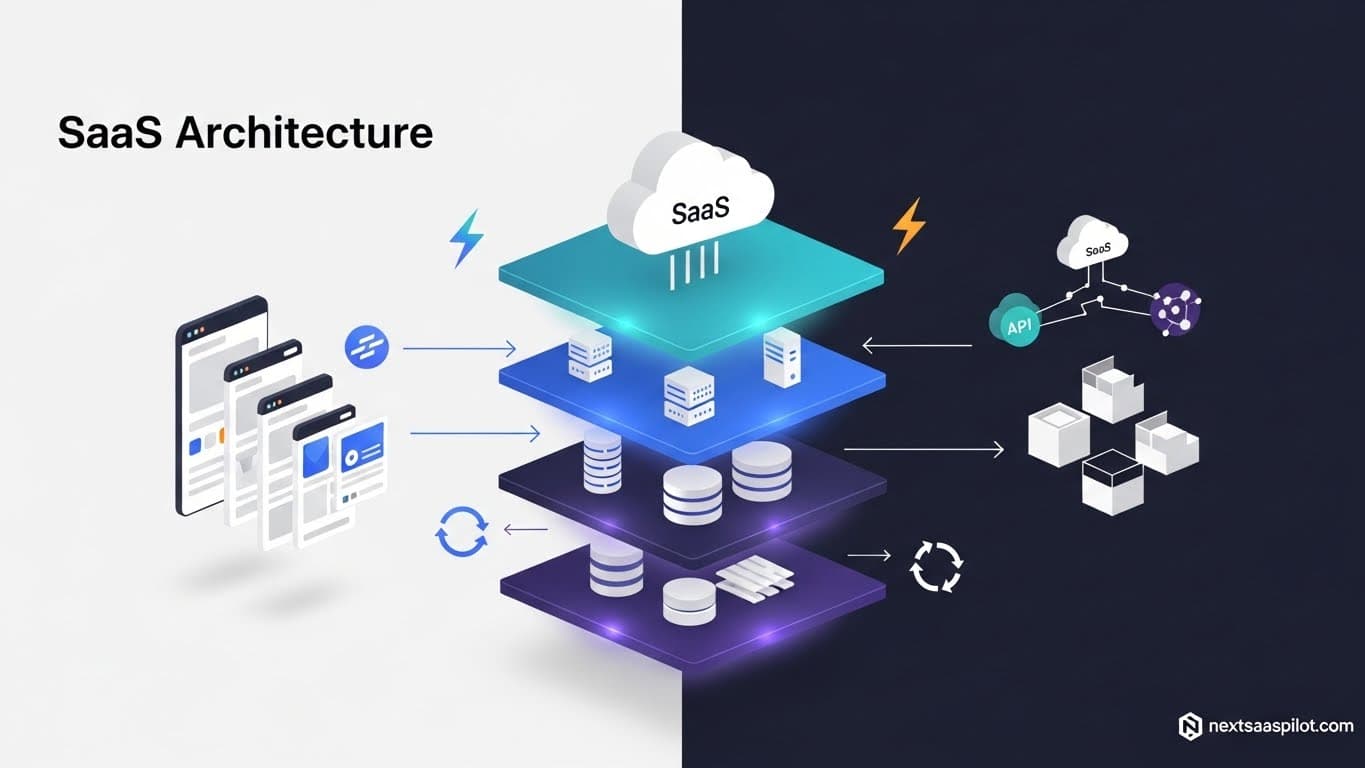
SaaS architecture defines how a software application is structured to serve multiple tenants over the internet efficiently and securely. Unlike traditional on-premise software, a robust SaaS foundation must handle shared resources, data isolation, and automated scaling while maintaining high availability for a global user base.
Building a successful SaaS platform requires more than just clean code; it demands a strategic approach to infrastructure. I have seen brilliant product ideas fail simply because the underlying architecture could not handle the transition from 100 to 10,000 users. Whether you are bootstrapping an MVP or re-platforming for enterprise growth, your architectural decisions today will dictate your profitability tomorrow.

What Is SaaS Architecture and Why Does It Matter?
SaaS architecture refers to the blueprint of software delivery where a vendor hosts applications and makes them available to customers over the internet. It replaces individual installations with a centralized cloud model, enabling rapid updates, seamless scaling, and a subscription-based revenue stream that lowers upfront costs for users.
In the traditional model, you shipped a CD-ROM or a download link. If a bug was found, you prayed users would patch it. In SaaS, you fix it once on the server, and every user gets the update instantly. This shift requires a fundamental rethinking of how we handle databases, security, and deployment pipelines. A well-designed architecture ensures that your saas business model remains viable by keeping infrastructure costs low relative to revenue per user.
What Are the Core Tenancy Models in SaaS?
Tenancy models determine whether your customers share computing resources or operate in isolated environments, directly impacting cost, security, and scalability. The three primary models are single-tenancy (dedicated resources), multi-tenancy (shared resources), and hybrid tenancy, which balances isolation with efficiency.
- Single-Tenant: Every customer gets their own database and server instance. It is expensive but offers maximum security and customization.
- Multi-Tenant: All customers share the same infrastructure and database, logically separated by software. This is the standard for modern SaaS scalability.
- Hybrid-Tenant: Key components like the database are isolated, while compute resources are shared to optimize costs.
Choosing the wrong model is a costly mistake. I recall consulting for a healthcare startup that started with full multi-tenancy to save money. They later spent six months rewriting their data layer because enterprise hospitals refused to sign contracts without physical database isolation.
Comparison of Tenancy Models
| Feature | Single-Tenant | Multi-Tenant | Hybrid |
| Cost | High | Low | Moderate |
| Security | Maximum Isolation | Logical Isolation | Balanced |
| Maintenance | Complex (1 update per tenant) | Simple (1 update for all) | Moderate |
| Scalability | Linear (Slow) | Exponential (Fast) | Flexible |
| Best For | Banks, Government | B2B/B2C tools (e.g., Slack) | Enterprise SaaS |
Monolith vs. Microservices: Which Architecture Is Right for You?
A monolithic architecture bundles all functions into a single deployable unit, offering simplicity for early-stage startups, while microservices break the app into independent services, enabling large teams to scale complex features without blocking each other.
The industry often pushes microservices as the only option, but that is misleading. For a seed-stage startup, a monolith is a superpower. It allows you to refactor code and deploy changes instantly. You should only migrate to microservices when your engineering team grows too large to work on a single codebase effectively, or when specific components (like video processing) require independent scaling.
Don’t optimize for problems you don’t have yet. Start with a “Modular Monolith”—clean code boundaries within a single repo—so you can peel off services later without a total rewrite.
Key Components of a Robust SaaS Infrastructure
A production-ready SaaS infrastructure relies on specialized components like an API Gateway for routing, Identity Management (IdP) for secure auth, a Billing Engine for subscriptions, and a multi-layered storage solution to handle user data efficiently.
Your architecture is only as strong as its weakest component. A standard stack includes:
- Identity & Access Management (IAM): Handles Single Sign-On (SSO) and Role-Based Access Control (RBAC).
- API Gateway: Acts as the front door, managing rate limiting and routing requests to the correct service.
- Billing & Metering: Tracks usage for your saas revenue model, ensuring customers are charged correctly.
- Database Layer: Often a mix of relational (PostgreSQL) for transaction data and NoSQL (DynamoDB) for logs.
- CDN & Object Storage: Delivers static assets and documents globally with low latency.

How Do You Ensure Security in Multi-Tenant Environments?
Security in multi-tenancy requires strict logical isolation techniques, such as Row-Level Security (RLS) in databases and encryption at rest/transit, to prevent “noisy neighbor” issues and ensure that one tenant can never access another tenant’s private data.
Trust is the currency of SaaS. If a user accidentally sees another company’s data, your reputation is destroyed. To prevent this, avoid relying solely on application logic (e.g., WHERE tenant_id = X). Instead, enforce policies at the database level using RLS. This ensures that even if a developer forgets a WHERE clause, the database itself will block unauthorized access.
- Encryption: Use unique encryption keys for high-value tenants (Bring Your Own Key – BYOK).
- Network Isolation: Use Virtual Private Clouds (VPCs) to segment critical services.
- Audit Logging: Keep a tamper-proof record of every data access event for compliance.
Choosing the Right Cloud Provider Strategy (IaaS vs PaaS vs CaaS)
Selecting between Infrastructure as a Service (IaaS), Platform as a Service (PaaS), or Containers as a Service (CaaS) depends on your team’s DevOps maturity and your need for control versus convenience.
- IaaS (AWS EC2, Google Compute Engine): Maximum control. You manage the OS and runtime. Good for specialized workloads.
- PaaS (Heroku, Vercel, AWS Lambda): Maximum speed. You push code; they handle the rest. Ideal for most SaaS MVPs.
- CaaS (Kubernetes, ECS): The middle ground. Portable and scalable, but requires significant maintenance overhead.
Understanding caas vs paas trade-offs is vital. Many teams over-engineer with Kubernetes when a simple PaaS would suffice. For deeper insights into specific providers, review iaas paas y saas ejemplos to see how major players structure their offerings. Furthermore, mastering cloud application management is essential regardless of the model you choose.
Scalability Patterns: Vertical vs. Horizontal Scaling
Vertical scaling involves adding more power (CPU/RAM) to a single server to handle load, while horizontal scaling involves adding more server instances to distribute traffic, which is the preferred method for building resilient, infinite-scale SaaS applications.
Vertical scaling (getting a bigger server) is a temporary fix. It has a hard ceiling. Horizontal scaling (adding more servers) is limitless but adds complexity. You need load balancers to distribute traffic and stateless application logic so that any server can handle any user request.
- Statelessness: Never store user sessions in local server memory. Use Redis or a database.
- Auto-scaling Groups: Automatically spin up new servers during traffic spikes and shut them down when demand drops.
- Database Sharding: Split your database across multiple machines based on Tenant ID to prevent bottlenecks.
The Role of Hybrid SaaS in Modern Architectures
Hybrid SaaS solutions allow sensitive data or critical workloads to remain on a customer’s on-premise infrastructure while leveraging the cloud for updates, analytics, and general management, offering a “best of both worlds” approach for regulated industries.
This pattern is increasingly popular in finance and defense. The SaaS vendor manages the software code (the “Control Plane”) in the cloud, but the actual customer data (the “Data Plane”) resides in the customer’s private data center. This satisfies strict compliance rules while still delivering the ease of SaaS updates.
Financial and Operational Considerations in Architecture
Your architectural choices directly dictate your Cost of Goods Sold (COGS) and gross margins; inefficient resource usage or poor tenancy isolation can inflate infrastructure bills and erode the profitability of your subscription model.
Every database query costs money. Every gigabyte of storage costs money. A saas financial model must account for “Cost Per Tenant.” If a $50/month customer consumes $40/month in server resources, your architecture is flawed.
Implementing a robust subscription based software model requires your tech stack to handle dunning management (failed payments), upgrades, and downgrades gracefully. Additionally, the saas subscription model relies on high uptime; architecture must support zero-downtime deployments to prevent churning customers during maintenance windows.
XaaS and the Future of Software Delivery
Everything as a Service (XaaS) represents the evolution of SaaS architecture into new domains, where AI, hardware, and even human operations are delivered via APIs, requiring architectures that can handle massive concurrency and real-time data streams.
The future is API-first. We are moving beyond simple software to what is xaas, infrastructure, backend, and platforms as a service. This shift demands a flexible saas organizational structure where engineering teams are aligned around specific API products rather than generic layers.
Final Thoughts
SaaS architecture is not merely a technical specification; it is the strategic backbone of your business. The decisions you make regarding tenancy, scaling, and security will determine your ability to move upmarket and serve enterprise clients.
Start simple. Build a modular monolith that solves a specific problem well. But keep your eyes on the horizon. As you scale, evolve your infrastructure to support the weight of your success. In the world of SaaS, your architecture is the only thing that stands between rapid growth and crushing technical debt.