
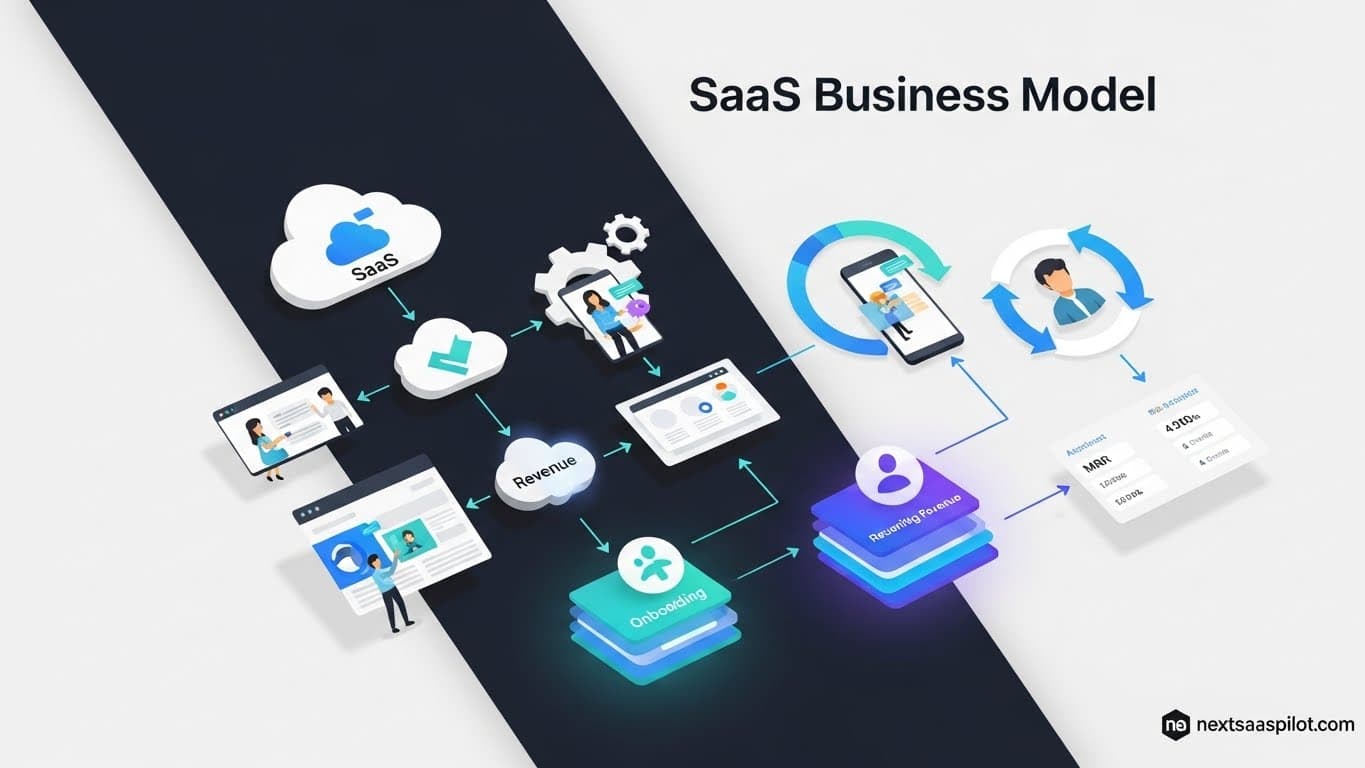
The saas business model has fundamentally rewritten the playbook for how software is built, sold, and scaled in the digital economy. It has shifted the paradigm from selling perpetual licenses to building enduring customer relationships through subscriptions. However, the allure of recurring revenue often masks the profound architectural and operational complexities required to sustain it.
I have advised founders who pivoted from traditional software to SaaS, only to realize that their code was the easy part. The real challenge lies in aligning your technical infrastructure with your financial goals. If your architecture cannot handle multi-tenancy efficiently, your margins will vanish. If your billing engine is rigid, your churn will spike. This guide dissects the symbiotic relationship between the business model and the technology that powers it.
What Defines the SaaS Business Model?
At its core, the SaaS business model is defined by centrally hosted software licensed on a subscription basis, where the vendor handles all maintenance, updates, and security, allowing customers to access the tool via a web browser. This shifts the burden of ownership from the user to the provider.
In the old world, software was a product. You bought it, you owned it, and you were responsible for keeping it running. In the SaaS world, software is a service.
This distinction is critical. It means your saas revenue model is not based on a single transaction, but on the lifetime value (LTV) of the customer. Your success is mathematically tied to retention. Therefore, every architectural decision—from database design to UI latency—must serve the goal of keeping the customer happy month after month.
How Does Architecture Impact the SaaS Business Model?
Your architecture dictates your unit economics; a poorly designed single-tenant system can lead to exorbitant infrastructure costs that erode the gross margins essential for a profitable subscription model. Conversely, a well-optimized multi-tenant architecture acts as a force multiplier for profitability.
I recall a client whose AWS bill was growing faster than their revenue. They had built a separate database for every $19/month customer. This “architectural debt” nearly killed the company.
A scalable saas architecture ensures that adding the 10,000th customer costs significantly less than adding the 10th. It allows you to decouple revenue growth from cost growth, which is the holy grail of SaaS valuation.
Key Components of SaaS Architecture
A robust SaaS architecture relies on a multi-tenant database, an identity provider for secure authentication, a billing engine for subscription management, and an API gateway to route traffic efficiently. These components form the “invisible chassis” of your business.
- Multi-Tenant Database: Stores data for all customers in a way that is logically isolated but physically shared.
- Identity Management (IdP): Manages user logins across thousands of organizations.
- Billing System: The heart of the saas subscription model. It must handle upgrades, downgrades, and dunning (failed payments) automatically.
- API Layer: Allows integrations, which are vital for retention.
Tenancy Models: Single vs. Multi-Tenant
Multi-tenancy involves sharing computing resources among all customers to maximize efficiency, while single-tenancy isolates resources for each customer to maximize security and customization. The choice between them is a trade-off between margin and compliance.
- Multi-Tenant: High margins, fast updates. Ideal for B2SMB (Small to Medium Business).
- Single-Tenant: Lower margins, high customization. Required for Enterprise clients in regulated industries (Finance, Healthcare).
Some companies adopt a Hybrid SaaS model, where the core software is shared, but the data storage is isolated. This allows them to sell to enterprise clients without sacrificing the operational efficiency of a single code base.
The Financial Engine: Recurring Revenue
The SaaS model runs on recurring revenue (MRR/ARR), which requires a relentless focus on minimizing churn and maximizing Customer Lifetime Value (LTV) through continuous product improvement. Unlike a one-time sale, the sale in SaaS never truly ends.
Your saas financial model looks different from a traditional business. You spend heavily upfront to acquire a customer (CAC), and you recover that cost over time.
This “J-Curve” cash flow dynamic means your architecture must be reliable. If your system goes down, you don’t just lose a sale; you lose the trust that sustains the subscription. High availability (99.9% uptime) is not an IT metric; it is a revenue metric.
Scalability: The Technical Requirement for Growth
Scalability in SaaS means the ability to handle exponential user growth without a linear increase in costs or performance degradation; this is achieved through horizontal scaling, microservices, and efficient database indexing.
If your marketing team succeeds and doubles your user base overnight, can your software handle it?
- Vertical Scaling: Buying bigger servers. Expensive and limited.
- Horizontal Scaling: Adding more servers. The SaaS standard.
Implementing cloud application management strategies like auto-scaling groups ensures that you only pay for the infrastructure you need at that exact moment, protecting your margins during quiet periods.
Subscription Management and Billing
A flexible billing architecture allows for complex pricing strategies like tiered plans, usage-based billing, and “freemium” models, which are essential for capturing different segments of the market.
Hardcoding your pricing is a death sentence. Your engineering team should build a flexible metering system that feeds into your billing engine. This allows the business team to experiment with pricing (e.g., charging per user vs. per gigabyte) without requiring a code deploy.
A robust subscription based software model handles the entire lifecycle:
- Trial start.
- Conversion to paid.
- Seat expansion (Upsell).
- Churn/Cancellation.
Security and Compliance in SaaS
Security is the foundation of trust in the SaaS model; a single breach can destroy your reputation and cause mass churn, making robust encryption, role-based access control (RBAC), and compliance (SOC 2, GDPR) non-negotiable.
In a multi-tenant environment, “Cross-Tenant Data Leakage” is the ultimate nightmare. You must implement rigorous testing to ensure Tenant A never sees Tenant B’s data. This often involves Row-Level Security (RLS) at the database layer.
Furthermore, as you move upmarket, enterprise customers will demand proof of your security posture. Your saas organizational structure should likely include a dedicated security officer or compliance lead earlier than you think.
The Role of XaaS in the Future
Everything as a Service (XaaS) expands the SaaS model beyond software to include platforms, infrastructure, and even operational processes delivered via the cloud, creating a hyper-connected ecosystem of services.
We are seeing a shift where SaaS companies consume other SaaS products to build their own. You use Stripe for payments (SaaS), AWS for compute (IaaS/PaaS), and Twilio for SMS (CPaaS). Understanding what is xaas helps you visualize your product not as an island, but as a node in a larger network.
Deciding Between PaaS, IaaS, and CaaS
Choosing the right underlying cloud model—Platform as a Service (PaaS) for speed, Infrastructure as a Service (IaaS) for control, or Containers as a Service (CaaS) for portability—is a strategic decision that impacts your team’s agility.
- PaaS (e.g., Vercel/Heroku): Best for early-stage SaaS. Focus on code, not servers.
- CaaS (e.g., Kubernetes): Best for scaling complex microservices. See caas vs paas for a detailed breakdown.
- IaaS (e.g., EC2): Best for specialized workloads needing raw control.
Reviewing iaas paas y saas ejemplos can help clarify which layer of the stack your team should manage versus what you should outsource to a cloud provider.
Conclusion
The saas business model thrives on alignment. Your architecture is not just a technical implementation; it is the physical manifestation of your business strategy.
If you want to sell to enterprises, build for isolation and security. If you want to sell to the masses, build for multi-tenancy and cost efficiency. The winners in this space are not the ones with the fanciest features, but the ones whose architecture enables their business model to scale profitably.