
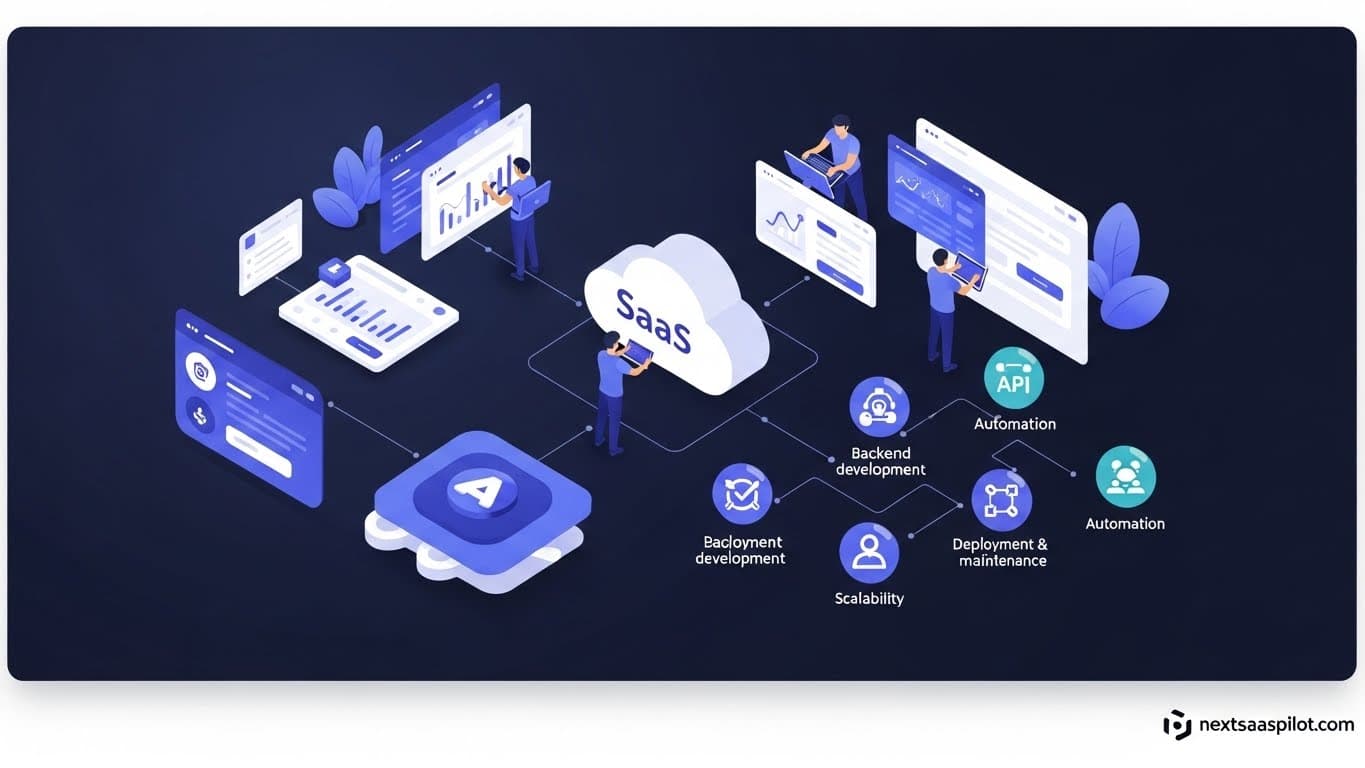
Choosing the right SaaS development company is one of the most critical decisions a founder will make. It’s not just about finding coders; it’s about partnering with an experienced team that understands recurring revenue, multi-tenancy, and the relentless pressure of the SaaS lifecycle.
In 2025, the market is saturated with agencies claiming expertise in SaaS. However, many are simply generalist software houses rebranding. This guide provides a battle-tested framework for vetting agencies, asking the right questions, and ensuring your investment delivers a scalable, market-ready product, not just a pile of code.
What Is a SaaS Development Company and Why Hire One?
A SaaS development company specializes in building and maintaining cloud-based software products designed for subscription models. You hire one to gain immediate access to a full team of designers, developers, and project managers without the overhead of hiring in-house, accelerating your time to market and ensuring best practices in architecture and security.
Many founders make the mistake of hiring a cheap freelancer or a generalist agency. This is a false economy. SaaS has unique architectural demands.
Why Specialization Matters: I once worked with a startup that hired a generalist web agency. They built a “SaaS” where every new customer required a manual server setup and a duplicate codebase. Within six months, their maintenance costs were astronomical, and they couldn’t push updates. A specialized SaaS development company would have designed a multi-tenant architecture from day one.
Key Benefits of Hiring a Specialist:
- Time to Market: Launch your SaaS MVP in months, not years.
- Expertise: Access to senior architects and designers who understand multi-tenancy, security, and scalability.
- Cost Efficiency: Avoid the high salaries, benefits, and recruitment costs of an in-house team.
When Should You Consider Hiring a SaaS Development Company?
You should consider hiring a SaaS development company when you lack the internal technical expertise to build a complex product, need to accelerate your time-to-market significantly, or require specialized skills like advanced cloud architecture or specific industry compliance (e.g., HIPAA, SOC 2).
Typical Scenarios:
- Non-Technical Founder: You have a brilliant idea but no coding skills. An agency acts as your interim CTO.
- Speed to Market: You need to launch an MVP quickly to beat competitors or seize a market opportunity.
- Scaling Existing Product: Your in-house team is swamped with maintenance, and you need an external team to build a new feature module or rewrite a legacy component.
- Specialized Expertise: You need a specific integration (e.g., AI/ML, complex blockchain) that your generalist team cannot handle.
If you are a technical founder, an agency can still be invaluable for augmenting your team or tackling non-core features, freeing your internal team for critical IP.
What Are the Key Qualities to Look for in a SaaS Development Partner?
Look for a SaaS development partner with demonstrable experience in building scalable, multi-tenant applications, a strong portfolio of live SaaS products, transparent communication practices (daily standups, shared project management tools), and a deep understanding of cloud infrastructure (AWS/Azure) and modern DevOps practices.
This is not a beauty contest based on a pretty website. This is about deep technical capability.
The Non-Negotiables:
- SaaS-Specific Portfolio: Do they have live, revenue-generating SaaS products they have built from scratch? Ask for case studies.
- Technical Acumen: Do they understand platform in software development concepts like multi-tenancy, microservices, and API design?
- Communication: Are they responsive? Do they use tools like Slack and Jira daily? Can you talk directly to the engineers?
- Process: Do they follow an Agile methodology with transparent sprints and clear deliverables? (See software project management for more on this).
- Post-Launch Support: What happens after launch? Do they offer maintenance and scaling?
Red Flag: If an agency only talks about “features” and not “architecture” or “scalability,” run. They are a generalist web developer, not a SaaS specialist.
How Do You Vet a SaaS Development Company’s Technical Capabilities?
You vet a SaaS development company’s technical capabilities by reviewing their technology stack expertise (e.g., Node.js, Python, React), inquiring about their cloud infrastructure experience (AWS, Azure, GCP), and examining their approach to security, scalability, and automated testing (CI/CD pipelines). Request to see their internal documentation standards.
This is where you need to ask deep, technical questions. If you are non-technical, bring an advisor or fractional CTO.
Technical Deep Dive Questions:
- “What is your approach to multi-tenancy in the database?” (Look for “pooled” with RLS or “database per tenant” for high security.)
- “Describe your CI/CD pipeline for a typical SaaS project.” (They should talk about automated testing, staging environments, and one-click deployments.)
- “How do you handle data backups and disaster recovery?” (Look for daily backups, geo-redundancy.)
- “What is your typical SaaS tech stack and why?” (Avoid agencies promoting obscure frameworks.)
- “How do you address security concerns like XSS, SQL injection, and DDoS protection?” (They should mention firewalls, encryption, and regular security audits.)
What Pricing Models Do SaaS Development Companies Use?
SaaS development companies primarily use “Time & Materials” (T&M) for projects with evolving requirements, or “Fixed-Price” for projects with rigidly defined scopes (like an MVP). T&M offers flexibility but requires careful budget management, while Fixed-Price offers predictability but often leads to costly change orders.
Pricing Model Comparison:
| Model | Pros | Cons | Best For |
| Time & Materials (T&M) | Flexible, iterative, no scope creep. | Budget can fluctuate, requires active management. | Agile development, complex products. |
| Fixed-Price | Predictable budget, clear deliverables. | Inflexible, change orders are costly, encourages shortcuts. | Simple MVPs, clearly defined features. |
My Recommendation:
For a complex SaaS platform development, T&M is almost always better. Fixed-price contracts often lead to agencies cutting corners or charging exorbitant fees for minor changes. Start with a fixed-price MVP, then transition to T&M.
How to Evaluate Their Design and User Experience (UX) Skills?
Evaluate their design and UX skills by reviewing their portfolio for intuitive interfaces, requesting wireframes and prototypes during the proposal phase, and assessing their process for user research and feedback integration. A good agency understands that SaaS success hinges on exceptional onboarding and a seamless user journey.
Users do not pay for code; they pay for a great experience.
Design Red Flags:
- No Case Studies: If they do not show how their designs solved a specific business problem, be wary.
- Static Mockups Only: They should show interactive prototypes (Figma, Adobe XD) that you can click through.
- Generic Templates: If all their past projects look the same, they lack originality.
Look for a partner who understands the psychology of a SaaS website inspiration and can translate complex functionality into simple, elegant workflows.
What Legal and Contractual Aspects Are Crucial?
Crucial legal and contractual aspects include clear intellectual property (IP) ownership transfer, well-defined service-level agreements (SLAs) for post-launch support, and robust confidentiality (NDA) clauses. Ensure the contract specifies payment terms, milestones, and mechanisms for conflict resolution to protect both parties.
The IP Clause: This is non-negotiable. Ensure that upon final payment, all source code and design assets are fully transferred to you. Many agencies try to retain ownership or charge extra for it.
SLAs (Service Level Agreements): What happens if your app crashes at 3 AM?
- Response Time: How quickly will they acknowledge the problem? (e.g., 1 hour).
- Resolution Time: How quickly will they fix it? (e.g., 4 hours for critical bugs).
Offshoring Concerns: If they are using offshore talent, ask about data privacy regulations and security protocols in those regions.
How Do You Manage Communication and Project Workflow?
You manage communication by establishing a single point of contact (e.g., a dedicated project manager), holding regular stand-up meetings (daily or bi-weekly), and using shared project management tools (Jira, Linear) for transparent task tracking. Over-communication is key; assume nothing and document everything.
Best Practices for Collaboration:
- Dedicated Slack Channel: One channel for urgent comms.
- Weekly Syncs: Review progress, blockers, and plan the next sprint.
- Shared Documentation: Use Notion or Confluence for requirements.
The software project management methodology they use is paramount. If they are still using Waterfall, they are probably not a good fit for SaaS.
What Post-Launch Support and Maintenance Should You Expect?
Expect a SaaS development company to offer ongoing post-launch support including bug fixes, security patches, performance monitoring, and server maintenance, often under a separate monthly retainer. A reputable partner should also provide guidance on future scaling, feature enhancements, and technical debt management.
The launch is not the finish line. It is the beginning.
Ongoing Services:
- Bug Fixing: SLA-driven resolution for critical issues.
- Security Audits: Regular penetration testing to find vulnerabilities.
- Scalability Consulting: Help with architecture when user load grows.
- Feature Development: Ongoing development of new modules.
The Handover:
If you plan to eventually build an in-house team, ask the agency about their handover process. Will they train your new developers? Provide detailed code documentation?
Can You Build a No-Code SaaS with an Agency?
Yes, you can build a no-code SaaS with an agency specializing in platforms like Bubble or Webflow. This route offers incredibly fast development cycles and significantly lower costs than traditional coding agencies, making it ideal for founders who want to validate an MVP quickly before investing in a custom codebase.
Many agencies now specialize in no-code SaaS development. This is an excellent option for non-technical founders or those with tight budgets.
Benefits of a No-Code Agency:
- Speed: Launch in weeks, not months.
- Cost: Significantly cheaper than traditional dev.
- Validation: Get a functional product to market quickly.
Final Thoughts
Choosing a SaaS development company is like choosing a co-founder for a period. Do your homework. Ask the hard questions. Check references. And trust your gut.
The right partner can accelerate your journey from idea to exit. The wrong one can sink your dream.