
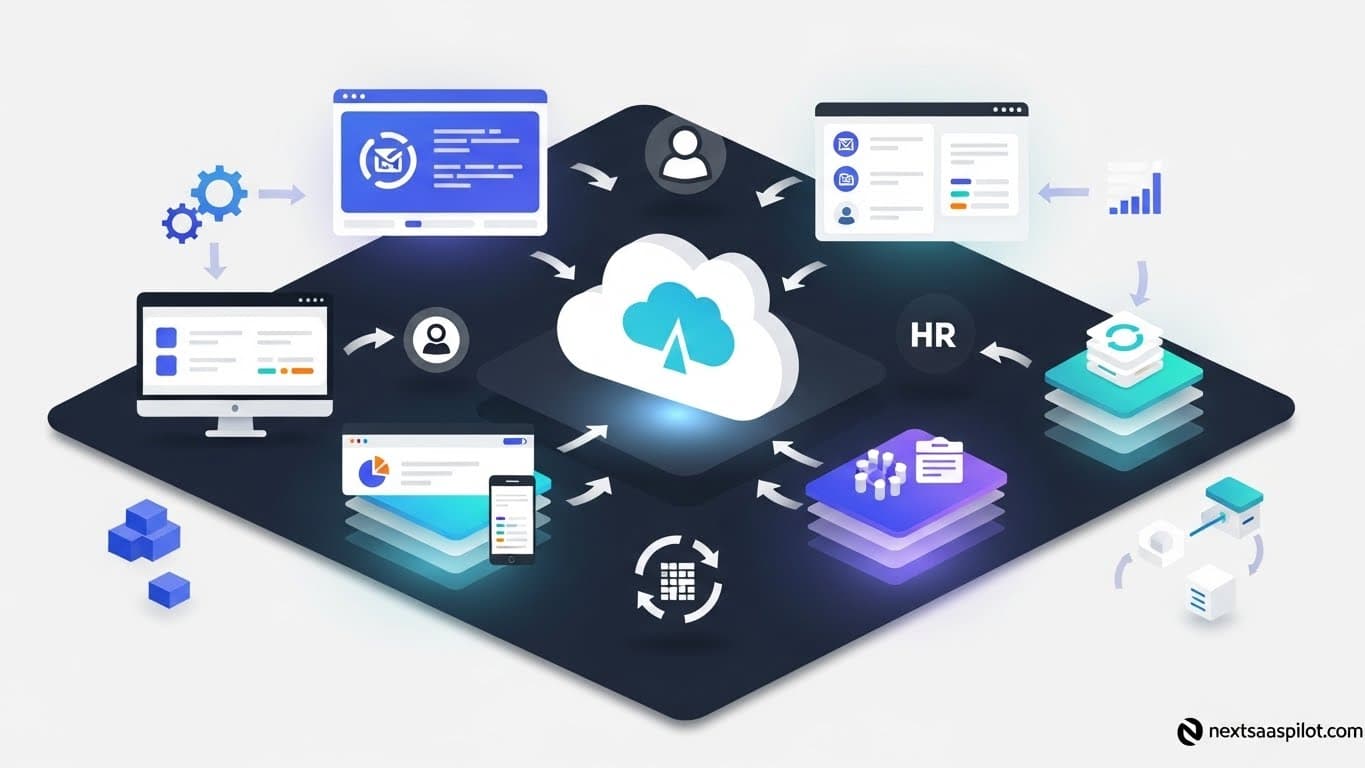
SaaS enterprise software has evolved from simple cloud-based tools to autonomous, AI-driven platforms that power the world’s largest organizations. In 2025, the definition of “best” has shifted: it is no longer just about feature lists, but about “Agentic AI”—software that doesn’t just record data, but actively performs tasks, predicts outcomes, and secures itself against threats.
For modern CTOs and CIOs, selecting the right stack is the difference between operational paralysis and exponential growth. This comprehensive guide analyzes the top-tier solutions across ERP, CRM, and HR, backed by 2025 market data and implementation realities.
What Defines “Enterprise-Grade” SaaS in 2025?
Enterprise-grade SaaS is defined by three non-negotiable pillars: autonomous AI capabilities (Agentic workflows), rigorous security compliance (ISO 42001 & SOC2), and seamless interoperability via robust APIs. Unlike SMB tools, these solutions must support thousands of concurrent users, multi-entity global operations, and data sovereignty requirements.
The era of “dumb” software is over. In 2025, if your ERP cannot automatically reconcile inter-company transactions or your CRM cannot autonomously qualify leads, it is already obsolete.
The “Enterprise” Checklist:
- Scalability: Can it handle 10TB+ of data and 50,000+ users without latency?
- AI Governance: Does it adhere to the new ISO/IEC 42001 standards for responsible AI?
- Customization: Can you modify the codebase or build custom apps on top (PaaS capabilities) without breaking the upgrade path?
I recently consulted for a logistics firm that migrated from a legacy on-premise system to a modern SaaS ERP. They assumed “cloud” meant “automatic.” They learned the hard way that SaaS enterprise software requires a fundamental shift in process, not just technology.
Which ERP Systems Rule the Enterprise Market?
The ruling ERP systems for the enterprise market are SAP S/4HANA, Oracle NetSuite, and Microsoft Dynamics 365. These platforms dominate because they offer “composable” architectures, allowing global corporations to modularly add finance, supply chain, and manufacturing capabilities as needed.
1. SAP S/4HANA Cloud
SAP remains the gold standard for manufacturing and heavy industry.
- Best For: Complex global supply chains and Fortune 500 manufacturing.
- 2025 Upgrade: Their “Joule” AI copilot now automates up to 40% of routine financial closing tasks.
- The “Moat”: If you have 50 subsidiaries in 30 countries with different tax laws, SAP handles the consolidation better than anyone.
2. Oracle NetSuite
NetSuite is the preferred choice for high-growth tech companies and mid-market enterprises scaling toward IPO.
- Best For: One-world financial consolidation and inventory management.
- Key Feature: “SuiteSuccess” implementation methodology that gets companies live in 100 days, a stark contrast to the multi-year deployments of the past.
3. Microsoft Dynamics 365
Microsoft wins on ecosystem integration. If your company runs on Office 365 and Azure, Dynamics is the logical choice.
- Best For: Organizations wanting a unified data model between their CRM and ERP.
- Integration: It natively talks to Excel and Teams, meaning users can update ERP records directly from a spreadsheet or chat window.
For a broader look at the players, check our cloud applications list.
What Are the Top Enterprise CRM Solutions?
The top enterprise CRM solutions are Salesforce, HubSpot Enterprise, and Microsoft Dynamics 365 Sales. While Salesforce remains the market share leader with its vast AppExchange ecosystem, HubSpot has aggressively moved upmarket with powerful custom objects and AI agents that rival legacy complexity.
1. Salesforce (Sales Cloud & Agentforce)
Salesforce has pivoted from a database to an “action engine.”
- The Shift: With the launch of Agentforce in 2025, Salesforce agents can now autonomously negotiate refunds or schedule meetings.
- Why It Wins: The ecosystem. There is a plugin for literally everything.
- Caution: Implementation costs can be 3x the license cost.
2. HubSpot (Sales Hub Enterprise)
Once just for SMBs, HubSpot is now a legitimate enterprise contender.
- Best For: Companies that want “usability” to be their competitive advantage.
- Adoption Rate: HubSpot typically sees 90%+ user adoption within 30 days, compared to ~50% for Salesforce.
For specific SaaS product ideas tailored to CRM extensions, the market is currently hungry for niche plugins that sit on top of these giants.
Which HRM Platforms Handle Global Workforce Management Best?
The best HRM platforms for global workforce management are Workday, Rippling, and Deel. Workday is the incumbent for massive headcount organizations, while Rippling and Deel have revolutionized the “Employer of Record” (EOR) model, allowing enterprises to hire and pay staff in 150+ countries instantly.
1. Workday
The definitive choice for the Fortune 500.
- Strength: Deep financial and human capital management (HCM) unification. It links headcount planning directly to the P&L.
- 2025 Feature: AI-driven skills ontology that automatically maps employee skills to open internal roles to improve retention.
2. Rippling
Rippling is eating the mid-market by automating IT and HR together.
- The “Magic”: When you hire someone in Rippling, it doesn’t just add them to payroll; it ships them a laptop, creates their email, and provisions their Slack account automatically.
3. Deel
The leader in global distributed teams.
- Best For: Enterprises with a “hire anywhere” strategy. Deel handles the legal compliance, local taxes, and benefits for contractors and employees globally.
How Is “Vertical SaaS” Disputing the Enterprise Market?
Vertical SaaS is disrupting the enterprise market by offering hyper-specialized, industry-specific workflows that generalist platforms cannot match. Leaders like Veeva (Pharma), Procore (Construction), and Toast (Hospitality) are winning because they come pre-configured with regulatory compliance and industry best practices out of the box.
Generalist tools are “a mile wide and an inch deep.” Vertical tools are “an inch wide and a mile deep.”
Top Vertical Leaders 2025:
- Veeva Systems: Owns the life sciences cloud. Their “Vault” platform manages clinical trials with FDA-compliant audit trails that Salesforce cannot easily replicate.
- Procore: The operating system for construction. It connects the site manager’s iPad to the CFO’s ledger, handling complex lien waivers and blueprints.
- ServiceTitan: Dominates the trades (HVAC, plumbing) by combining field dispatch with enterprise-grade accounting.
We analyze more of these niche players in our deep dive on cloud application SaaS providers.
What Are the Key Enterprise Trends for 2025?
Key enterprise trends for 2025 include the rise of “Agentic AI” that performs independent work, the enforcement of ISO 42001 AI governance standards, and the “Great Consolidation” of SaaS stacks to reduce bloat. CIOs are actively cutting redundant tools to fund higher-value AI initiatives.
1. Agentic AI & The “Service-as-Software” Shift
We are moving from “Software as a Service” to “Service as Software.” You don’t just buy a tool to send emails; you buy an AI agent that runs your email marketing.
- Example: Microsoft Copilot in Dynamics 365 Supply Chain can now predict inventory shortages and draft purchase orders for human approval.
2. ISO/IEC 42001 Compliance
This is the new SOC2.
- What it is: The international standard for Artificial Intelligence Management Systems.
- Impact: Enterprise buyers in 2025 are demanding vendors be ISO 42001 certified to prove they have guardrails against AI hallucinations and bias.
3. The “Platformization” of Security
Point solutions are dying. Companies are consolidating onto platforms like CrowdStrike or Palo Alto Networks that cover endpoint, cloud, and identity security in one pane of glass.
Implementation: Stories from the Front Lines
Successful implementation relies on “Change Management” more than code. Real-world success stories, like Old Mutual’s digital adoption or Domina’s use of Vertex AI, prove that engaging users early and simplifying workflows are the strongest predictors of ROI. Conversely, ignoring data migration cleanup is the #1 cause of failure.
Success Story: The “Digital Twin” Logistics Win
- Company: Domina (Logistics)
- The Win: They used Google Cloud’s Vertex AI to build a “digital twin” of their shipping network.
- Result: By predicting package returns and automating address validation, they improved delivery effectiveness by 15%.
- Lesson: They didn’t just buy software; they used SaaS to model their business.
Cautionary Tale: The “Big Bang” Failure
I witnessed a manufacturing client try to go live with a new ERP across 12 global factories on the same day—a “Big Bang” rollout.
- The Error: They underestimated data format differences between their German and US plants.
- The Crash: Production halted for 4 days. Trucks were turned away.
- The Fix: We had to roll back to the legacy system and spend 3 months cleaning data.
- Takeaway: Always use a phased rollout. Start with a pilot site, learn, fix, and then scale.
The “FAME” Framework for Adoption:
- Focus on one critical workflow first.
- Automate the drudgery to get quick wins.
- Measure success publicly.
- Expand to other departments.
How Do You Measure ROI on Enterprise SaaS?
You measure ROI on enterprise SaaS by calculating “Time to Value” (TTV) and “Operational Efficiency Gains,” rather than just license cost savings. True ROI comes from labor productivity—how many hours were saved or how much faster revenue was realized—minus the Total Cost of Ownership (TCO).
The 2025 ROI Formula:
$$\text{SaaS ROI} = \frac{(\text{Value of Labor Saved} + \text{Revenue Increase}) – (\text{License Cost} + \text{Implementation Cost})}{\text{Total Cost}} \times 100$$
Real-World Metrics:
- NPS (Net Promoter Score): If employees hate the software, they won’t use it. Low usage = 0 ROI.
- Ticket Deflection: For service tools, how many tickets did the AI handle without a human?
- Closing Speed: For CRM, did the “quote-to-cash” cycle shorten?
For those looking to build a career in managing these metrics, checking out a SaaS certification can provide the framework needed to lead these evaluations.
Final Thoughts
The best company softwares today are not just tools; they are teammates. Whether you are deploying SAP for a multinational or HubSpot for a scaler, the goal is the same: to build an “autonomous enterprise” where software handles the routine, and humans handle the strategy.
As you evaluate these vendors, look beyond the sales pitch. Ask for their ISO 42001 certification. Ask to see their “Agentic” roadmap. And most importantly, ask to speak to a customer who had a terrible implementation—and ask how the vendor fixed it. That will tell you more than any demo ever could.
For a deeper historical context on how these systems evolved, Enterprise Software is an excellent resource.