
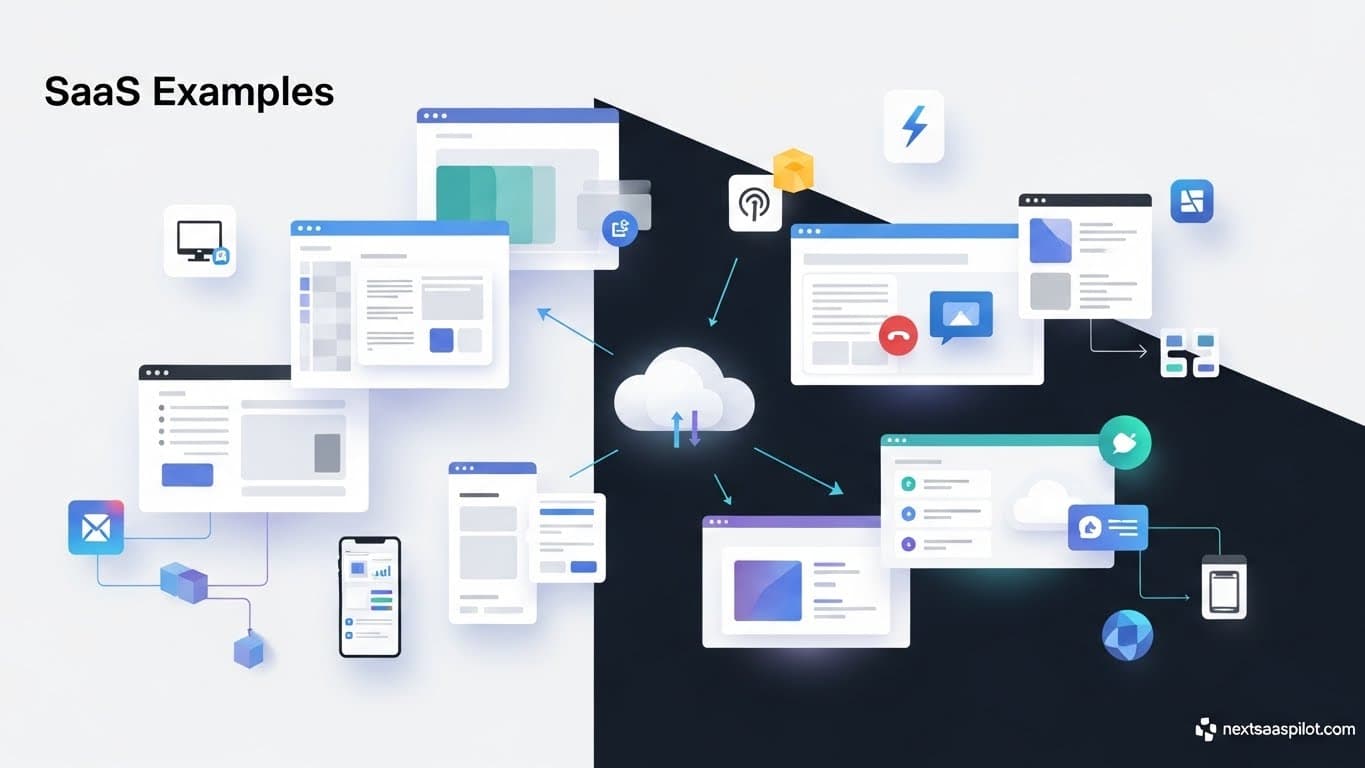
Understanding the diverse landscape of saas examples is the fastest way to grasp the magnitude of the cloud computing revolution. Software as a Service (SaaS) has fundamentally shifted how businesses operate, moving us from the era of purchasing expensive CD-ROMs to subscribing to agile, cloud-hosted platforms. Whether you are a startup founder looking for product ideas or a CTO evaluating enterprise tools, analyzing successful SaaS models provides the blueprint for modern digital infrastructure.
In my years consulting for tech firms, I have seen companies struggle not because of poor technology, but because they failed to understand the business model and user expectations set by industry giants. This guide dissects the top SaaS platforms, categorizes them by function, and explains the economic engines that power them.
What Exactly Defines a SaaS Platform?
SaaS is a software distribution model where a third-party provider hosts applications and makes them available to customers over the Internet, usually via a web browser. Unlike traditional software that requires installation on individual computers, SaaS eliminates the need for hardware maintenance and manual updates.
In the past, if you wanted a CRM, you bought servers, hired IT staff, and installed the software. Today, you simply log in. This shift reduces the Total Cost of Ownership (TCO) and allows for rapid scaling.
The core characteristics include:
- Multi-tenancy: All users share a single infrastructure code base.
- Subscription-based: Payments are recurring (monthly or annually).
- Centralized updates: The vendor patches the software remotely; users always have the latest version.
For a deeper dive into the foundational concepts, you can explore what is saas and the specific benefits of saas that drive adoption.
What Are the Best Horizontal SaaS Examples?
Horizontal SaaS products are broad platforms designed to serve a wide range of industries regardless of their specific niche, focusing on common business problems like marketing, communication, or accounting. These tools are “industry agnostic” and rely on massive volume to generate revenue.
The most prominent examples include:
- Salesforce: The undisputed king of CRM. It works for a nonprofit just as well as it works for a Fortune 500 bank.
- Slack: A communication hub that replaces email for internal teams.
- HubSpot: A marketing and sales platform that invented “Inbound Marketing.”
- Zoom: Video conferencing that became a household name.
- Microsoft 365: The cloud version of the classic Office suite.
Horizontal SaaS is often harder to break into today because the market leaders have established massive moats. However, understanding horizontal saas is crucial because these platforms often set the UI/UX standards for the rest of the industry.
What Are Top Vertical SaaS Examples?
Vertical SaaS refers to software solutions targeted at a specific industry or niche, such as construction, healthcare, or restaurants, offering specialized features that broad horizontal platforms cannot match.
While Salesforce (Horizontal) can technically be used by a construction company, it lacks blueprints and compliance tools out of the box. Vertical SaaS fills this gap.
Key Examples:
- Procore: Specifically designed for construction project management.
- Veeva: CRM and data management for the pharmaceutical and life sciences industry.
- Toast: Point of sale and management software built strictly for restaurants.
- Clio: Practice management software for law firms.
Vertical SaaS is currently one of the hottest areas for saas product ideas because the customer acquisition cost is often lower, and churn is lower due to the specialized nature of the tool.
Which B2B SaaS Products Dominate the Enterprise?
Enterprise B2B SaaS products are robust, scalable platforms designed to handle complex workflows, high security requirements, and thousands of concurrent users within large organizations. These are high-ticket items often requiring long sales cycles.
Selling to the enterprise requires more than just good code; it requires compliance, uptime guarantees, and integration capabilities.
Major Enterprise Players:
- ServiceNow: Digital workflows for IT service management (ITSM).
- Workday: Human capital management and financial management.
- Atlassian (Jira/Confluence): Project tracking for software development teams.
- Snowflake: Data cloud warehousing.
These companies often fall under the category of public saas companies, meaning their financials are visible, offering a masterclass in SaaS metrics. You can find comprehensive cloud applications list to see how deep this market goes.
How Do SaaS Business Models and Pricing Work?
SaaS business models rely on recurring revenue streams, typically structured around Freemium, Flat-rate, Tiered, or Usage-based pricing strategies to maximize customer lifetime value.
Your pricing strategy is your product’s packaging. Here is how the top examples do it:
- Freemium (Dropbox, Slack): You get a basic version for free forever. The goal is to lower the barrier to entry and upsell power users.
- Tiered Pricing (Mailchimp, HubSpot): Good, Better, Best. Features are gated behind higher price points (e.g., “Basic,” “Pro,” “Enterprise”).
- Usage-Based (AWS, Twilio, Snowflake): You pay for what you use (e.g., per gigabyte, per SMS, or per API call). This aligns cost with value.
- Per-User/Seat (Salesforce, Asana): You pay a set fee for every employee who needs access.
Understanding these models is essential for anyone taking a saas finance course or planning a startup.
Are There SaaS Examples for Small Businesses?
Yes, there is a massive market of SaaS tools specifically designed for small businesses (SMBs) that prioritize ease of use, affordability, and self-service onboarding over complex enterprise features.
Small business owners don’t have IT departments. They need tools that work immediately.
SMB Favorites:
- Shopify: Allows anyone to start an e-commerce store.
- Canva: Makes graphic design accessible to non-designers.
- QuickBooks Online / Xero: Cloud accounting for non-accountants.
- Calendly: Simple scheduling automation.
These tools often leverage saas for small business strategies, focusing heavily on content marketing and community building to grow.
SaaS vs. PaaS vs. IaaS: Where Does It Fit?
SaaS sits at the top of the cloud computing pyramid as a finished product for end-users, while PaaS (Platform as a Service) is for developers building apps, and IaaS (Infrastructure as a Service) is for admins managing servers.
To understand saas examples, you must understand the stack:
- SaaS: Google Workspace (You use it).
- PaaS: Heroku, Google App Engine (You build on it). See best platform as a service for examples.
- IaaS: AWS EC2, DigitalOcean (You rent the machine). See iaas cloud service providers.
For a detailed breakdown of the differences, review our guide on paas vs iaas vs saas vs caas.
How Is Security Handled in SaaS Applications?
Security in SaaS is governed by a shared responsibility model where the provider secures the infrastructure (cloud, network, application code) and the customer secures their data access (passwords, user roles).
Trust is the currency of the cloud. If a secure cloud provider fails, the SaaS fails. Top platforms invest heavily in:
- SOC 2 Compliance: Third-party audits of security controls.
- Encryption: Data is encrypted at rest and in transit.
- SSO (Single Sign-On): Allowing enterprise users to manage access centrally.
Ignoring these protocols creates massive saas security risks.
SaaS vs. On-Premise: The Shift
The shift from on-premise to SaaS is driven by the desire to convert Capital Expenditure (CapEx) into Operational Expenditure (OpEx), allowing companies to pay for software as a utility rather than an asset.
On-Premise (Legacy):
- High upfront cost.
- You manage the updates.
- Data is physically in your building.
SaaS (Modern):
- Low entry cost.
- Vendor manages updates.
- Data is in the cloud.
This transition is fully detailed in our comparison of saas vs on premise.
What Is the Role of APIs in SaaS?
Modern SaaS platforms are rarely islands; they use APIs (Application Programming Interfaces) to connect with other software, allowing data to flow seamlessly between different tools in a company’s tech stack.
For example, Slack connects to Google Drive via API. When you paste a link, Slack “talks” to Google to show a preview. This connectivity has given rise to building an api as a core product strategy. Companies like Stripe and Twilio are essentially “API-first” SaaS products—they sell the infrastructure code itself.
SaaS Agencies and Implementation Partners
Because enterprise SaaS tools like Salesforce or HubSpot are complex, a thriving ecosystem of agencies and implementation partners exists to help companies configure, customize, and manage these platforms.
You don’t just “buy” Salesforce; you often hire a consultant to set it up. This service layer is a massive industry in itself.
- Agencies: Marketing agencies manage HubSpot for clients.
- System Integrators: IT firms connect ERP systems.
Explore saas agencies and saas implementation to understand this service economy. Furthermore, many SaaS vendors rely on market through partners saas strategies to scale their reach.
Clarification: SaaS vs. SAS
It is crucial to distinguish between SaaS (the software delivery model) and SAS (Statistical Analysis System), which is a specific legacy software company specializing in advanced analytics and business intelligence.
I often see these terms confused in job descriptions and search queries.
- SaaS: A business model (e.g., Gmail, Trello).
- SAS: A specific company (SAS Institute) and language used for data science.
If you are looking for analytics, you might look at sas statistical software or sas consulting. For a direct comparison, read saas vs sas.
The Future: AI and Mobile SaaS
The future of SaaS is being shaped by Artificial Intelligence integration, creating “SaaS 2.0” where tools don’t just facilitate work but actively perform tasks, alongside a mobile-first approach for field workforces.
We are moving from “Systems of Record” (databases) to “Systems of Intelligence” (AI).
- AI: Notion using AI to write summaries. Intercom using AI to answer support tickets.
- Mobile: Field service apps for plumbers or logistics that run entirely on phones.
Check out saas mobile apps to see how the desktop tether is being broken.
Managing the SaaS Sprawl
As companies adopt more SaaS tools, “SaaS Sprawl” becomes a challenge, requiring IT teams to implement SaaS Management Platforms (SMPs) to track spending, usage, and security compliance across the organization.
An average enterprise uses over 100 different SaaS apps. Without saas application management, you end up paying for “Zombie Apps”—licenses that no one uses.
Conclusion
The examples listed above—Salesforce, Slack, Shopify—are more than just software; they are the infrastructure of the modern economy. Whether you are analyzing b2b saas products for your company or looking for company softwares to invest in, understanding the nuances of the SaaS model is critical.
From the saas experience meaning for the end-user to the complex saas partner programs that drive sales, the ecosystem is vast. By studying these examples, you can better navigate the cloud-first world.