
Understanding the true SaaS experience meaning is vital for modern business growth. It is no longer just about code; it is about the service wrapper around that code. In the digital economy, your software is only as good as the experience it delivers. If users cannot find value quickly, they cancel. This guide breaks down exactly what “SaaS experience” entails and why it dictates your bottom line.
What Is the True SaaS Experience Meaning?
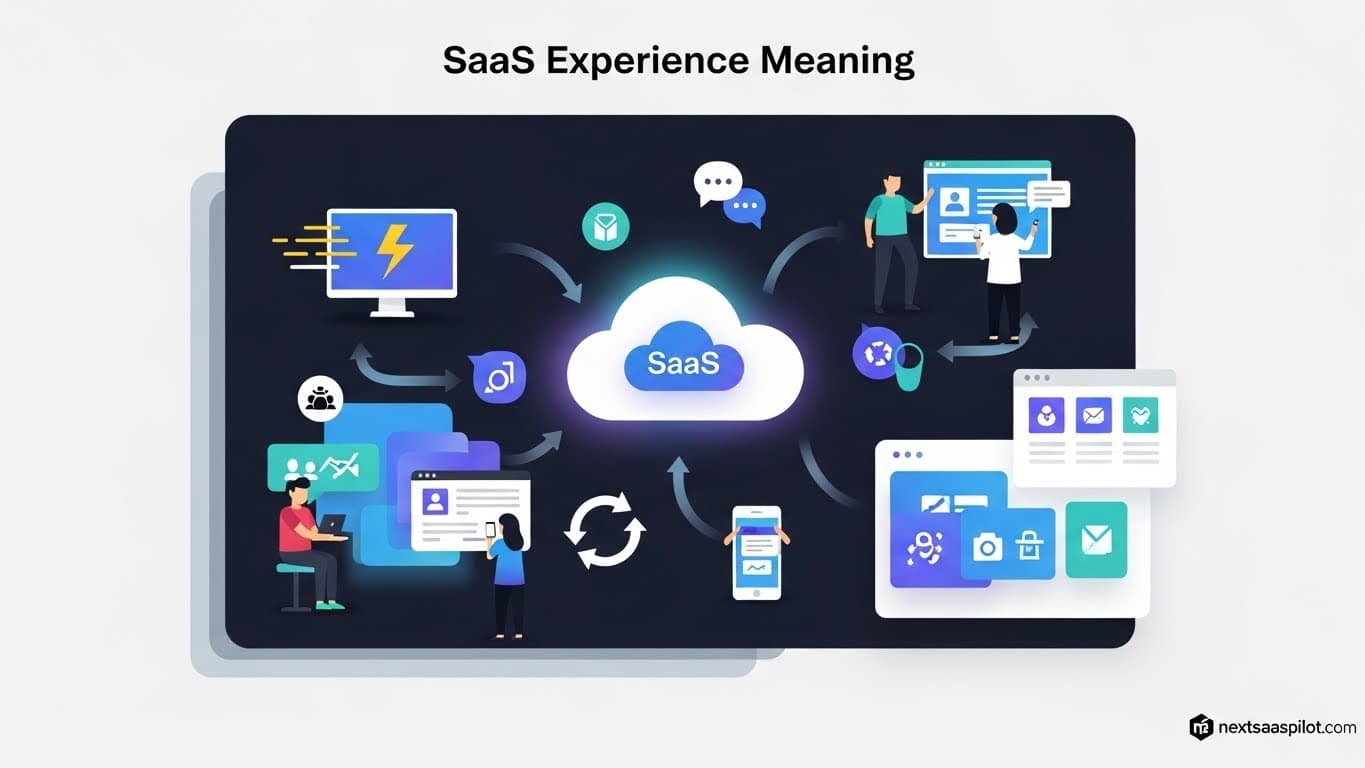
The SaaS experience meaning encompasses the entire lifecycle of a user’s interaction with cloud-based software, from the initial sign-up and onboarding to daily usage and technical support. It shifts the focus from simply owning a static product to consuming a continuously evolving service that is centered entirely on user success and value realization.
When we talk about “SaaS experience,” we are moving beyond the user interface (UI). While UI is part of it, the “experience” is the holistic feeling a customer has about the vendor. It is the difference between buying a car (ownership) and using Uber (experience).
In the traditional software world, you bought a CD-ROM, installed it, and the relationship ended until you bought the next version. In SaaS, the relationship never ends. The vendor must re-earn the customer’s business every month.
The Three Layers of Experience:
- The Product Layer: Is the software fast, bug-free, and intuitive?
- The Service Layer: Is support responsive? Is there educational content?
- The Commercial Layer: Is billing transparent? Is upgrading easy?
I have worked with companies that had incredible code but a terrible SaaS experience because their billing portal was confusing. They lost customers not because the tool didn’t work, but because the experience of paying for it was painful.
How Does SaaS Experience Differ from Traditional Software (SAAP)?
SaaS experience differs from traditional software by prioritizing continuous delivery and relationships over a one-time transaction. While traditional software (SAAP) focuses on ownership, maintenance, and static features, SaaS focuses on access, automatic updates, and ensuring the user achieves ongoing value to prevent churn.
To understand the future, we must look at the past. Traditional models, often referred to as SAAP software (Software as a Product), placed the burden of experience on the buyer. If the server crashed, it was your problem. If the interface was clunky, you were stuck with it for three years.
Comparison: SaaS vs. SAAP Experience
| Feature | Traditional (SAAP) Experience | Modern SaaS Experience |
| Relationship | Transactional (Buy and goodbye) | Relational (Continuous partnership) |
| Updates | Massive, painful annual upgrades | Seamless, invisible daily updates |
| Support | Often requires a separate paid contract | Usually included; focused on success |
| Feedback | Slow feedback loops (years) | Instant feedback loops (days) |
| Risk | Buyer takes all the risk | Vendor shares the risk (cancellation) |
This shift is fundamental. In SaaS, the vendor is not just selling a tool; they are selling the outcome that the tool provides.
What Are the Core Pillars of a Great SaaS Experience?
The core pillars of a great SaaS experience include intuitive User Interface (UI) design, frictionless onboarding, proactive Customer Success (CS), and reliable performance. Together, these elements ensure that users can navigate the platform easily, achieve “Time to Value” quickly, and receive support before issues escalate.
If you remove any one of these pillars, the experience collapses.
1. Intuitive Design (UI/UX)
The interface must be self-explanatory. In 2025, users expect consumer-grade design (like Instagram or Spotify) even in B2B enterprise tools. If a user needs a manual to find the “Log Out” button, the experience has failed.
2. Frictionless Onboarding
This is the bridge between “Sign Up” and “Wow.” Great SaaS experience means guiding the user to their first win immediately.
- Bad Experience: “Welcome! Here is a blank dashboard. Good luck.”
- Good Experience: “Welcome! Let’s set up your first project together in 3 clicks.”
3. Reliability and Uptime
Nothing kills experience faster than downtime. It doesn’t matter how pretty your dashboard is if it doesn’t load. This relates to the underlying infrastructure, whether it is PaaS vs IaaS vs SaaS vs CaaS. The architecture dictates the reliability.
Why Is Onboarding Critical to the SaaS Experience?
Onboarding is critical because it dictates the “Time to Value” (TTV); if a user cannot figure out how to use the tool within the first hour, they are likely to churn. Effective onboarding acts as a guided bridge, turning a confused trial user into a confident, paying customer through interactive walkthroughs and checklists.
I often tell clients: “You don’t have a churn problem; you have an onboarding problem.”
The first 72 hours of the SaaS experience are the “Golden Window.” If the user doesn’t form a habit or see a result in this window, they mentally check out.
Elements of High-Impact Onboarding:
- Empty States: Don’t show empty tables. Show sample data so the user sees what the tool could look like.
- Progress Bars: Humans are wired to complete tasks. A “70% Complete” bar motivates action.
- Persona-Based Flows: Ask the user “Are you a Marketer or a Developer?” and change the onboarding experience based on the answer.
If you look at the best SaaS tools, you will notice they all obsess over this initial phase. They know that confusion is the enemy of revenue.
How Does Customer Success Define the SaaS Experience?
Customer Success defines the experience by shifting support from reactive troubleshooting to proactive growth. In SaaS, the vendor’s revenue relies on renewal, so the “experience” must include dedicated guidance, strategy sessions, and training to ensure the client is maximizing the software’s potential.
Customer Support fixes bugs. Customer Success fixes businesses.
In the SaaS experience economy, a Customer Success Manager (CSM) is part of the product. For complex platforms, the software is only 50% of the value; the other 50% is the advice on how to use it.
The Shift to “Consultative” Experience:
Many SaaS companies are now adopting models similar to SAS consulting, where deep technical expertise is paired with the software. This is especially true in high-stakes industries like analytics or cybersecurity.
- Reactive: “I reset your password.”
- Proactive: “I noticed you aren’t using our new reporting feature. Can I show you how it could save you 3 hours a week?”
What Role Does Integration Play in the User Experience?
Integration is vital because modern businesses use dozens of tools, and a positive SaaS experience requires the software to “play nice” with others via APIs. If a tool cannot exchange data seamlessly with the user’s existing tech stack, the experience becomes fragmented, leading to data silos and manual entry frustration.
No SaaS tool is an island. The average enterprise uses over 100 different applications. If your tool is the one that forces a user to download a CSV and upload it manually elsewhere, you are the bottleneck.
The Ecosystem Effect:
This is why horizontal SaaS platforms (like Slack or Microsoft Teams) rely so heavily on integrations. Their “experience” is defined by how well they connect with Salesforce, Jira, or Zoom.
- Native Integrations: Pre-built connections (e.g., “Click to connect Gmail”).
- iPaaS Support: connecting via tools like Zapier or Make.
- Open APIs: allowing developers to build their own connections.
A seamless flow of data between apps is often the difference between a “sticky” product and one that gets replaced.
How Do You Measure the Quality of SaaS Experience?
You measure the quality of SaaS experience using metrics like Net Promoter Score (NPS), Customer Satisfaction (CSAT), and Churn Rate. Additionally, product usage analytics—such as daily active users (DAU) and feature adoption rates—reveal the brutal truth about whether the experience is engaging or repelling users.
You cannot improve what you do not measure. Subjective feelings (“I think they like it”) must be replaced by objective data.
Key Experience Metrics:
| Metric | What It Measures | What It Tells You |
| NPS (Net Promoter Score) | Loyalty | Would they recommend you to a friend? |
| CES (Customer Effort Score) | Friction | How hard was it to solve their problem? |
| TTV (Time to Value) | Onboarding speed | How long until they got an ROI? |
| Retention Rate | Long-term value | Are they finding reasons to stay? |
| Feature Adoption | Depth of use | Are they using the whole tool or just 10%? |
Analyzing these metrics helps distinguish between SaaS vs SAS models. While SaaS relies on high-volume, low-touch metrics (like DAU), legacy SAS models often rely on high-touch relationship metrics.
Can SaaS Experience Be Customized for Partners?
Yes, SaaS experience can be customized for partners through white-labeling, co-branded portals, and dedicated reseller dashboards. This ensures that agencies and consultants who resell the software can present a unified brand experience to their own clients, increasing the value of the partnership.
Many SaaS companies grow by leveraging SaaS partner programs. The experience for a partner is different from an end-user.
Partner Experience Needs:
- Admin Controls: The ability to manage multiple client accounts from one login.
- Resource Hubs: Access to sales decks and training materials.
- Attribution: Clear visibility into commissions and leads.
If the partner experience is clunky, they will stop selling your product. It is that simple.
Future Trends: Where Is SaaS Experience Heading?
The future of SaaS experience is heading toward “Agentic AI” and hyper-personalization. Software will no longer just wait for inputs; it will anticipate needs, automate complex workflows autonomously, and adapt the interface in real-time based on the user’s specific role and behavior.
We are moving from “Point and Click” to “Describe and Done.”
Emerging Trends:
- Generative UI: Interfaces that change based on what you are doing. If you are an accountant, the dashboard shows numbers. If you are a CEO, it shows charts.
- Proactive AI Agents: Instead of a notification saying “Inventory low,” the AI says “Inventory was low, so I ordered more. Click here to approve.”
- Verticalization: As seen in SaaS examples, generic tools are being replaced by hyper-specific vertical tools that offer a “perfect fit” experience for niche industries.
Innovators looking for SaaS product ideas should focus here: How can you reduce the cognitive load on the user? The ultimate experience is one where the user barely has to use the software at all because the software is doing the work for them.
Final Thoughts
Ultimately, the “SaaS experience meaning” is the sum of every interaction a business has with your service. It is the sales call, the loading speed, the error message, and the renewal email.
In a saturated market, features are easily copied. Experience is the only defensible moat. If you obsess over the user’s journey, the revenue will follow.
For a broader historical context on how this delivery model evolved, SaaS provides an excellent background on the technical shift that enabled this experience economy.