
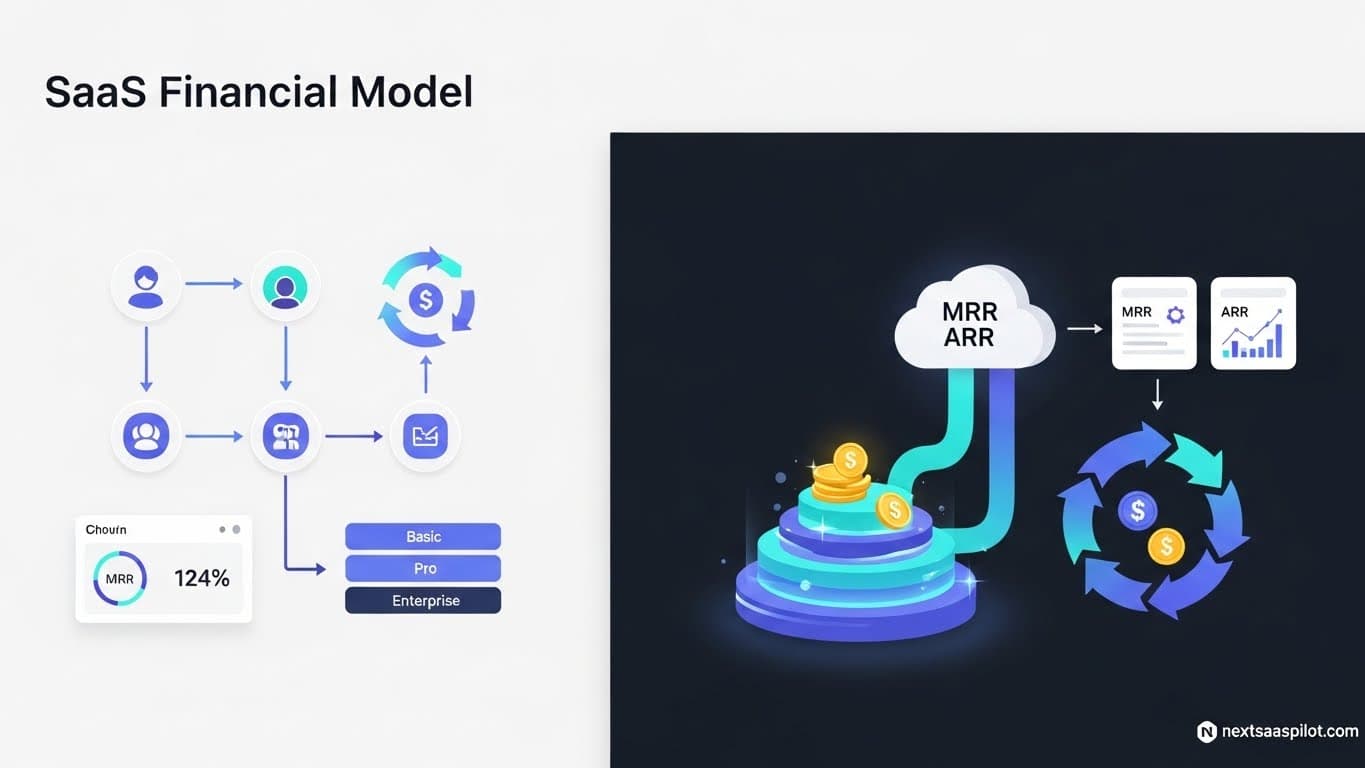
A robust saas financial model is the navigational chart for your startup, transforming your abstract vision into concrete numbers that investors trust. While many founders obsess over code and product features, the most successful CEOs spend just as much time engineering their spreadsheets.
I have sat in boardrooms where brilliant technical founders were laughed out of the room because they couldn’t explain their unit economics. They had a great product but a broken financial engine. A proper model doesn’t just predict the future; it tells you when to hire, how much to spend on marketing, and exactly when you will run out of cash. This guide is not an accounting lecture; it is a practical blueprint for building a model that drives growth.
What Is a SaaS Financial Model and Why Do You Need One?
A SaaS financial model is a spreadsheet tool used to forecast a company’s future financial performance by projecting revenue, expenses, and cash flow based on key drivers like customer acquisition, churn, and headcount. It serves two primary purposes: internal operational planning (budgeting) and external fundraising (valuation).
Unlike a traditional widget-selling business, a saas business model relies on recurring revenue. You spend money upfront to acquire a customer, but you get paid back over months or years. This creates a “cash trough” that kills many startups.
Your financial model simulates this reality. It helps you answer critical questions: “If I hire three sales reps today, when will their revenue cover their salaries?” or “How does a 1% increase in churn affect my runway?” It connects your operational reality to your bank account.
Step 1: How Should You Structure the Revenue Forecast?
You should structure your revenue forecast using a “Bottom-Up” approach driven by acquisition channels and conversion rates, rather than a “Top-Down” approach based on capturing a percentage of the market. This involves modeling the funnel: Traffic → Leads → Opportunities → Closed Deals → New MRR.
I always advise founders to ban the phrase “If we just get 1% of the market” from their pitch decks. That is a top-down guess, and it is usually wrong.
Instead, build a bottom-up engine.
- Traffic Sources: Organic, Paid Ads, Referrals.
- Conversion Rates: What % of visitors become trials? What % of trials become paid?
- Pricing: What is the Average Revenue Per User (ARPU)?
This granularity allows you to spot bottlenecks. If you miss your revenue target, you can look at the model and see exactly why: “Oh, our lead-to-opportunity conversion dropped.” This aligns perfectly with your saas revenue model, ensuring your pricing strategy (Flat vs. Tiered) is accurately reflected in the math.
Step 2: Calculating Cost of Goods Sold (COGS) and Gross Margin
COGS in SaaS includes all direct costs required to deliver the software to the customer, such as cloud hosting fees, third-party API costs, and customer support salaries. Your target Gross Margin (Revenue minus COGS) should ideally be above 80% to command a premium valuation.
Many founders mistakenly put their hosting bill in “Operating Expenses.” This is incorrect. If AWS shuts down, your product stops working. That is a Cost of Good Sold.
When modeling COGS, you need to account for:
- Hosting: AWS/Azure/Google Cloud bills. Note that using expensive PaaS solutions can hurt margins compared to raw IaaS (see caas vs paas).
- Customer Success: The portion of the team dedicated to support tickets (not upsells).
- Third-Party Licenses: Tools embedded in your product (e.g., Twilio for SMS).
Investors look at Gross Margin first. If your margin is 50%, you look like a consultancy, not a software company.
Step 3: Modeling Operating Expenses (OpEx) and Headcount
Operating Expenses should be categorized into three standard buckets: Research & Development (R&D), Sales & Marketing (S&M), and General & Administrative (G&A), with headcount acting as the primary driver for all three categories. You must model a “Hiring Plan” that triggers new hires based on revenue milestones.
In software, people are your biggest expense. Your model should have a dedicated tab for “Staffing.”
- R&D: Engineers, Product Managers, Designers.
- S&M: Sales Reps, Marketers, RevOps.
- G&A: CEO, Finance, HR, Legal.
A sophisticated model links hiring to growth. For example, “Hire one Customer Success Manager for every $50k in new ARR.” This ensures your saas organizational structure scales logically without bloating the payroll before the revenue arrives.
Step 4: How Do You Model Churn and Retention?
Churn should be modeled as both “Logo Churn” (count of customers lost) and “Revenue Churn” (dollar value lost), while also accounting for “Expansion Revenue” from upsells to calculate Net Revenue Retention (NRR). High churn renders customer acquisition efforts futile.
Churn is the leaky bucket. If you acquire $10k in new revenue but lose $10k from existing customers, you are running on a treadmill.
Your model must separate:
- Gross Churn: Revenue lost from cancellations.
- Expansion: Revenue gained from existing customers upgrading.
- Net Churn: Gross Churn minus Expansion.
If Expansion > Gross Churn, you have “Net Negative Churn.” This is the holy grail of the saas subscription model. It means your business grows even if you never sign a new customer.
Step 5: The Three Statements (P&L, Balance Sheet, Cash Flow)
A complete financial model must generate the three core financial statements: the Profit & Loss (P&L) shows profitability over time, the Balance Sheet shows assets and liabilities (including deferred revenue), and the Cash Flow Statement tracks the actual movement of money in and out of the bank.
SaaS accounting is tricky because of “Deferred Revenue.” If a customer pays $120 upfront for a year, you have $120 in cash, but you can only recognize $10 in revenue this month. The other $110 is a liability (you owe them service).
- P&L: Tells you if the business model works.
- Cash Flow: Tells you if you can make payroll next Friday.
You can be profitable on the P&L but bankrupt on the Cash Flow statement if your customers pay late. Conversely, you can be unprofitable but cash-rich if you collect annual upfronts.
Key Metrics Dashboard: What Investors Want to See
Your model should feed into a dashboard summary that highlights the “North Star” metrics investors care about, specifically CAC Payback Period, LTV:CAC Ratio, Magic Number, and Rule of 40. These efficiency metrics prove that your growth is sustainable and capital-efficient.
Do not make investors hunt for the numbers. Put them on the first tab.
| Metric | Formula | Target |
| CAC Payback | CAC / (MRR × Gross Margin %) | < 12 Months |
| LTV:CAC | LTV / CAC | > 3x |
| Magic Number | Net New ARR / S&M Spend | > 1.0 |
| Rule of 40 | Growth Rate % + Profit Margin % | > 40% |
| Burn Multiple | Net Burn / Net New ARR | < 2.0 |
Handling Cloud Infrastructure Costs in the Model
As you scale, your cloud infrastructure costs will not be linear; you must model step-function cost increases for things like database upgrades or multi-region deployments, utilizing FinOps principles to forecast usage-based billing accurately.
Early on, your hosting bill is negligible. But as you hit scale, cloud application management becomes a massive line item.
If you have a usage-based subscription based software model, your revenue and your costs are linked. If a customer uses 10TB of data, you charge them more, but you also pay AWS more. Your model must link these two variables dynamically.
Scenario Planning: Base, Bull, and Bear Cases
You should build your model with toggle switches that allow you to view different scenarios—Base (expected), Bull (optimistic), and Bear (pessimistic)—by adjusting key drivers like growth rate and churn. This sensitivity analysis prepares you for market volatility.
Never walk into a pitch with just one plan. Investors will ask, “What happens if conversion drops by half?”
You need to be able to toggle a cell and say, “Then we still have 18 months of runway, but we hire slower.” This demonstrates that you are in control of the machine.
The Importance of “Bookings” vs. “Revenue”
Bookings represent the value of a contract signed (the commitment), while Revenue represents the recognized value of the service delivered (the accounting reality); confusing these two can lead to disastrous cash flow mismanagement.
- Booking: Customer signs a $12k contract today.
- Revenue: You recognize $1k/month for 12 months.
- Billings: You send an invoice for $12k today.
Your sales team cares about Bookings. Your accountant cares about Revenue. Your bank account cares about Billings. A great saas architecture ensures your billing systems feed this data correctly into your finance tools.
Conclusion
A saas financial model is a living document. It is never “finished.” You must update it every month with actual data (Budget vs. Actuals) to refine your forecast accuracy.
Building this model forces you to understand every lever of your business. It reveals that your pricing is too low, or your support costs are too high. It connects the dots between your code, your customers, and your cash. In the world of financial modeling, the goal isn’t to predict the future perfectly; it’s to be prepared for whatever future arrives.