
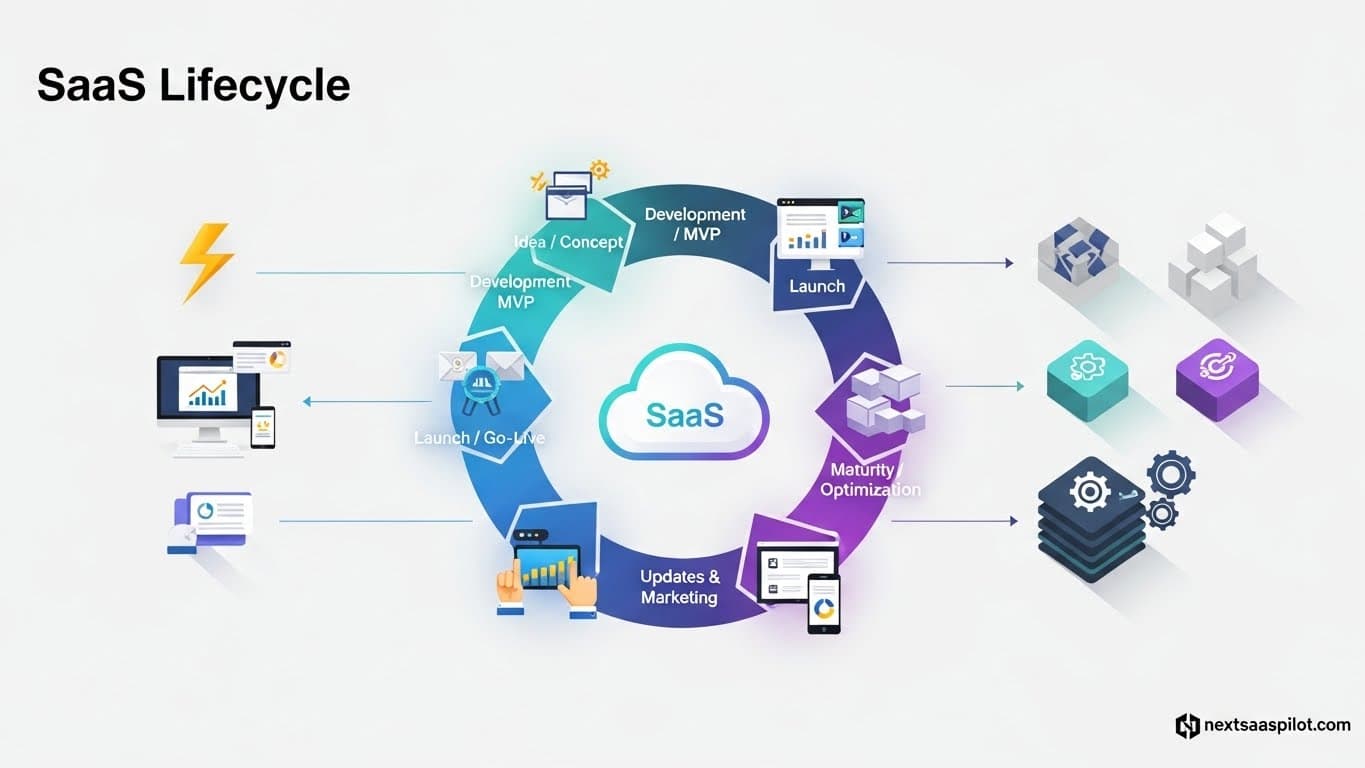
The SaaS lifecycle is the heartbeat of every subscription software business, dictating the journey from raw concept to scalable exit. It is not a straight line; it is a continuous loop of innovation, deployment, and feedback. In 2025, mastering this cycle differentiates unicorn founders from those stuck in “tutorial hell.”
Understanding this lifecycle is critical because SaaS is not a “build once, sell forever” model. It requires constant nurturing. If you treat your software like a static product, you will churn. If you treat it like a living service, you will scale.
This guide breaks down the seven critical stages of the SaaS journey, providing a battle-tested roadmap for technical leaders and founders.
What Is the SaaS Lifecycle?
The SaaS lifecycle refers to the distinct stages a software-as-a-service product moves through, from initial concept and development to growth, maturity, and eventual exit. Unlike traditional software, this lifecycle is cyclical, requiring continuous updates and feature iterations to maintain subscriber value.
Think of the lifecycle as the biological age of your company. You don’t feed a teenager baby food, and you don’t treat a mature enterprise platform like a scrapping MVP.
The 7 Stages of SaaS:
- Envisioning: The “Napkin Sketch” phase.
- Planning: The Architecture and Roadmap.
- Development: Writing the code.
- Launch: Going to market.
- Growth: Scaling the user base.
- Maturity: Optimizing for profit.
- Exit/Evolution: Selling or pivoting.
I once advised a founder who tried to hire a VP of Sales (Growth Stage) while he was still in the Envisioning Stage. He burned $200,000 in salary for a salesperson who had nothing to sell. Understanding where you sit in the lifecycle saves your runway.
Phase 1: How Does Planning Determine Success?
The planning phase determines success by validating market demand before code is written. It involves defining the Ideal Customer Profile (ICP), selecting the appropriate tech stack, and mapping out the architectural roadmap to prevent costly technical debt later.
This is the “Measure Twice, Cut Once” phase.
Market Validation: Before you hire a developer, you must validate the problem.
- The Mom Test: Talk to potential users. If they aren’t actively looking for a solution, your idea might be a “nice to have,” not a “need to have.”
- Competitive Audit: Who else is doing this? If the answer is “no one,” be careful. It might mean there is no market.
Tech Stack Selection: Choosing your SaaS tech stack is one of the most permanent decisions you will make. Switching from a SQL database to NoSQL halfway through development is a nightmare.
- Backend: Node.js, Python, or Go?
- Frontend: React, Vue, or Angular?
- Cloud: AWS, Azure, or Google Cloud?
Phase 2: Why Is the MVP Stage Critical?
The MVP (Minimum Viable Product) stage is critical because it tests the core value proposition with real users using minimal resources. It allows founders to gather actionable feedback and pivot early without burning through the entire budget on unnecessary features.
Your SaaS MVP should be embarrassing. If you aren’t slightly ashamed of your V1, you launched too late.
The “Feature Slice” Strategy: Don’t build a half-finished car (a chassis with no engine). Build a skateboard (a simple board with wheels). Both get the user from A to B, but the skateboard takes a week to build.
Speed vs. Code Quality: In this phase, speed wins. This is why many non-technical founders are turning to no-code SaaS tools. Platforms like Bubble or Webflow allow you to validate a concept in days. If the idea fails, you lost a weekend, not six months of engineering salary.
Phase 3: What Happens During Development?
During the development phase, engineering teams write the code, establish database architectures, and implement security protocols. This stage transforms the MVP wireframes into a functional, secure application capable of handling multi-tenant user loads.
This is where the heavy lifting happens. SaaS platform development is distinct from building a standard website because of multi-tenancy—the ability for one software instance to serve thousands of separate customers securely.
Key Development Milestones:
- Alpha Build: Internal testing only. Feature complete but buggy.
- Beta Build: External testing with friendly users.
- Production Candidate: The version you intend to sell.
Infrastructure Choices: Many developers leverage Platform as a Service (PaaS) providers like Heroku or Vercel during this stage. These tools abstract away the server management, allowing the team to focus 100% on business logic.
Phase 4: How Do You Execute a Launch?
A successful launch requires a coordinated effort between product, marketing, and sales to generate initial traction. It involves beta testing, setting up customer support channels, and executing a go-to-market strategy that converts interest into paying users.
Learning how to launch SaaS is a skill in itself. It’s not a singular event; it’s a campaign.
The Soft Launch vs. Hard Launch:
- Soft Launch: Quietly opening the doors to your email waitlist. This helps you catch critical bugs before the public sees them.
- Hard Launch: The Product Hunt post, the press release, the LinkedIn blast. This is for traffic volume.
Design Matters: Your landing page is your best salesperson. Review SaaS website inspiration galleries to ensure your site communicates value in under 5 seconds. If a user can’t tell what you do from the hero section, they will bounce.
Phase 5: Strategies for Growth and Scaling
Growth strategies focus on optimizing unit economics, reducing Customer Acquisition Cost (CAC), and maximizing Lifetime Value (LTV). This phase requires scaling infrastructure to handle increased traffic and expanding sales teams to capture broader market share.
You have product-market fit. Now you pour fuel on the fire.
The Scaling Triad:
- Sales: Moving from founder-led sales to hiring Account Executives.
- Marketing: Investing in SEO, Content, and Paid Ads.
- Product: Refactoring code to handle 10x the data load.
The Churn Trap: Growth masks churn. If you are adding 100 customers a month but losing 90, you aren’t growing; you’re spinning. In this phase, you must obsess over Retention.
Phase 6: Managing Maturity and Optimization
Managing maturity involves shifting focus from aggressive acquisition to aggressive retention and profitability. Companies must analyze churn metrics, implement customer success programs, and continuously release new features to prevent the product from becoming stale.
At this stage, you are a “real” company. You have HR, Finance, and Ops.
Optimization Tactics:
- Pricing Audits: Are you charging enough? Most mature SaaS companies raise prices annually.
- Upsell/Cross-sell: Selling new features to existing customers is cheaper than finding new customers.
- Technical Debt Paydown: Pausing new features to fix the “spaghetti code” written during the MVP phase.
Phase 7: The Exit Strategy
The exit stage is the final monetization event, involving either an acquisition by a larger strategic buyer or an Initial Public Offering (IPO). Successful exits require clean financial audits, robust intellectual property documentation, and a defensible market position.
Even if you don’t plan to sell, you should run your company as if you are selling it tomorrow.
Exit Readiness:
- Clean IP: Do you own all your code? (Did every freelancer sign an IP assignment agreement?)
- Clean Cap Table: Are your equity grants organized?
- Clean Data: Is your customer data secure and compliant (GDPR/SOC2)?
Common Pitfalls in the SaaS Lifecycle
Common pitfalls include premature scaling, neglecting technical debt, and failing to pivot when market feedback demands it. Many founders run out of cash by hiring expensive sales teams before the product is truly ready for the mass market.
- The “Feature Factory”: Building endless features that nobody uses instead of fixing the core workflow.
- Ignoring Onboarding: If users can’t figure out your app in 5 minutes, they leave.
- Underpricing: Charging $10 for a tool that saves the customer $10,000.
Final Thoughts
The SaaS lifecycle is a journey of endurance. It requires you to be a visionary in the beginning, a builder in the middle, and an optimizer at the end.
By understanding which stage you are in, you can focus on the right metrics. Don’t worry about “Exit Multiples” when you are in the “Planning” phase. Don’t worry about “MVP Speed” when you are in the “Maturity” phase.
Build for the stage you are in, and the next stage will follow.