
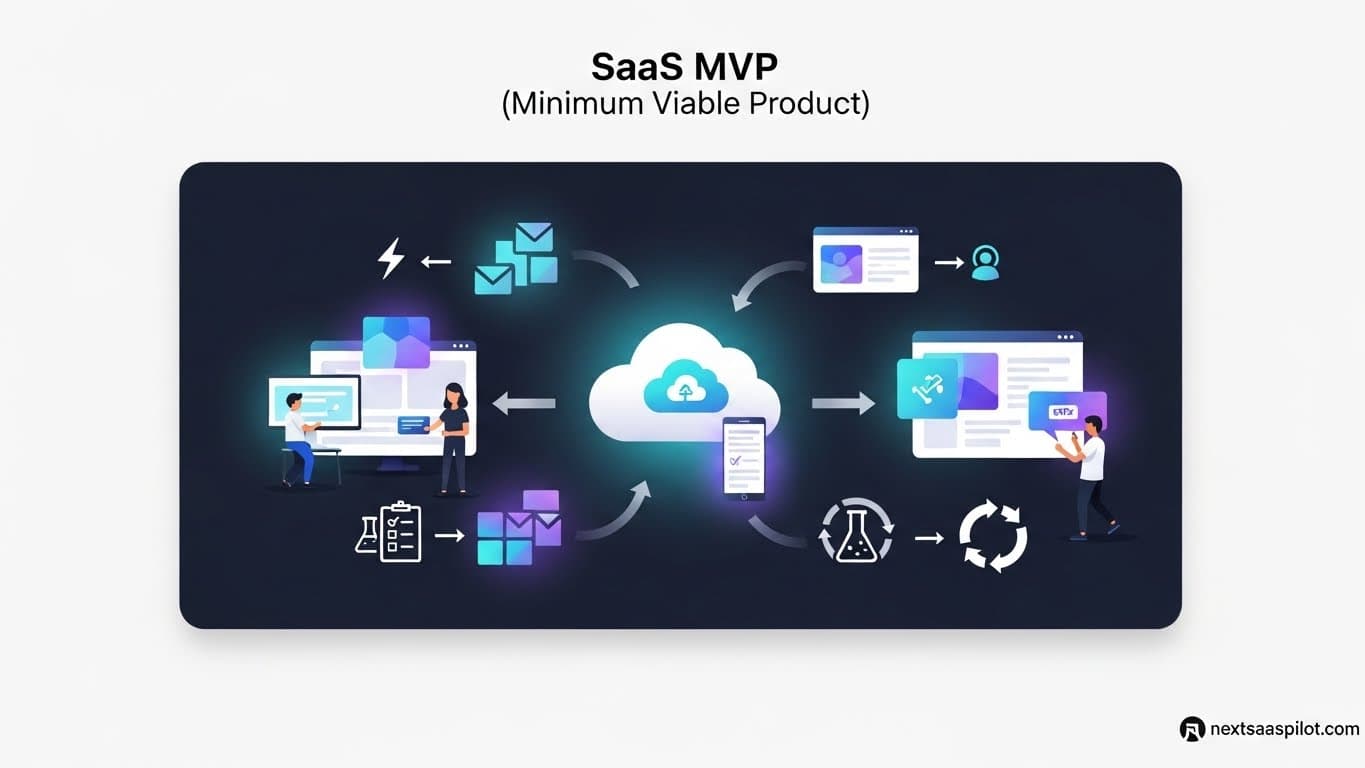
Building a SaaS MVP is the art of strategic subtraction. It is not about building a “lite” version of your dream software; it is about building the smallest possible mechanism that delivers value to a customer. In 2025, where the market is flooded with tools, speed and precision are your only competitive advantages.
Founders often mistake an MVP for a “beta” or a prototype. This is dangerous. A prototype demonstrates a concept; an MVP sells a solution. This guide provides a battle-tested roadmap to navigate the chaos of early-stage development, moving from a napkin sketch to a revenue-generating platform without burning your runway.
What Is a SaaS MVP and Why Is It Critical?
A SaaS MVP (Minimum Viable Product) is the most basic version of a software application that solves a single core problem for a specific target audience well enough to be sold. It allows founders to validate market demand, gather user feedback, and minimize development costs before committing to a full-scale build.
The graveyard of startups is filled with “perfect” products that nobody wanted. The MVP is your insurance policy against that fate.
The “Skateboard” Analogy: If your goal is to build a car, don’t start by building a wheel, then an axle, then a chassis. That takes a year, and you can’t travel anywhere until it is finished.
- The MVP Approach: Build a skateboard. It is simple, cheap, and gets the user from Point A to Point B immediately.
- The Iteration: Turn the skateboard into a scooter. Then a bike. Then a car.
By following this logic, you are providing value at every stage. When you are learning how to start a software company, remember: you are not building a product; you are building a solution to a problem.

How Do You Validate Your Idea Before Writing Code?
You validate your idea before writing code by conducting customer discovery interviews, creating high-fidelity mockups, and running “smoke tests” with landing pages to gauge purchase intent. The goal is to secure pre-sales or letters of intent (LOI), ensuring that a paying market exists before investing in engineering.
I once coached a founder who spent $80,000 building a complex inventory management tool for dentists. When he finally tried to sell it, he learned that dentists don’t manage their own inventory—their assistants do, and the assistants preferred pen and paper. He could have learned that for free with five phone calls.
The Validation Checklist:
- The Problem Interview: Talk to 20 potential users. Do not mention your idea. Ask: “What is the hardest part of your day?” If they don’t mention the problem you are solving, pivot.
- The Solution Interview: Show them a mockup (Figma). Ask: “If this existed today, would you pay $50/month for it?”
- The Smoke Test: Build a landing page. Run $200 of ads. If nobody clicks “Sign Up,” the market isn’t there.
How to Prioritize Features Using the MoSCoW Method?
Prioritize features using the MoSCoW method—Must Have, Should Have, Could Have, and Won’t Have—to prevent scope creep. For a SaaS MVP, you strictly build only the “Must Have” features that solve the core pain point, ruthlessly cutting any feature that does not directly contribute to the “Aha!” moment for the user.
Scope creep is the silent killer of MVPs. You start building a to-do list app, and suddenly you are adding AI chat and video conferencing.
Applying MoSCoW to a hypothetical CRM:
| Category | Definition | CRM Example |
| Must Have | Non-negotiable. The product fails without it. | Add/Edit Contacts, Log Calls. |
| Should Have | Important but not vital for launch. | Google Calendar Integration. |
| Could Have | Desirable features (Nice to have). | Dark Mode, Mobile App. |
| Won’t Have | Out of scope for now. | AI Predictive Analytics. |
Should You Choose No-Code or Custom Development?
Choose No-Code if your SaaS logic is standard (e.g., directories, simple marketplaces) and you need to launch in weeks with a budget under $5,000. Choose custom development if your product requires proprietary algorithms, complex data processing, or high-performance computing that exceeds the limits of platforms like Bubble or Webflow.
The no-code SaaS revolution has changed the game. You can now build functional software without a CTO.
The “Hybrid” Strategy:
Many founders launch v1.0 on No-Code to get their first 100 customers. Once they have revenue and validated data, they use those funds to hire a team for SaaS platform development to rebuild v2.0 in scalable code. This significantly de-risks the initial investment.
What Is the Best Tech Stack for a Scalable MVP?
The best tech stack for a scalable MVP balances developer availability with performance; the MERN stack (MongoDB, Express, React, Node.js) is the industry standard for web apps, while Python (Django/FastAPI) is preferred for AI-driven tools. Avoiding obscure languages ensures you can easily hire developers or transfer the codebase to an agency later.
Do not let your developer convince you to build your MVP in Rust or Haskell just because it is “trendy.” You need stability and speed.
Recommended Stacks:
- Frontend: React.js or Vue.js (Fast, responsive user interfaces).
- Backend: Node.js (Great for real-time apps) or Python (Great for data/AI).
- Database: PostgreSQL (Reliable, structured data) or MongoDB (Flexible, fast iteration).
- Hosting: AWS or Vercel (Scalable infrastructure).
How Do You Manage the Development Process?
Manage the development process using Agile methodology, breaking the build into 1-2 week “sprints” with clear deliverables. utilize project management tools like Jira or Linear to track tasks and enforce a strict “definition of done” to ensure that features are fully tested and bug-free before being marked complete.
Effective software project management is more important than coding skill. Without it, you get “spaghetti code” and missed deadlines.
The Sprint Cycle:
- Planning: Select the “Must Haves” for the next 2 weeks.
- Build: Developers write code.
- Review: Test the features. Do they work?
- Deploy: Push to a staging environment.
Hiring: Freelancers vs. Agencies vs. In-House?
Hiring freelancers offers the lowest cost but requires heavy management; agencies offer reliability and speed but come at a premium; in-house teams offer the best long-term alignment but are too slow and expensive for a typical MVP phase. For most non-technical founders, a specialized SaaS agency or a fractional CTO is the safest path to a robust V1.
The Agency Route:
If you have the budget, a dedicated SaaS development company can handle the architecture, design, and security compliance (SOC2), allowing you to focus on sales.
The Freelancer Route:
If you are bootstrapping, platforms like Upwork are viable. However, you must act as the Product Manager. If you cannot write a detailed technical spec, do not hire a freelancer—they will build exactly what you ask for, not what you need.
How to Design a User-Centric MVP Interface?
Design a user-centric MVP interface by prioritizing “Time to Value” over aesthetic perfection; the user should be able to achieve their primary goal within three clicks of signing up. Use pre-built component libraries (like Tailwind UI or Material Design) to save weeks of design time while ensuring a clean, professional look.
Your MVP doesn’t need to win design awards, but it must be intuitive.
- Onboarding: Use tooltips to guide the user.
- Empty States: Don’t show a blank screen. Show sample data so the user understands what the tool does.
For visual benchmarks, look at SaaS website inspiration to see how unicorns structure their dashboards.
What Are the Common MVP Mistakes to Avoid?
Common MVP mistakes include “feature stuffing” (trying to do too much), ignoring mobile responsiveness, and neglecting the onboarding experience. Another fatal error is delaying the launch to polish the code; an MVP should be embarrassing enough that you are uncomfortable shipping it, but functional enough to solve the problem.
The “One Feature” Rule:
Zoom started with video conferencing. Dropbox started with file syncing. Uber started with black cars. They didn’t launch with ecosystems; they launched with one feature that worked perfectly.
How Do You Launch Your MVP to the Market?
Launch your MVP by starting with a “Soft Launch” to a waiting list of 50-100 beta users to fix critical bugs, followed by a “Hard Launch” on platforms like Product Hunt and LinkedIn. The goal of the launch is not just user acquisition, but learning; you need to set up analytics (Mixpanel or Google Analytics) to track exactly where users are getting stuck.
The Launch Timeline:
- Alpha (Weeks 1-4): Internal testing with friends and advisors.
- Beta (Weeks 5-8): Invite the email waitlist. Focus on bug fixes.
- Public Launch: Open registration. Execute the marketing plan from how to launch SaaS.
What Comes After the MVP?
After the MVP, the focus shifts to “Product-Market Fit” (PMF) by analyzing retention metrics and iterating based on user feedback. You transition from building “Must Haves” to enhancing the user experience and adding “Should Haves,” eventually scaling the architecture to a full platform.
The MVP is just the starting line. Once you have users, you need to manage the SaaS lifecycle—balancing new feature requests with technical debt and scalability.
Final Thoughts
Building a SaaS MVP is a test of discipline. It forces you to make hard choices about what matters most. Remember, the software is just a tool to deliver a result. If you can deliver that result faster, cheaper, or easier than the competition, your MVP is a success.
For further reading on the academic definition and history of this concept, Minimum Viable Product provides excellent context on the lean startup methodology.