
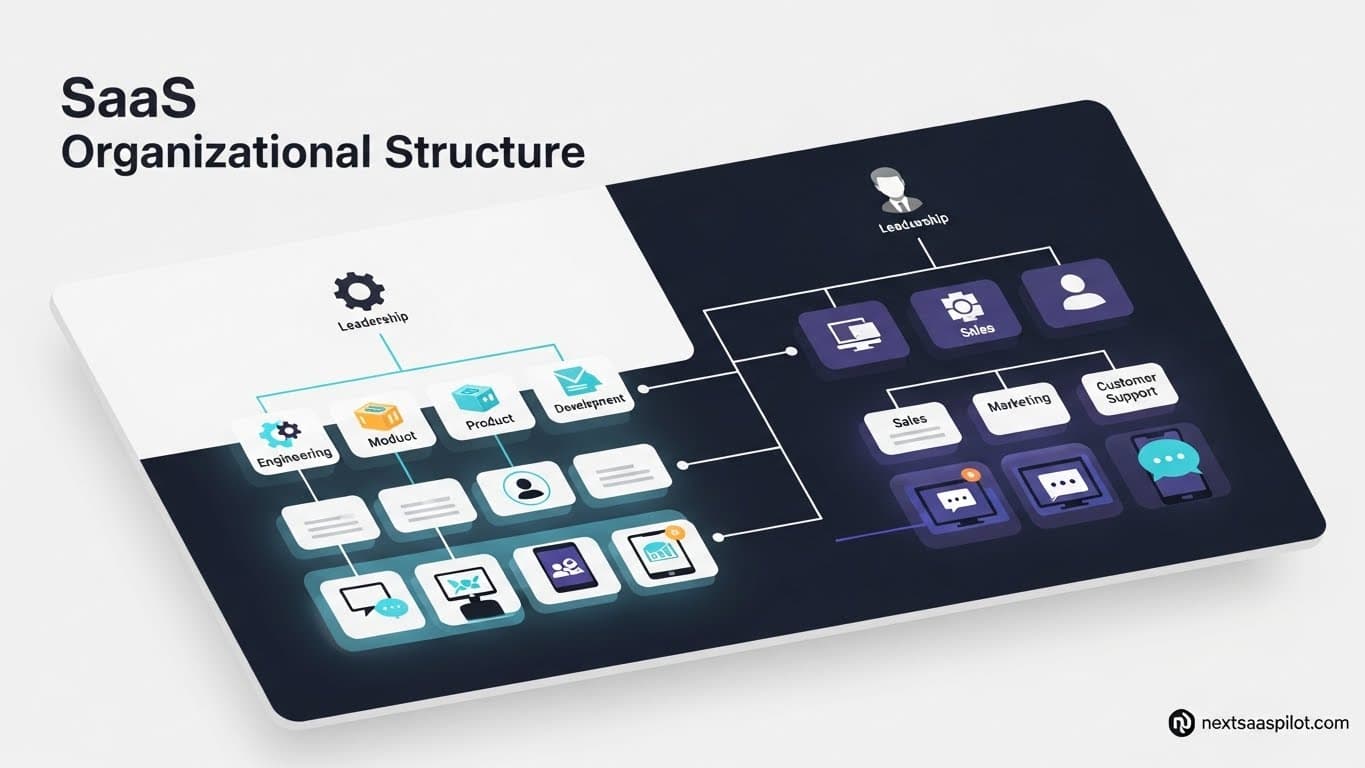
Designing a robust saas organizational structure is the blueprint that determines whether your startup scales into a unicorn or collapses under its own weight. In the fast-paced world of software-as-a-service, your org chart is not just a hierarchy of names; it is the operating system of your business, dictating how information flows, how decisions are made, and how value is delivered to the customer.
I have advised founders who scaled from 5 to 500 employees, and the most common point of failure wasn’t the code—it was the people architecture. They held onto flat structures too long, or they built rigid silos that killed agility. A modern SaaS company requires a fluid, customer-centric structure that aligns Engineering, Sales, and Success around the metric of recurring revenue. This guide dissects the evolution of the SaaS org chart and how to build one that supports hyper-growth.
What Is the Ideal SaaS Organizational Structure?
The ideal SaaS organizational structure is a customer-centric hierarchy that breaks down silos between Sales, Product, and Support, aligning all teams around the goal of maximizing Customer Lifetime Value (LTV). Unlike traditional manufacturing or retail structures, a SaaS org chart prioritizes “Customer Success” as a core revenue engine, not just a support function.
In the traditional world, you have a factory (Product) and a store (Sales). Once the product is sold, the relationship ends. In the saas business model, the sale is just the beginning.
Therefore, your structure must reflect the infinite loop of the customer journey: Acquire -> Retain -> Expand. If your Engineering team never talks to your Customer Success team, you are building features nobody wants. If your Sales team closes deals that your Onboarding team can’t implement, you will churn customers faster than you acquire them.
How Does Structure Evolve from Seed to Scale-Up?
SaaS organizations typically evolve through three distinct phases: the “Generalist” phase (Seed), where everyone wears multiple hats; the “Functional” phase (Series A), where specialized departments form; and the “Matrix” phase (Scale-up), where cross-functional squads align around specific product lines or market segments.
Understanding where you are in this lifecycle is critical. Hiring a VP of Sales before you have Product-Market Fit is a death sentence.
Phase 1: The Commando Team (0-10 Employees)
- Structure: Flat.
- Key Hires: Founders, Full-stack Engineers, one “Hustler” (Sales/Marketing hybrid).
- Focus: Survival and Iteration.
Phase 2: The Functional Depts (10-50 Employees)
- Structure: CEO manages Heads of Departments (Engineering, Sales, Marketing, CS).
- Key Shift: You stop doing everything yourself. You hire managers.
- Focus: Repeatable processes.
Phase 3: The Matrix/Scale-Up (50+ Employees)
- Structure: C-Suite (CRO, CTO, CPO). Cross-functional “Pods” (e.g., a “Growth Pod” containing a dev, a marketer, and a designer).
- Focus: Optimization and Expansion.
Why Is Customer Success Central to the Chart?
Customer Success (CS) must be a standalone department reporting directly to the CEO or CRO, distinct from Customer Support; while Support reacts to bugs, Success proactively drives adoption, retention, and upsells, directly impacting the company’s Net Revenue Retention (NRR).
In a subscription based software model, the majority of your profit comes from the renewals, not the initial signup. If CS is buried under Sales or Marketing, it becomes an afterthought.
I’ve seen companies treat CS as “glorified tech support.” The result? High churn. A modern SaaS org chart elevates CS. They own the “Health Score” of the customer base. They feed critical feedback to the Product team. They are the guardians of the saas subscription model.
Product-Led vs. Sales-Led: How Does It Affect Org Charts?
Product-Led Growth (PLG) organizations heavily staff Engineering and Growth Marketing to drive self-service adoption, whereas Sales-Led organizations build massive SDR and Account Executive teams to manage high-touch pipelines and enterprise contracts.
Your go-to-market strategy dictates your headcount allocation.
Product-Led (e.g., Slack, Zoom):
- Dominant Teams: Engineering, UX Design, Data Science.
- Sales Role: “Sales Assist” – they only talk to users who are already active but want enterprise features.
- Revenue Model: Aligned with the saas revenue model of low friction, high volume.
Sales-Led (e.g., Salesforce, Workday):
- Dominant Teams: Sales (SDRs, AEs), Solutions Engineering, Field Marketing.
- Product Role: Builds features specifically requested by large enterprise clients.
- Structure: Very hierarchical sales territories.
The Engineering Squad Model: Organizing Developers
Instead of a monolithic engineering department, modern SaaS companies utilize “Squads” or “Pods”—small, cross-functional teams (Dev, PM, Design, QA) that own specific features or metrics—to increase development velocity and ownership.
This structure is often referred to as the “Spotify Model.” If you have 50 engineers reporting to one CTO, bottlenecks are inevitable. By breaking them into squads (e.g., “The Onboarding Squad” or “The API Squad”), you decentralize decision-making.
This also aligns with modern saas architecture. Conway’s Law states that “organizations design systems that copy their communication structures.” If you want a microservices architecture, you need a micro-teams organizational structure.
The Rise of Revenue Operations (RevOps)
Revenue Operations (RevOps) is a strategic function that unifies Sales, Marketing, and Customer Success data into a single “source of truth,” breaking down silos to ensure the entire revenue engine runs efficiently and predictably.
In the past, Marketing had their data (HubSpot), Sales had theirs (Salesforce), and CS had theirs (Zendesk). The numbers never matched. RevOps sits in the middle. They own the tech stack. They ensure that a lead flows seamlessly from Marketing -> Sales -> CS.
RevOps is critical for maintaining a healthy saas financial model. They calculate CAC (Customer Acquisition Cost) and LTV (Lifetime Value) holistically, ensuring the CEO has accurate data for decision-making.
Key Roles You Must Hire Early
Beyond the founders, prioritize a Product Manager to organize roadmap chaos, a Customer Success Lead to prevent early churn, and a Tech Lead/Architect to manage technical debt; avoid hiring a VP of Sales until you have a repeatable sales motion.
The “First 10 Hires” dilemma is real.
- The Mistake: Hiring a CMO when you don’t have a product.
- The Fix: Hire a “Full Stack Marketer” who can write copy, run ads, and do SEO.
- The Mistake: Hiring 5 junior devs without a senior lead.
- The Fix: Hire one robust Architect who understands cloud application management.
Managing Remote and Distributed SaaS Teams
Remote SaaS structures rely on asynchronous communication, clear documentation, and output-based management rather than presence; they often require a “Head of Remote” or robust People Ops to maintain culture across time zones.
SaaS is uniquely positioned for remote work. The tools we build (Slack, Zoom, Jira) are the tools we use. However, structure matters more in remote. You cannot rely on “watercooler moments.”
- Documentation: If it’s not written down in Notion/Confluence, it didn’t happen.
- Global Talent: You can hire the best engineer in Brazil or Poland, reducing costs and increasing quality.
Financial Alignment and the CFO Role
The SaaS CFO is a strategic partner who manages unit economics, cash burn, and cloud infrastructure costs (FinOps), working closely with Engineering to ensure that hosting bills do not erode gross margins.
In SaaS, the biggest costs are People and Cloud Hosting. The CFO must understand the difference between caas vs paas.
- PaaS: Faster dev time, higher monthly bill.
- CaaS: Slower setup, lower long-term cost. The CFO and CTO must align on these choices to ensure the saas revenue model remains profitable.
The Future: XaaS and Organizational Flexibility
As the industry shifts toward “Everything as a Service” (XaaS), organizations must become more fluid, creating API-first teams that can partner with external ecosystems rather than building everything in-house.
The concept of as a service means your organization is part of a mesh network. Your “Integration Team” might become as important as your “Core Product Team.” Understanding what is xaas helps you visualize a structure where you leverage external APIs (like Stripe or Twilio) to keep your internal team lean and focused on core IP.
Conclusion
Your saas organizational structure is not static. It is a living organism that must adapt as you grow from finding product-market fit to scaling a sales machine.
Don’t copy Google’s org chart. Build the chart that solves your current bottlenecks. If you are slow to ship, look at your Engineering structure. If you are losing customers, look at your CS structure. In SaaS, the right people in the right configuration are your ultimate competitive advantage.