
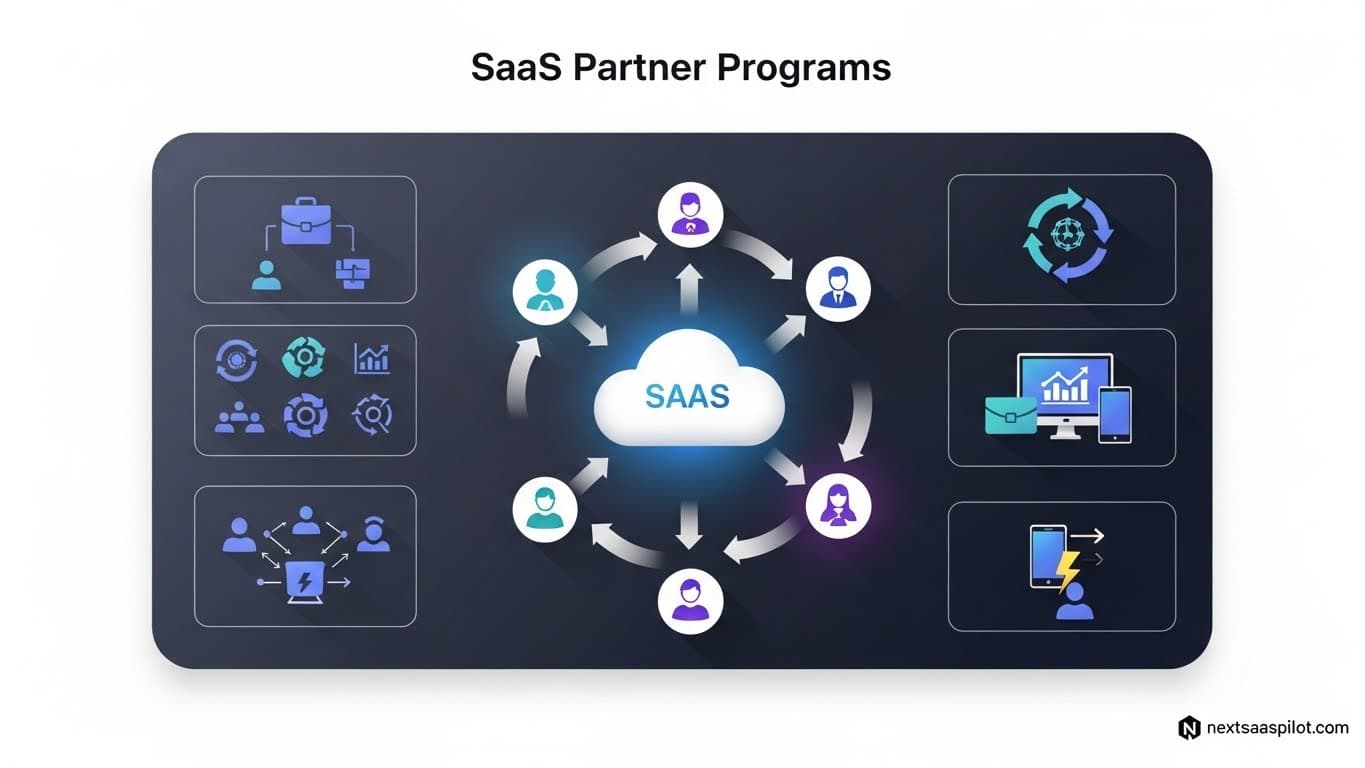
SaaS partner programs are the most effective lever for scaling revenue without linearly increasing headcount. By building an ecosystem of affiliates, resellers, and integration partners, companies can lower their Customer Acquisition Cost (CAC) and enter new markets faster. In the current efficiency-focused market, “who you sell with” is becoming just as important as “what you sell.”
For founders and revenue leaders, launching a partner program isn’t just a marketing tactic; it is a fundamental shift in business strategy. It moves a company from a direct-sales monolith to a platform-based ecosystem. This guide explores how to build, manage, and scale these programs effectively.
What Are SaaS Partner Programs and Why Do They Matter?
SaaS partner programs are strategic alliances between a software vendor and third-party entities—such as agencies, consultants, or other tech companies—to sell, refer, or integrate the vendor’s product. They matter because they leverage the trust and existing relationships of partners to accelerate sales cycles and reduce the cost of acquiring new customers.
The era of “Direct Sales only” is fading. In 2025, trust is the currency of B2B buying. Buyers are less likely to trust a cold email from your SDR and more likely to trust a recommendation from a consultant they already work with.
The “Trust Transfer” Effect: When a trusted agency recommends your tool to their client, that trust transfers to you. I experienced this firsthand when launching a marketing tool. Our direct outreach had a 2% conversion rate. However, leads that came through our agency partners converted at 35%. The partner had already vetted us, so the “sales” phase was effectively skipped.
Key Benefits of Partner Ecosystems:
- Lower CAC: You pay for performance (commissions) rather than clicks (ads).
- Higher Retention: Customers who use integrated tools stick around longer.
- Market Penetration: Partners can take you into verticals or geographies your direct team cannot reach.
What Are the Different Types of SaaS Partner Models?
The different types of SaaS partner models include Affiliate Partners (marketing focused), Referral Partners (warm introductions), Value-Added Resellers (VARs), and Technology/Integration Partners. Each model serves a different stage of the customer journey, from generating awareness at the top of the funnel to technical implementation at the bottom.
Understanding the nuance between these types is critical for structuring your program.
1. Affiliate Partners
These are volume-based marketers. They place links on blogs, YouTube channels, or newsletters.
- Model: Self-serve.
- Compensation: One-time bounty or small recurring percentage.
- Best For: Low-touch, product-led growth (PLG) tools.
2. Referral Partners
These are consultants or agencies who know the prospect personally. They make a warm intro.
- Model: High-touch relationship.
- Compensation: 10-20% of First Year Revenue.
- Best For: Mid-market B2B software.
3. Value-Added Resellers (VARs) / Solution Partners
These partners sell your software as part of a larger service package. They might sell your CRM and then charge the client for the setup and training.
- Model: The partner owns the billing relationship.
- Compensation: High margins (20-30% recurring).
- Link: These partners often handle the heavy lifting described in SaaS implementation.
4. Technology (Integration) Partners
These are other SaaS companies that connect their tool to yours via API.
- Model: Co-marketing and sticky workflows.
- Compensation: Usually non-monetary; value is exchanged through shared leads.
How Do Integration Partnerships Drive Growth?
Integration partnerships drive growth by connecting two non-competing software products to solve a unified problem for the user. This creates a “sticky” ecosystem where users are less likely to churn because removing one tool would break their automated workflows. These partnerships also open up co-marketing opportunities to cross-pollinate user bases.
This is often called “Ecosystem-Led Growth.”
The API Strategy: To execute this, you must invest in building an API that is robust and well-documented. If your product is a “walled garden,” you cannot have tech partners.
- Example: Slack grew massive not just because it was a good chat app, but because it integrated with Google Drive, Trello, and Zoom. It became the “hub” for other tools.
Co-Marketing Tactics:
- Webinars: “How to use Tool A and Tool B together.”
- Marketplace Listings: Getting listed in a major player’s “App Store” (like the Salesforce AppExchange) can be a primary lead source.
How Do You Structure Partner Commissions and Incentives?
Structuring partner commissions involves balancing attractive payouts for partners with sustainable margins for your business. Common structures include a 15-30% recurring revenue share for resellers, or a one-time “bounty” equal to one month of subscription revenue for affiliates. Incentives should also include non-monetary perks like dedicated support and co-marketing funds.
Getting the math right is crucial. If you pay too little, partners won’t care. If you pay too much, you destroy your unit economics.
The Margin Analysis: Before launching, you need to understand your Customer Lifetime Value (LTV). A solid SaaS finance course will teach you to calculate “Blended CAC.”
- Direct CAC: $500 (Ad spend + Sales Salary).
- Partner CAC: $300 (Commission payout).
- Result: Even with a 20% commission, partner deals are often more profitable than direct deals because there is zero ad spend waste.
Tiered Structures:
- Bronze: 10% commission (No requirements).
- Silver: 20% commission (Must close 3 deals/year).
- Gold: 30% commission (Must get certified and close 10 deals/year).
What Tools Do You Need to Manage a Partner Ecosystem?
To manage a partner ecosystem effectively, you need Partner Relationship Management (PRM) software like Allbound, Impartner, or PartnerStack. These tools automate the tracking of referral links, manage deal registration to prevent conflict, and host resource libraries where partners can download sales decks and training materials.
Managing partners via email and spreadsheets works for the first 10 partners. It breaks at partner #11.
Essential Tech Stack:
- PRM (Partner Relationship Management): The portal where partners log in.
- Attribution Tracking: Cookies that track a lead from a partner’s blog post to your signup page.
- Payout Automation: Systems that automatically send wire transfers or PayPal payments to partners globally.
You can find many of these specific platforms in our list of best SaaS tools, specifically filtering for channel management.
How Do You Prevent Channel Conflict?
You prevent channel conflict by establishing clear “Rules of Engagement” and implementing a rigorous Deal Registration system. This ensures that if a partner registers a lead, your direct sales team is “hands-off” and cannot steal the commission. Without these protections, partners will distrust your organization and stop bringing you deals.
Channel conflict is the #1 killer of partner programs. It happens when your internal sales rep and your partner both try to sell to the same company.
The “Deal Reg” Solution:
- The partner logs into your portal and registers “Acme Corp.”
- The system checks Salesforce.
- If “Acme Corp” is already an open opportunity owned by a direct rep, the partner is told “Denied.”
- If “Acme Corp” is cold, the partner is approved and gets 60 days of exclusivity.
I have seen entire programs collapse because a VP of Sales allowed their internal team to “shark” deals from partners to hit their quarterly quota. The short-term revenue gain resulted in long-term ecosystem death.
What Can We Learn from Top SaaS Partner Program Examples?
Top SaaS partner program examples, such as HubSpot and Shopify, teach us that success comes from empowering partners to build their own businesses on top of your platform. By offering extensive certification academies and service directories, these companies turned agencies into their primary sales force, creating a symbiotic relationship where partners grow as the vendor grows.
HubSpot’s Agency Model: HubSpot didn’t just ask agencies to sell software. They taught agencies how to sell “Inbound Marketing Services.”
- The Hook: “Sell HubSpot, and you can charge your client monthly retainers for writing blogs and managing SEO.”
- The Result: Agencies became dependent on HubSpot for their own service revenue.
Shopify’s Ecosystem: Shopify allows developers and designers to make money.
- The Hook: “Build themes or apps for our store, and keep 80-100% of the revenue.”
- The Result: A massive army of developers pushing Shopify because it feeds their families.
Reviewing successful SaaS examples highlights that the best programs focus on the partner’s success first.
How Do Cloud Providers Influence SaaS Partnerships?
Cloud providers like AWS, Microsoft Azure, and Google Cloud act as massive distribution channels for SaaS partners through their cloud marketplaces. By listing your solution on these marketplaces, you allow enterprise buyers to purchase your software using their pre-committed cloud spend, significantly shortening procurement cycles.
This is the new frontier of “Co-Selling.”
The “Burn Down” Benefit: Large enterprises commit millions to AWS or Azure (EDP contracts). If they don’t use it, they lose it.
- If your SaaS is listed on the AWS Marketplace, a CIO can buy your tool to “burn down” their committed spend.
- This makes the budget approval process almost instant.
Many cloud application SaaS providers are shifting their entire enterprise sales motion to transact through these cloud marketplaces.
Is a Partner Program Right for Early-Stage Startups?
A partner program is generally not right for early-stage startups until they have achieved product-market fit and established a repeatable direct sales motion. Launching a program too early drains resources, as partners struggle to sell a product that the vendor hasn’t yet figured out how to sell themselves.
The “Crawl, Walk, Run” Approach:
- Founder Sales: The founder sells the first $1M.
- Direct Sales: Hire AEs to scale to $5M.
- Partner Sales: Launch a program to scale to $20M+.
If you cannot sell your product, an external partner certainly won’t be able to. Partners accelerate what is already working; they do not fix what is broken.
How Do Industry Trends Impact Partner Strategies?
Industry trends like the consolidation of tech stacks and the rise of AI are forcing partners to become more specialized. The 2025 landscape rewards partners who offer deep vertical expertise or technical implementation skills, rather than generic resellers who simply take an order. Vendors must adapt their enablement materials to support this specialization.
According to the latest SaaS industry report, 70% of commerce flows through some form of intermediary. The “who” is changing, but the volume is increasing.
The Rise of “Service Partners”: As SaaS tools become more complex (AI agents, automation), the need for human implementation rises. Partners are pivoting from “reselling licenses” to “selling outcomes.”
Final Thoughts
SaaS partner programs are the ultimate leverage. They allow you to have a sales team of thousands without paying a single salary. However, they require trust, patience, and rigorous operations.
To succeed, you must stop viewing partners as a “channel” and start viewing them as an extension of your team. If you feed them, train them, and protect them, they will build your empire for you.