
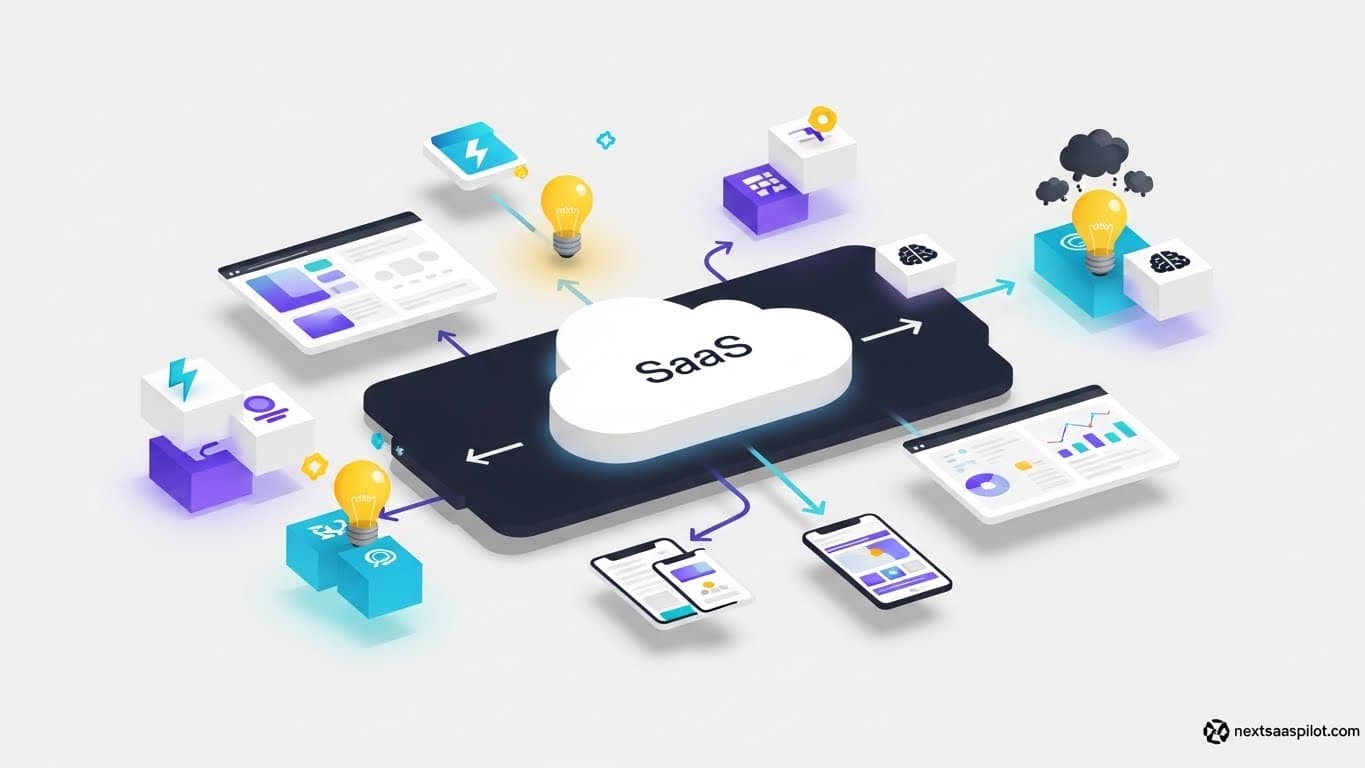
Innovative SaaS product ideas in 2025 are moving away from generic productivity tools and toward specialized, autonomous agents. The market is saturated with “to-do” lists, but it is starving for software that performs complex labor without human intervention. If you are looking to build the next unicorn or a profitable lifestyle business, the opportunity lies in solving “boring” problems with “agentic” AI.
This guide explores the most lucrative territories for founders this year, ranging from vertical-specific solutions to enterprise-grade compliance automation.
What Defines the Best SaaS Product Ideas in 2025?
The best SaaS product ideas in 2025 are defined by their ability to deliver outcomes rather than just utility. Unlike traditional tools that require constant user input, successful modern concepts leverage “Agentic AI” to autonomously execute workflows—such as scheduling, coding, or auditing—thereby reducing labor costs and increasing operational efficiency for the buyer.
The shift is subtle but profound. In 2020, a good SaaS idea was a tool that helped a human write a blog post faster. In 2025, a winning SaaS idea is an agent that researches, writes, and publishes the blog post while the human sleeps.
The “Service-as-Software” Shift: We are witnessing the death of “seat-based” pricing and the rise of “work-based” value.
- Old Idea: A CRM where sales reps log calls.
- New Idea: An AI voice agent that makes the calls and updates the CRM.
I recently spoke with a founder who pivoted from a generic “AI writing assistant” to a hyper-specific “AI Grant Writer for Non-Profits.” His revenue tripled in three months. Why? because he stopped selling a tool and started selling a completed task.
Which AI-Driven SaaS Ideas Are Ready for Disruption?
AI-driven SaaS ideas ready for disruption include autonomous compliance auditors, personalized employee training agents, and automated legacy code refactoring tools. These solutions address high-cost, high-friction corporate problems where human error is expensive, making them ideal targets for AI models that excel at pattern recognition and consistency.
The “AI wrapper” era is over. You cannot just put a UI on ChatGPT and call it a business. You must solve a deep workflow problem.
Idea 1: The “Compliance Copilot” Enterprises spend millions on internal audits.
- The Concept: An AI that continuously scans Slack, Email, and Jira for GDPR or SOC2 violations and auto-remediates them.
- Why it works: It reduces the risk of fines. See how this fits into the broader landscape of saas enterprise software.
Idea 2: Automated Legacy Code Refactoring Banks and airlines run on code written in the 1980s (COBOL).
- The Concept: A SaaS platform that ingests legacy codebases, documents them (which is often missing), and suggests modern refactoring in Python or Go.
- The Moat: Deep technical complexity and high switching costs.
Idea 3: AI-First Customer Support for Niche Industries General chatbots are bad.
- The Concept: A support agent trained specifically on plumbing parts or medical device schematics.
- The Value: It answers technical questions that a generic LLM would hallucinate on.
Why Is Vertical SaaS the Gold Mine for Founders?
Vertical SaaS is a gold mine because it targets specific industries with tailored features, resulting in lower churn and higher customer lifetime value compared to horizontal competitors. By solving the unique, unsexy problems of niche markets—like waste management or dental logistics—founders face less competition and gain rapid word-of-mouth growth.
“The riches are in the niches.” I cannot stress this enough. If you try to build another project management tool to kill Asana, you will die. But if you build “Asana for Funeral Homes,” you might own the market.
Idea 4: ERP for Specialized Trades Think about industries that run on pen and paper.
- The Concept: An all-in-one mobile ERP for Solar Panel Installers. It handles permitting, inventory, crew scheduling, and government rebate filings.
- Why it wins: Generic tools don’t handle “rebate filings.” This specific feature makes the product sticky. Check out successful saas companies that have dominated niches like this.
Idea 5: Supply Chain Transparency for Food
- The Concept: A platform that tracks farm-to-table data for organic food brands, ensuring compliance with new EU labeling laws.
- The Driver: Regulatory pressure is a great driver for SaaS adoption.
Idea 6: HOA (Home Owners Association) Management
- The Concept: A portal for HOAs to manage dues, vote on rules, and handle maintenance requests.
- The Reality: Most HOAs are run by volunteers using messy spreadsheets. They are desperate for organization.
What Micro-SaaS Ideas Can Solopreneurs Build?
Micro-SaaS ideas for solopreneurs focus on solving singular, painful problems within existing ecosystems like Shopify, Salesforce, or Notion. These “plugin” style apps require less marketing because they leverage the existing traffic of the parent platform’s marketplace, allowing a single developer to generate significant automated revenue.
You don’t need VC funding. You need a problem small enough to solve alone but annoying enough to pay for.
Idea 7: The “Missing Feature” Plugin Go to the Shopify App Store or Salesforce AppExchange reviews. Look for 1-star reviews saying “I wish this app did X.”
- The Concept: Build “X.” Maybe it’s a plugin that allows Shopify stores to bundle “Mystery Boxes” easily.
- Validation: The demand is already visible in the forums.
Idea 8: Notion Template Automator People love Notion, but hate setting it up.
- The Concept: A SaaS that connects to a user’s Google Calendar and automatically generates daily journal pages in Notion with meeting notes pre-filled.
Idea 9: API Connectors for Legacy Systems There are thousands of old software systems that don’t talk to the cloud.
- The Concept: A simple “middleman” service that translates data from an old SQL database into a JSON format for modern web apps. Read more on the technical side of building an API as a product.
How Can SaaS Solve Remote Work Challenges?
SaaS can solve remote work challenges by creating asynchronous communication platforms that replace constant video meetings and manage physical equipment logistics. As “hybrid” becomes the permanent standard, companies need better ways to track employee sentiment, manage asset retrieval, and foster culture without forcing real-time presence.
Remote work is here to stay, but the “Zoom fatigue” is real.
Idea 10: The “Async” Standup Tool
- The Concept: A video tool where teams record 2-minute updates. The AI analyzes the transcript, extracts action items, and updates the Jira board automatically.
- The Benefit: No more 9:00 AM meetings.
Idea 11: IT Asset Retrieval Platform When a remote employee quits, getting the laptop back is a nightmare.
- The Concept: A SaaS platform that connects HR software to logistics providers (UPS/FedEx). When an employee is offboarded in the HR system, the SaaS automatically ships a return box to their house and tracks the asset back to IT.
- Context: This blends software with real-world logistics, a trend seen in modern saas mobile apps.
What B2B SaaS Products Are Enterprises Craving?
Enterprises are craving B2B SaaS products that simplify security compliance, manage “SaaS sprawl,” and automate vendor risk assessments. As large organizations drown in thousands of subscriptions, they prioritize platforms that provide visibility, governance, and cost control over new productivity tools.
If you want to sell to the Fortune 500, solve a headache for the CIO or CFO.
Idea 12: The SaaS Sprawl Manager
- The Concept: A platform that ingests credit card statements and SSO logs to identify every software tool employees are using. It then highlights duplicate tools (e.g., “You have 50 people using Trello and 50 using Asana—consolidate?”).
- The Buyer: The CFO who wants to cut costs. This fits squarely into the high-demand category of b2b saas products.
Idea 13: Automated Vendor Risk Assessment Every time an enterprise buys software, they send a 100-question security spreadsheet.
- The Concept: An AI agent that reads the vendor’s documentation and fills out the security questionnaire automatically with citations.
Which Green Tech SaaS Ideas Are Trending?
Green Tech SaaS ideas trending in 2025 involve Carbon Accounting, ESG (Environmental, Social, and Governance) reporting, and supply chain ethical auditing. With new government mandates requiring companies to disclose their carbon footprint, businesses are scrambling for software that can calculate and report these metrics accurately.
Sustainability is no longer just PR; it is compliance.
Idea 14: Carbon Accounting for SMBs Enterprise tools exist, but small businesses are now being asked by their enterprise clients to report emissions.
- The Concept: A “QuickBooks for Carbon.” Connect it to the utility bill and travel expenses, and it estimates the carbon footprint.
Idea 15: Circular Economy Marketplace
- The Concept: A B2B platform for manufacturing companies to sell their “waste” (scrap metal, off-cuts) to other companies that can use it as raw material.
How Do You Validate SaaS Product Ideas Before Building?
You validate SaaS product ideas before building by conducting “Pre-Sales,” creating landing pages to test messaging, and interviewing potential users to confirm the pain point is acute enough to pay for. The goal is to collect hard data—email signups or deposits—rather than supportive words from friends.
Do not write a single line of code until you have sold the idea.
The “Smoke Test” Method:
- Build a Landing Page: Describe the problem and your solution.
- Run Ads: Spend $100 on LinkedIn or Google Ads targeting your niche.
- Measure: If nobody clicks or signs up, your idea (or messaging) is wrong.
The “Consulting Flip”: Start by solving the problem manually as a consultant. If people pay you for the manual service, they will pay for the software. This path is often covered in saas implementation guides where service transitions to product.
What Is the Role of Mobile in Future SaaS Ideas?
The role of mobile in future SaaS ideas is to empower the “deskless workforce”—the 80% of global workers who do not sit at a computer. Product ideas that focus on field services, logistics, and construction must be “mobile-first,” offering offline capabilities and native hardware integrations like camera scanning and GPS tracking.
We often forget that most people aren’t knowledge workers.
Idea 16: The “Offline-First” Field App
- The Concept: An app for oil rig inspectors that works perfectly without internet for 3 days and syncs when back online.
- The Tech: This requires sophisticated local database management, a key differentiator for saas mobile apps.
Idea 17: Augmented Reality (AR) Maintenance
- The Concept: An app where a junior technician points their phone at a broken machine, and the SaaS overlays repair instructions or connects them via video to a senior expert.
Can You Succeed with a SaaS Clone?
Yes, you can succeed with a SaaS clone if you differentiate through vertical specialization, superior user experience (UX), or a disruptive pricing model. Many successful companies are simply “X for Y” (e.g., “Uber for Dog Walking”), taking a proven business model and applying it to an underserved market segment.
You don’t need to invent the wheel; you just need to make it roll smoother for a specific person.
The Unbundling Strategy: Look at Craigslist or Excel. They do everything poorly.
- Idea: Unbundle Excel. Build a SaaS just for Cap Table Management (like Carta).
- Idea: Unbundle Craigslist. Build a SaaS just for finding roommates.
- Reference: See how established players started by cloning concepts in our saas examples list.
Why Is Financial Literacy Vital for SaaS Founders?
Financial literacy is vital for SaaS founders because understanding metrics like Customer Acquisition Cost (CAC), Lifetime Value (LTV), and Burn Rate determines whether a great product becomes a viable business. Without grasping the unit economics of recurring revenue, founders risk running out of cash even while growing.
It is tragic to see a good product die because of bad math. If you are building a SaaS, you are in the finance business.
- Pricing Power: Knowing how to price your product is a financial skill, not a marketing one.
- Churn Management: Understanding that retaining a customer is cheaper than finding a new one.
For founders without a finance background, investing time in a saas finance course or obtaining a saas certification can be the difference between bankruptcy and exit.
Final Thoughts
The window for building “lazy SaaS” has closed. You cannot just scrape data and sell it back to people. The winners of 2025 will be the founders who aren’t afraid to get their hands dirty in complex industries, who embrace AI agents to do real work, and who treat their software as a service that delivers guaranteed outcomes.
Don’t look for the “cool” idea. Look for the expensive, boring problem that nobody else wants to touch. That is where the margin is.
For a broader definition of the underlying delivery model, Software as a Service provides the foundational context for these innovations.