
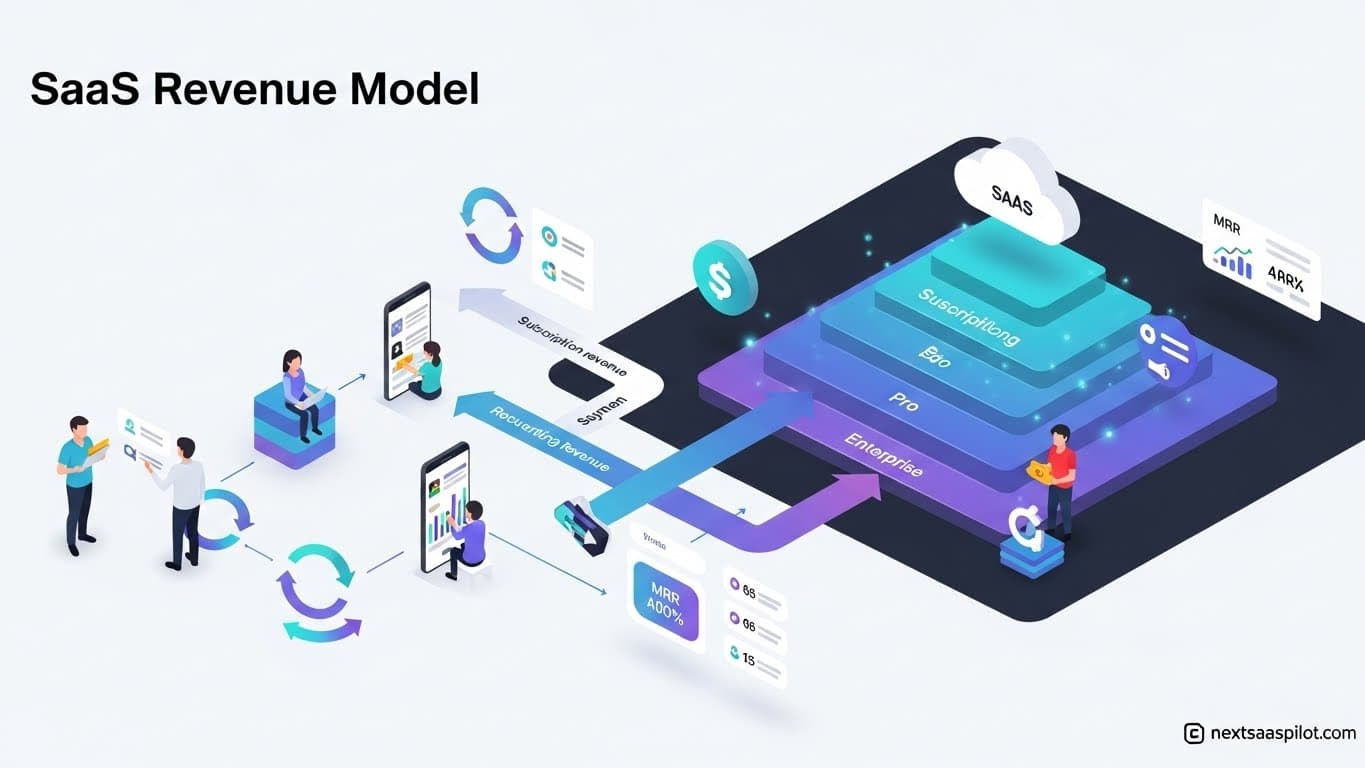
Selecting the right saas revenue model is the single most critical strategic decision a founder makes, determining not just how you get paid, but how you build, market, and scale your product. In the subscription economy, your pricing strategy is your product’s packaging; get it wrong, and even the best software will fail to generate sustainable cash flow.
I have advised startups that built incredible technology but failed because their revenue model was misaligned with the value they delivered. They charged flat rates for products that should have been usage-based, capping their upside, or they used per-seat pricing for tools used by only one admin, limiting their expansion. This guide dissects the mechanics of monetization, helping you choose a model that maximizes Customer Lifetime Value (LTV) while minimizing friction.
What Is a SaaS Revenue Model?
A SaaS revenue model is a framework that defines how a software company charges its customers for the value it provides, typically focusing on recurring revenue streams like subscriptions, usage fees, or transactional charges. Unlike the broader business model, which encompasses the entire value creation process, the revenue model focuses strictly on the monetization mechanism.
Think of the business model as the car engine—it generates power (value). The revenue model is the transmission—it transfers that power to the wheels (bank account). You can have a powerful engine, but if the transmission is broken, you won’t move forward.
In the modern saas business model, revenue is not a one-time event. It is a relationship. Therefore, your revenue model must align with how your customers derive success. If they succeed, they pay more. If they fail, they churn.
How Does a Revenue Model Differ from a Business Model?
The business model describes the holistic strategy of how a company creates, delivers, and captures value, whereas the revenue model specifically describes the pricing strategy and the structural method of collecting money from customers.
- Business Model: “We provide an AI-driven CRM to help sales teams close leads faster.”
- Revenue Model: “We charge $50 per user/month with tiered feature gates.”
Many founders conflate these terms. Understanding the distinction allows you to pivot your pricing (revenue model) without necessarily changing your core value proposition (business model). For a deeper dive into the broader strategy, review the fundamentals of the saas business model.
What Are the Most Effective SaaS Revenue Models?
The most proven revenue Models in SaaS are Flat Rate pricing, Per-User (Per-Seat) pricing, Tiered pricing, Usage-Based pricing, and Freemium; each serves a specific growth stage and customer type. Choosing the right one depends on whether your value metric is headcount, feature complexity, or raw consumption.
Let’s break down the pros and cons of the dominant strategies:
1. Is Flat-Rate Pricing Still Viable?
Flat-rate pricing charges a single fixed fee for access to the software, regardless of usage or user count. While simple to communicate, it is rarely used in scaling SaaS companies because it fails to capture the additional value generated by large enterprise customers.
I often see early-stage startups use this: “$29/month for everything.” It works for getting your first 50 customers. However, it leaves money on the table. If a Fortune 500 company signs up, they pay the same as a freelancer. You cannot expand revenue without acquiring new logos.
2. Why Is Per-User Pricing the Industry Standard?
Per-user pricing (or per-seat) charges a monthly fee for every individual login, making revenue growth predictable and directly aligned with the customer’s organizational adoption. It is the standard for collaborative tools like Slack, Salesforce, and Asana.
This model works best when the software relies on network effects—where the tool becomes more valuable as more people use it. However, beware of the “login sharing” trap, where teams share a single password to save money.
3. When Should You Use Usage-Based Pricing?
Usage-based pricing (pay-as-you-go) charges customers based on their actual consumption of resources, such as gigabytes stored, API requests made, or emails sent. This model, popularized by AWS and Snowflake, aligns cost perfectly with value but can lead to unpredictable revenue forecasting.
This is rapidly becoming the preferred model for infrastructure and developer tools. It removes the barrier to entry. A startup pays pennies; an enterprise pays millions. It naturally supports the what is xaas trend, where granular metering is possible.
4. The Tiered Pricing Strategy
Tiered pricing packages features into distinct bundles (e.g., Basic, Pro, Enterprise) at different price points, allowing you to capture different segments of the market simultaneously. This is the “Goldilocks” approach found on almost every pricing page.
How Do You Calculate Key Revenue Metrics?
To track the health of your revenue model, you must monitor Monthly Recurring Revenue (MRR), Annual Recurring Revenue (ARR), Customer Acquisition Cost (CAC), and Lifetime Value (LTV). These metrics tell you if your business is sustainable or if you are burning cash to acquire unprofitable customers.
You cannot optimize what you do not measure.
| Metric | Definition | Why It Matters |
| MRR | Monthly Recurring Revenue | The heartbeat of your cash flow. |
| ARR | Annual Recurring Revenue | Used for valuation and long-term planning. |
| CAC | Customer Acquisition Cost | Total marketing spend / New customers. |
| LTV | Lifetime Value | (ARPU × Gross Margin) / Churn Rate. |
| ARPU | Average Revenue Per User | Shows if you are moving upmarket. |
A healthy saas financial model usually aims for an LTV:CAC ratio of 3:1 or higher. If you spend $1 to get a customer, you should make $3 back.
The Freemium Trap: When to Avoid It?
Freemium serves as a marketing strategy where a basic version is free forever, aiming to convert a small percentage of users to paid plans; however, it creates high support costs and is only viable if you have a massive top-of-funnel market and low marginal costs.
I have seen startups bleed out using Freemium. If your product requires high-touch onboarding or has high server costs, Freemium will kill you. It is not a revenue model; it is an acquisition channel. It works for Zoom or Dropbox because their cost to serve a free user is near zero. If your saas architecture is expensive (e.g., heavy AI processing), avoid Freemium.
How Does Architecture Impact Your Revenue Model?
Your technical architecture dictates the flexibility of your revenue model; usage-based pricing requires a complex metering engine, while per-seat pricing requires robust identity management and provisioning systems.
If you decide to pivot from “Per Seat” to “Usage Based,” you can’t just change the website text. You need code that tracks every API call. You need a database that aggregates this data in real-time.
- Metering Service: Logs usage events.
- Billing Engine: Applies pricing logic to those events.
- Payment Gateway: Collects the funds.
This operational reality is why saas subscription model decisions must be made in tandem with engineering.
The Impact of Churn on Revenue Sustainability
Churn is the percentage of customers who cancel their subscription; high churn renders even the best revenue model useless because you cannot grow if you are leaking customers faster than you can acquire them.
There are two types of churn:
- Voluntary Churn: They don’t like the product.
- Involuntary Churn: Their credit card failed.
Your revenue model must account for “Expansion Revenue” (Upsells/Cross-sells) to offset churn. This is known as “Net Negative Churn.” If your existing customers spend more each year, you can grow even without new sales. This is the power of the subscription based software model.
Hybrid Models: Can You Mix Strategies?
Yes, the most profitable SaaS companies often use hybrid models, such as charging a base subscription fee (platform fee) plus a usage-based component (overages), which stabilizes cash flow while allowing for uncapped upside.
Example: An email marketing platform charges $50/month (Base) which includes 5,000 emails. If you send more, you pay $0.01 per email (Usage).
This gives you the predictability of a subscription with the scalability of usage. It aligns the saas revenue model with the customer’s growth.
Operationalizing Revenue: Billing and FinOps
Implementing your revenue model requires strict financial operations (FinOps) to monitor the Cost of Goods Sold (COGS) per tenant, ensuring that your pricing covers the underlying infrastructure costs.
If you charge $10/month, but your cloud application management costs for that user are $12/month, you are scaling a loss. You must track profitability at the unit level.
This is especially relevant when choosing between caas vs paas; using expensive PaaS infrastructure might eat your margins in a low-cost revenue model.
The Role of Sales vs. Product-Led Growth (PLG)
Your revenue model dictates your go-to-market strategy; low-price models ($10-$50/mo) require Product-Led Growth with self-service checkout, while high-price models ($10k+/yr) require a dedicated sales team to navigate complex procurement processes.
You cannot afford a sales team if your ARPU (Average Revenue Per User) is $20. The math doesn’t work.
- PLG: User finds, tries, and buys the software without human contact.
- Sales-Led: User requests a demo, negotiates a contract.
Your saas organizational structure must adapt to this. PLG needs more engineers and designers. Sales-Led needs Account Executives.
Conclusion
A saas revenue model is never finished. It is an iterative process of experimentation. As you move upmarket, you might shift from flat-rate to tiered. As you add AI features, you might add usage-based tokens.
The goal is to find the friction point where the customer feels they are getting more value than they are paying for, while you generate enough margin to reinvest in the product. Start simple, measure everything, and don’t be afraid to raise your prices as your value increases.