
Mastering the saas subscription model is the difference between a startup that burns out in year one and a unicorn that compounds revenue for a decade. In the software-as-a-service economy, the sale doesn’t end when the customer signs the contract; that is merely the starting line. The real challenge lies in designing a pricing structure that scales with value and a retention strategy that prevents the “leaky bucket” of churn.
I have worked with founders who engineered brilliant software but failed because they treated subscriptions like one-time transactions. They hardcoded pricing tiers that trapped them in low margins, or they ignored involuntary churn until it ate 10% of their revenue. This guide dissects the mechanics of recurring revenue, helping you align your pricing psychology with your technical architecture to build a resilient business.
What Is a SaaS Subscription Model?
A SaaS subscription model is a recurring revenue framework where customers pay a periodic fee (typically monthly or annually) to access software hosted in the cloud, rather than purchasing a perpetual license upfront. This shifts the vendor’s focus from selling units to maintaining long-term relationships and delivering continuous value.
In the old world of “shrink-wrapped” software, you sold a box, collected the cash, and hoped the user would come back in two years for an upgrade. In the modern subscription based software model, you are essentially renting out your technology.
This creates a fundamental shift in economics. Your revenue isn’t a spike; it’s a stream. This predictability allows for aggressive reinvestment in growth, but it also means you must constantly re-earn the customer’s business. If the software stops working or stops improving, the subscription stops.
How Do You Choose the Right Pricing Strategy?
The most effective pricing strategy depends on your “value metric”—the unit by which your customer derives success—ranging from Flat-Rate (simplicity) and Per-Seat (collaboration) to Tiered (segmentation) and Usage-Based (consumption) models. Aligning price with value consumption is the single most powerful lever for growth.
Choosing the wrong pricing model is a silent killer. Here is a breakdown of the standard strategies:
- Flat-Rate Pricing: You charge one price for the product, regardless of usage.
- Pros: Easy to sell, easy to build.
- Cons: You leave money on the table with large enterprises and price out small startups.
- Per-User (Per-Seat) Pricing: The industry standard for B2B tools like Slack or Asana.
- Pros: Revenue scales naturally as your customer’s team grows.
- Cons: Can discourage adoption; teams might share logins to save money.
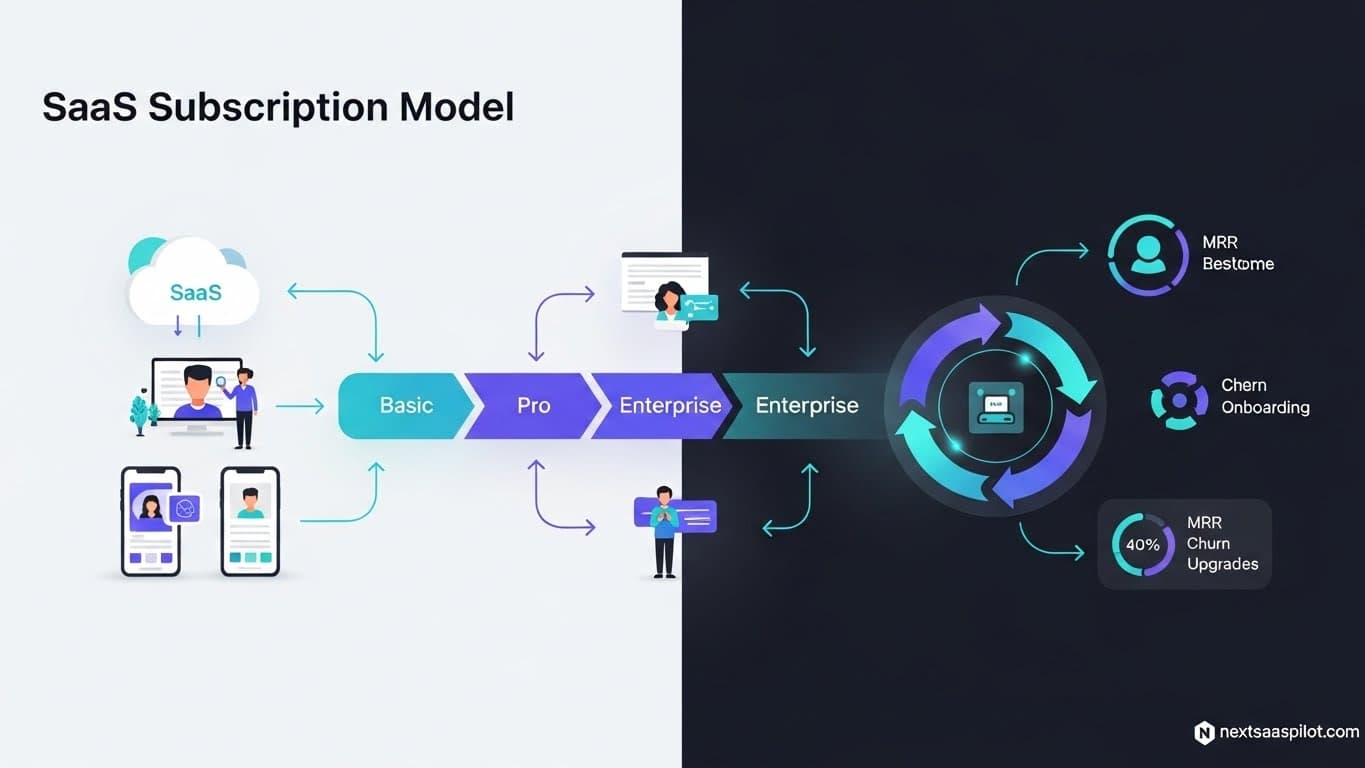
- Tiered Pricing: Offering bundles (e.g., Basic, Pro, Enterprise) with different feature sets.
- Pros: Captures different personas and willingness to pay.
- Cons: Complexity in feature gating.
- Usage-Based Pricing: Charging based on consumption (e.g., API calls, storage, emails sent).
- Pros: Lowest barrier to entry; unlimited upside (e.g., AWS, Snowflake).
- Cons: Harder to forecast revenue; customers fear “bill shock.”
Your choice here dictates your saas revenue model. If you choose usage-based pricing, your entire engineering stack must support accurate metering.
Is Freemium a Viable Subscription Strategy?
Freemium is a customer acquisition strategy, not a revenue model, where a basic version is offered for free forever to attract a wide user base, with the goal of converting a small percentage to paid plans. It is only viable if your marginal cost to serve an additional user is near zero and you have a massive addressable market.
I have seen startups bleed cash because they offered a “Free Tier” that included expensive compute resources. Freemium works for Dropbox because storage is cheap. It fails for AI startups where every query costs money.
If you implement Freemium, you must have a relentless focus on conversion rates. If free users aren’t upgrading, you are running a charity, not a business. Often, a “Free Trial” (time-limited) is safer for B2B products than a “Free Tier” (feature-limited).
What Metrics Define Subscription Success?
To manage a subscription business, you must track Monthly Recurring Revenue (MRR), Annual Recurring Revenue (ARR), Customer Acquisition Cost (CAC), Lifetime Value (LTV), and Churn Rate. These metrics provide the diagnostic health check of your financial engine.
You cannot improve what you do not measure. A robust saas financial model relies on these pillars:
| Metric | Definition | The Goal |
| MRR | Total predictable revenue for the month. | Consistent month-over-month growth. |
| CAC | Total Sales & Marketing Cost / New Customers. | Recover CAC in < 12 months. |
| LTV | Average Revenue Per User (ARPU) × Customer Lifetime. | LTV should be 3x higher than CAC. |
| Churn | Percentage of revenue/customers lost. | Keep under 5% annually for enterprise, <5% monthly for B2C. |
| NRR | Net Revenue Retention. | > 100% (Expansion revenue outweighs churn). |
How Does Churn Impact the Subscription Model?
Churn is the rate at which customers cancel their subscriptions; minimizing it is critical because acquiring a new customer costs 5 to 25 times more than retaining an existing one. Churn compounds negatively, meaning a high churn rate will eventually cap your growth regardless of how many new users you acquire.
There are two types of churn you must fight:
- Voluntary Churn: The customer clicks “Cancel” because they didn’t see value. This is a product or Customer Success failure.
- Involuntary Churn: The customer’s credit card failed, and their subscription lapsed. This is an operational failure.
Implementing “Dunning Management”—automated emails and retries for failed payments—can recover 20-40% of involuntary churn. This is “found money.”
What Is the Role of Architecture in Subscriptions?
Your technical architecture must support your subscription logic by integrating a billing engine with your identity provider and database, enabling automated provisioning (upgrades) and de-provisioning (cancellations) without manual intervention.
If a user upgrades from “Basic” to “Pro,” they expect the new features to unlock instantly. They don’t want to wait for a human to flip a switch.
This requires a tight coupling between your payment gateway (like Stripe) and your application logic.
- Identity Management: Controlling who can log in.
- Feature Flagging: Checking
if (user.plan == 'pro')before rendering a component. - Webhooks: Listening for payment success events to update the database.
Refer to our guide on saas architecture to see how billing engines fit into the broader tech stack.
The Psychology of Pricing Pages
An effective pricing page uses psychological triggers like “Decoy Pricing” (adding an expensive option to make the middle option look like a deal) and “Anchoring” to guide users toward the preferred tier. The design should reduce cognitive load and highlight the “Recommended” plan clearly.
Your pricing page is the most important landing page on your site.
- Simplicity: Don’t offer 10 plans. Offer 3.
- Currency: Display local currency if possible.
- Annual Discounts: Offer “2 months free” for annual payments. This improves your cash flow upfront and reduces churn (users commit for a year).
This connects directly to the broader saas business model, where cash flow management is often the biggest hurdle for early-stage companies.
Moving Upmarket: Enterprise Subscriptions
Enterprise subscriptions differ from standard plans by requiring custom contracts, Service Level Agreements (SLAs), security compliance (SOC 2), and often a dedicated Account Executive rather than self-service checkout.
When you move upmarket, the saas organizational structure changes. You move from “Product-Led Growth” (PLG) to “Sales-Led Growth.”
Enterprises don’t pay with credit cards; they pay with invoices. Your system must handle purchase orders and wire transfers. They also demand “Single Tenant” or isolated environments for security, which impacts your cloud application management.
How Do Usage-Based Models Fit the Future?
Usage-based models are becoming the standard for AI and infrastructure tools, aligning costs directly with value; however, they require complex metering infrastructure to track consumption in real-time and bill accurately.
This is the what is xaas evolution. If you are building an API, charging per seat makes no sense. You charge per request.
However, this introduces architectural complexity. You need a high-performance metering system that doesn’t slow down the app. If you use a PaaS for this, your margins might suffer due to high infrastructure costs, so often a caas vs paas analysis is required to ensure your unit economics remain positive.
Conclusion
The saas subscription model is a promise of ongoing value. It forces you to build a better product every day.
Founders often obsess over the “Acquisition” side of the funnel—getting the signup. But the unicorns are built on the “Retention” side—keeping the subscription. By aligning your pricing strategy with your customers’ success and building an architecture that handles the lifecycle of billing seamlessly, you turn your software into a compound interest machine.
For more on the economic theory behind recurring revenue, see Subscription Business Models.