
Your SaaS tech stack is the digital spine of your business. In 2026, choosing the right technologies is no longer just about coding preferences; it is a strategic business decision that dictates your speed to market, ability to hire talent, and future valuation. A bloated stack burns cash, while a lean stack accelerates innovation.
Founders often suffer from “Shiny Object Syndrome,” picking the newest, trendiest frameworks only to hit a wall when they need to scale. Conversely, sticking to outdated legacy systems creates massive technical debt. The sweet spot lies in boring, battle-tested technologies paired with modern, AI-ready infrastructure.
This guide provides a pragmatic, CTO-level analysis of the ideal architecture for building scalable, profitable software today.
What Is a SaaS Tech Stack?
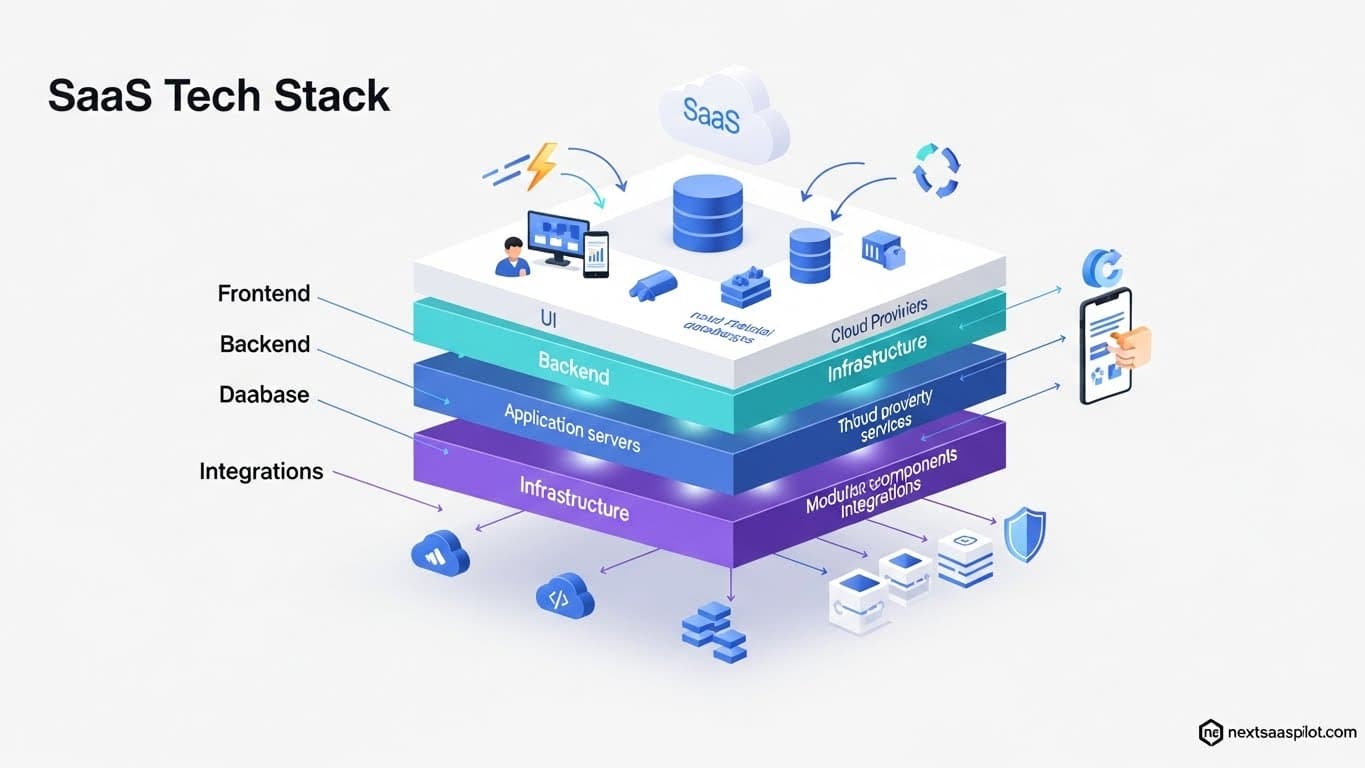
A SaaS tech stack is the combination of programming languages, frameworks, libraries, databases, and server infrastructure used to build a cloud-based software application. It typically consists of the Frontend (client-side), Backend (server-side), Database (storage), and Infrastructure (hosting/DevOps).
Think of your stack as the materials used to construct a building. You need concrete for the foundation (database), steel for the frame (backend), and glass for the facade (frontend). If you choose wood for a skyscraper, it will collapse.
The Four Core Layers:
- Frontend: What the user sees (UI/UX).
- Backend: The logic and intelligence.
- Database: Where the data lives.
- Infrastructure: Where the code runs.
How Do You Choose the Right Tech Stack for 2025?
Choose the right tech stack by prioritizing developer velocity, community support, and talent availability over raw performance benchmarks. In 2025, the ideal stack leans heavily on “Serverless” and “Managed Services” to reduce DevOps overhead, allowing small teams to ship features faster than large enterprises.
Do not reinvent the wheel. If you are building a CRM, do not build your own database engine.
The Selection Criteria:
- Talent Pool: Can you hire developers easily? (JavaScript developers are everywhere; Rust developers are rare/expensive).
- Ecosystem: Are there pre-built libraries for Stripe, Twilio, and OpenAI?
- Scalability: Will this handle 100 users? How about 1 million?
- Exit Strategy: Investors prefer standard stacks (React/Node/Python) because they are easier to audit and acquire.
Understanding the SaaS lifecycle helps here. In the early stages, speed is everything. In later stages, stability is king.
What Is the Best Frontend Framework?
The best frontend framework for 2025 is React.js (specifically Next.js), due to its massive ecosystem, SEO capabilities, and component reusability. While Vue.js is easier to learn and Angular is powerful for enterprise, React remains the industry standard, ensuring you can easily find developers and pre-built UI kits.
Your frontend determines your user experience. If it feels slow or clunky, users churn.
Why Next.js (React) Wins:
- Server-Side Rendering (SSR): Crucial for SEO and fast initial load times.
- Vercel Integration: Deploys in seconds.
- Component Libraries: You can copy-paste beautiful UIs from libraries like Tailwind UI or Shadcn.
Alternative Options:
- Vue.js: Great for solo founders who want simplicity.
- Svelte: fast performance, but a smaller hiring pool.
When designing your frontend, looking at SaaS website inspiration can help you visualize how these frameworks render complex dashboards in the real world.
Which Backend Language Should You Choose?
Choose Node.js (JavaScript/TypeScript) if you want a unified full-stack team using one language, or Python if your product relies heavily on AI, data science, or machine learning. Go (Golang) is an excellent alternative for high-performance microservices, but Node.js and Python remain the top choices for speed of development.
The backend is the brain of your application.
The “One Language” Strategy: Using TypeScript for both frontend and backend (via Node.js) is a massive efficiency hack. Developers can switch contexts instantly, and you can share code (types/interfaces) between the client and server. This significantly reduces bugs.
The AI Factor: If you are building an AI wrapper or data tool, Python is non-negotiable. The libraries for AI (PyTorch, TensorFlow, LangChain) are native to Python.
Database: SQL vs. NoSQL for SaaS?
Use a SQL database like PostgreSQL for B2B SaaS applications requiring complex relationships, financial transactions, and structured data integrity. Use NoSQL databases like MongoDB only for high-volume, unstructured data logs or rapid prototyping where the schema changes frequently.
In 2026, PostgreSQL is the default choice for 90% of startups.
Why SQL (Postgres) Dominates:
- ACID Compliance: Ensures data validity (vital for billing).
- JSON Support: Postgres handles JSON well, bridging the gap with NoSQL.
- Extensions: Tools like PostGIS (maps) or pgvector (AI vector search) turn Postgres into a super-database.
The Mistake to Avoid: Don’t choose NoSQL just because it’s “easy.” Migrating from NoSQL to SQL later when you need complex reporting is a nightmare often handled by a specialized SaaS development company at a high cost.
What Is the Modern Infrastructure Stack (Cloud)?
The modern infrastructure stack has shifted from raw IaaS (AWS EC2) to PaaS and Serverless solutions like Vercel, Supabase, and Render. These platforms abstract away server management, allowing teams to deploy code via Git push without hiring a dedicated DevOps engineer.
Unless you are Netflix, you do not need to manage Kubernetes clusters manually.
The “Indie/Startup” Stack:
- Frontend Hosting: Vercel or Netlify.
- Backend/Database: Supabase (Postgres + Auth) or Firebase.
- Media Storage: AWS S3 (or Cloudflare R2 for zero egress fees).
The “Scale/Enterprise” Stack:
- Cloud Provider: AWS or Azure.
- Containerization: Docker.
- Orchestration: Amazon ECS or EKS.
This aligns with modern SaaS platform development principles: buy infrastructure, don’t build it.
How Do You Integrate AI into the Tech Stack?
Integrate AI by adding a Vector Database (like Pinecone or pgvector) to store embeddings and an Orchestration Layer (like LangChain) to manage interactions with LLMs. This allows your SaaS to “remember” user data and provide context-aware AI responses rather than just wrapping generic ChatGPT API calls.
AI is no longer a feature; it is a layer of the stack.
The AI Stack Components:
- LLM Provider: OpenAI (GPT-4), Anthropic (Claude), or open-source models via Hugging Face.
- Vector Store: A database that understands “meaning,” not just keywords.
- Orchestration: Code that chains prompts together (e.g., “Read this PDF, summarize it, then email it”).
What About Payments and Billing?
For payments and billing, Stripe remains the undisputed standard due to its developer-friendly API and comprehensive handling of global taxes, subscriptions, and invoicing. Alternatives like Paddle act as a “Merchant of Record,” handling sales tax liability for you, which is ideal for lean global teams.
Do not build your own billing engine. It is a regulatory minefield.
Integration: Stripe integrates seamlessly with the software project management of your user tiers. When a user upgrades, Stripe sends a webhook to your backend to unlock features instantly.
How Does the Stack Change from MVP to Scale?
From MVP to scale, the stack evolves from a monolithic architecture (all code in one place) to microservices (separated functions) to handle load. Initially, prioritize speed and simplicity (e.g., a single Next.js repo); as you scale, introduce caching (Redis), load balancers, and dedicated service layers.
The MVP Phase:
- Speed is life.
- Use “Boring Technology” you already know.
- Reference our guide on the SaaS MVP for specific scoping strategies.
The Scale Phase:
- Optimize for latency.
- Split the frontend and backend if needed.
- Invest in observability tools (Datadog, Sentry) to track errors.
Final Thoughts
The best SaaS tech stack is the one that allows you to ship value to customers today, not six months from now.
In 2025, the winning formula is often: TypeScript (Next.js) for the frontend, Node.js or Python for the backend, PostgreSQL for the database, and Vercel/Supabase for infrastructure. This combination maximizes developer happiness, community support, and scalability.
When you are learning how to start a software company, remember: Technology is just a tool. The business model is the product.