
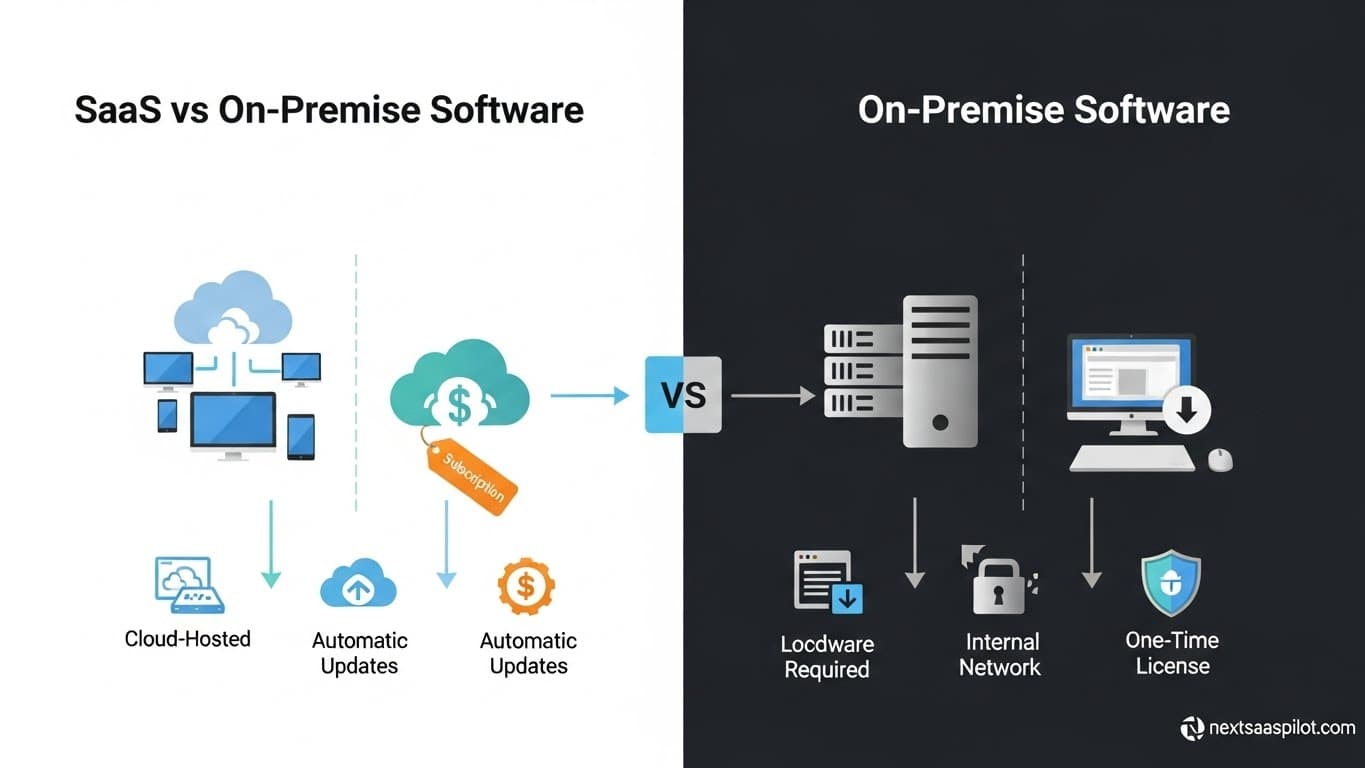
The debate between SaaS vs On-Premise software has shifted from a technical preference to a critical financial strategy. In 2025, the question is no longer just about where your data lives; it is about how fast your business can pivot.
While SaaS offers rapid scalability and lower upfront costs, On-Premise remains the fortress of control for highly regulated industries. Choosing the wrong model today can bleed your budget through hidden cloud egress fees or shackle your innovation with depreciating hardware.
This comprehensive guide dissects the financial, operational, and security realities of both models to help you decide which architecture aligns with your future.
What Is the Core Difference Between SaaS and On-Premise?
The core difference lies in deployment and responsibility. SaaS (Software as a Service) is hosted and managed by a third-party vendor in the cloud, accessed via the internet. On-Premise software is installed locally on a company’s own servers, requiring the organization to manage the hardware, security, and maintenance internally.
Think of it as the difference between renting a luxury apartment (SaaS) and building a custom house (On-Premise).
- SaaS: You pay a monthly fee. If the roof leaks, the landlord fixes it. If you need more space, you upgrade your plan.
- On-Premise: You buy the land and bricks. You have total freedom to renovate, but if the furnace breaks at 2 AM, you are the one fixing it.
SaaS vs On-Premise: A Technical Comparison
| Feature | SaaS (Cloud) | On-Premise (Local) |
| Deployment | Instant (Browser/App based) | Slow (Requires hardware setup) |
| Cost Model | OpEx (Subscription, predictable) | CapEx (Upfront hardware/license) |
| Maintenance | Vendor-managed (Automatic updates) | IT-managed (Manual patches) |
| Scalability | Instant (Click to add seats) | Limited (Buy more servers) |
| Data Control | Shared responsibility | 100% Internal control |
The “Hidden Cost” Reality Check: TCO in 2025
Total Cost of Ownership (TCO) is rarely what it seems on the sticker price. While SaaS appears cheaper initially, scaling costs can spiral. Conversely, On-Premise appears expensive upfront, but operational energy costs are rising faster than hardware prices.
The Hidden Costs of SaaS: Egress Fees
SaaS is not always the cheaper option for data-heavy companies.
- The Trap: Cloud providers often charge minimal fees to upload data (Ingress) but hefty fees to move it out (Egress).
- Real-World Example: GEICO famously saw their cloud costs triple after migrating hundreds of applications, realizing that for certain stable, high-volume workloads, the “rent” was higher than the “mortgage.”
- 2025 Stat: Research indicates that up to 6% of total cloud storage costs now come from unexpected egress and retrieval fees.
The Hidden Costs of On-Premise: The Energy Spike
On-premise servers are capital assets, but they are also energy vampires.
- The Trap: With global energy prices volatile, the cost to power and cool a private data center has skyrocketed.
- Projection: Data center energy consumption is projected to rise 25% by 2030, meaning your “fixed” on-premise costs are actually subject to utility inflation.
Security vs. Sovereignty: Who owns the Risk?
Security in SaaS is about trust; security in On-Premise is about control. In 2025, SaaS providers like Microsoft and AWS generally offer better cybersecurity than any single company can build, but they cannot offer “Data Sovereignty” in the same way a locked server room can.
The SaaS Security Advantage
SaaS vendors invest billions in threat detection.
- Pros: Automatic patching of zero-day vulnerabilities. You don’t need to wake up at 3 AM to patch a server.
- Cons: You are one tenant in a massive building. If the vendor suffers a breach (like the Identity attacks seen in 2024), your data is at risk despite your own good hygiene.
The On-Premise Sovereignty Advantage
For industries like Defense, Aerospace, and Government, where the data sits is a legal requirement.
- Use Case: Airbus maintains significant on-premise infrastructure not because they dislike the cloud, but because aviation manufacturing data often cannot legally leave the country of origin due to ITAR and export control laws.
- The Trade-off: You have total control, but you also have total liability. If you get hacked, there is no vendor to blame.
The Rise of Hybrid Cloud: The “Best of Both Worlds”?
The hybrid model is the dominant trend for 2025, combining the agility of SaaS for customer-facing apps with the security of On-Premise for core databases. Companies use middleware like MuleSoft or Dell Boomi to bridge legacy mainframes with modern cloud tools.
Complete cloud migration is rare. “Repatriation”—moving workloads back on-premise—is happening for specific use cases like Dropbox, who saved millions by building their own storage infrastructure.
Successful Hybrid Architecture:
- Tier 1 Data (Highly Sensitive): Kept On-Premise (e.g., Patient health records, banking cores).
- Tier 2 Data (Operational): Processed in Private Cloud.
- Tier 3 Apps (Collaboration/CRM): SaaS (e.g., Salesforce, Slack, Zoom).
Implementation Tip:
If connecting a legacy mainframe to a modern SaaS, avoid custom code. Use established API gateways. A common failure mode in 2024 was companies trying to build custom connectors that broke whenever the SaaS vendor updated their API.
Industry Verdict: Which Should You Choose?
Choose SaaS if you are a startup or SMB prioritizing speed and cash flow preservation. Choose On-Premise if you are a massive enterprise with stable, predictable workloads or strict regulatory requirements that prohibit third-party data hosting.
Startup / SMB Verdict: Go SaaS
- Why: You cannot afford the CapEx of servers or the salary of a SysAdmin. Speed is your only advantage.
- Tools: SaaS for small business stacks like HubSpot and QuickBooks allow you to operate like a Fortune 500 company on a shoestring budget.
Enterprise Verdict: Go Hybrid
- Why: You have legacy “technical debt” that cannot be moved, but you need modern tools to compete.
- Strategy: Keep your “Systems of Record” (ERP, Core Banking) on-premise but surround them with “Systems of Engagement” (Mobile Apps, Analytics) in the cloud.
Final Thoughts on the Future of Deployment
The war between SaaS vs On-Premise is ending in a truce. The future isn’t binary; it’s composable.
The most successful companies in 2025 aren’t those who zealously stick to one model. They are the ones who treat infrastructure as a portfolio—investing in On-Premise where control is currency, and spending on SaaS where speed is survival.
For a deeper look at the market shifts driving these decisions, check our latest SaaS industry report.