
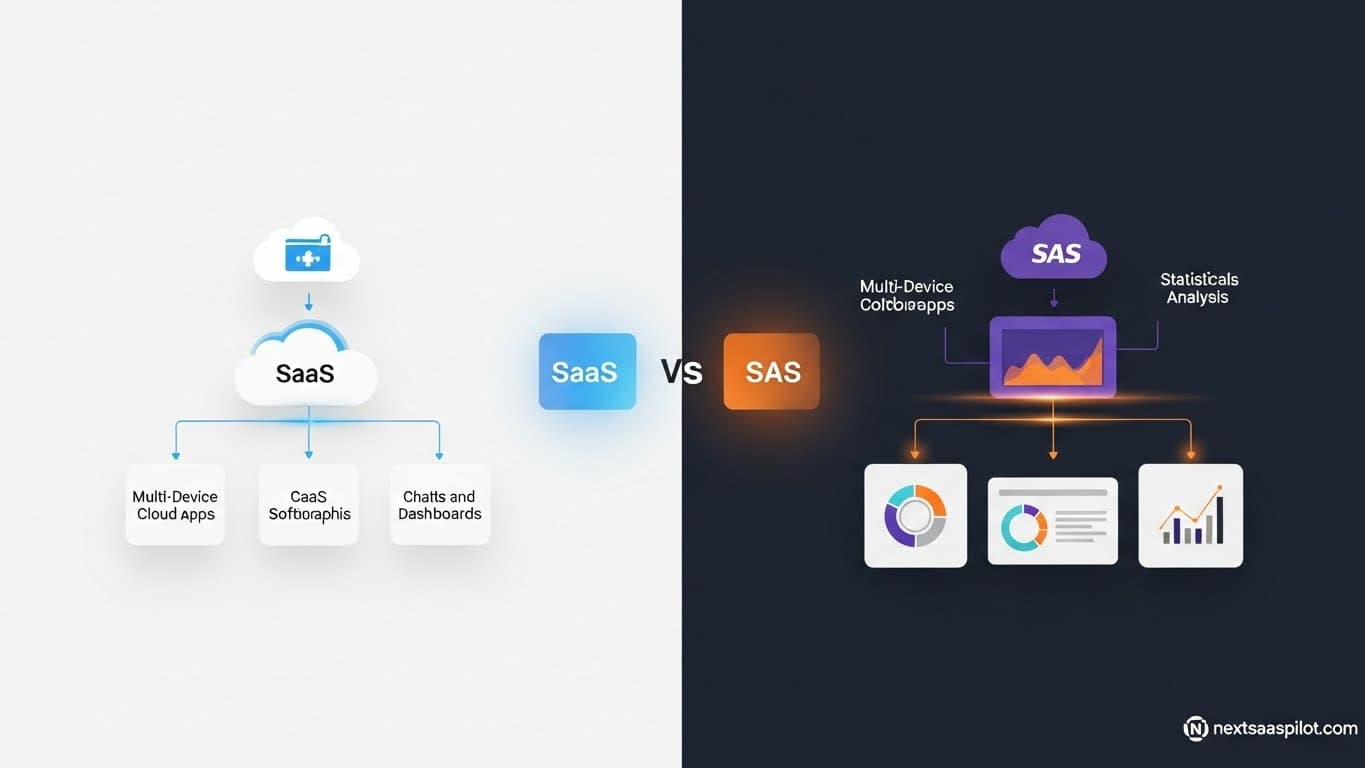
SaaS (Software as a Service) is a cloud-based delivery model where you subscribe to software hosted online, whereas SAS (Statistical Analysis System) is a specific software suite used for advanced data analytics and business intelligence. Confusing the two is common because they sound identical, but one describes how you buy software, and the other is a specific brand of software.
If you are a founder, investor, or job seeker, knowing the difference saves you from embarrassing mix-ups. I once witnessed a sales candidate interview for a role at a “SAS” consultancy, spending 20 minutes pitching their expertise in recurring revenue models (SaaS), only to realize the company analyzed clinical trial data for pharmaceutical giants. The acronyms are similar; the worlds are not.
This guide breaks down the technical, financial, and operational differences between these two pillars of the tech world.
What Is SaaS (Software as a Service)?
SaaS (Software as a Service) is a software delivery model where applications are hosted by a vendor in the cloud and accessed by users via the internet, typically on a subscription basis. It eliminates the need for users to install, maintain, or update hardware or software locally.
SaaS is the default business model of the modern internet. If you use Gmail, Slack, or Netflix, you are a SaaS user.
Core Characteristics of SaaS:
- Cloud-Hosted: It lives on someone else’s servers (AWS, Azure, Google Cloud).
- Subscription Pricing: You pay a monthly or annual fee (OpEx) rather than a one-time purchase (CapEx).
- Automatic Updates: New features appear without you needing to download a “Version 2.0” patch.
For a deeper look at the companies defining this space, review our list of public SaaS companies.
What Is SAS (Statistical Analysis System)?
SAS is a proprietary software suite developed by the SAS Institute for advanced analytics, multivariate analysis, business intelligence, data management, and predictive modeling. It is the gold standard in highly regulated industries like healthcare, banking, and government for processing massive datasets.
SAS is not a “model”; it is a product. It has its own programming language (also called SAS) and is famous for its ability to handle data at a scale that would crash Excel in seconds.
Core Characteristics of SAS:
- Heavy Analytics: Designed for complex statistical operations (regression, forecasting, optimization).
- Legacy & Reliability: It has been around since the 1970s and is trusted by the FDA for clinical drug trials.
- Hybrid Deployment: Historically on-premise, but modern versions like SAS Viya operate in the cloud.
How Do SaaS and SAS Differ in Business Models?
SaaS is a delivery method applicable to any software category (CRM, HR, Marketing), while SAS is a specific vendor focused on data science. While SaaS companies aim for “viral growth” and user-friendly interfaces, SAS focuses on enterprise-grade reliability, compliance, and deep technical functionality for data scientists.
Comparison Table: SaaS vs. SAS
| Feature | SaaS (The Model) | SAS (The Software) |
| Full Name | Software as a Service | Statistical Analysis System |
| What is it? | A method of delivering software. | A brand of analytics software. |
| Primary User | Everyone (Sales, HR, Consumers). | Data Scientists, Statisticians, Risk Officers. |
| Pricing | Low barrier (e.g., $10/user/month). | High enterprise contracts (Often $10k+). |
| Learning Curve | Low (Designed for ease of use). | High (Requires learning a coding language). |
| Examples | Zoom, Salesforce, HubSpot. | SAS Viya, SAS/STAT, JMP. |
Why Do People Confuse SaaS and SAS?
People confuse SaaS and SAS because the acronyms are pronounced identically (“sass”) and both involve enterprise technology. This confusion is rampant in the job market, where recruiters or candidates mix up “SaaS Sales” (selling subscription software) with “SAS Programming” (writing code for statistical analysis).
The “Resume Roulette” Problem:
- Job A: “Looking for a SaaS Expert.” (They want someone who knows how to lower churn and increase recurring revenue.)
- Job B: “Looking for a SAS Expert.” (They want someone who can write PROC SQL queries to analyze patient survival rates.)
If you are entering the tech field, be precise. I have seen resumes list “Proficient in SaaS” which is meaningless—it’s like saying “Proficient in Subscription.” Conversely, listing “Proficient in SAS” tells a recruiter you know a specific, hard technical skill.
What Are the Key Use Cases for SAS Software?
The key use cases for SAS software are clinical trial analysis, financial fraud detection, and government risk management. Because SAS code is proprietary and heavily audited, it is the preferred choice for industries that require absolute data lineage and security to satisfy regulators like the FDA or SEC.
You don’t use SAS to manage your calendar; you use it to predict if a bank loan will default.
Industry Examples:
- Pharma: Analyzing Phase III drug trial data to prove efficacy to the FDA.
- Banking: Real-time monitoring of millions of credit card transactions to spot fraud.
- Government: optimizing logistics for disaster relief or census data analysis.
While modern open-source languages like Python and R are popular, SAS remains dominant in legacy sectors because of its “supported” nature—if the code fails, there is a company to sue. With open source, there isn’t.
Can SAS Be Delivered as a SaaS?
Yes, SAS can be delivered as a SaaS solution, specifically through its modern platform, SAS Viya. SAS Institute has modernized its offering to run on cloud infrastructure (Azure, AWS), allowing customers to access SAS tools via a browser-based subscription model, effectively making it “SAS as a SaaS.”
This is where the lines blur.
- Old World: You bought a SAS license and installed it on a mainframe in your basement.
- New World: You subscribe to SAS Viya on the cloud.
This evolution is critical for their survival against cloud-native competitors. You can read more about these shifts in our SaaS industry report.
Which Career Path is More Lucrative: SaaS or SAS?
Both career paths are lucrative but reward different skill sets; SaaS careers (Sales, Product, CSM) reward strategic thinking and revenue generation, while SAS careers (Data Analyst, Programmer) reward deep technical and mathematical expertise. Senior roles in either field frequently command six-figure salaries.
- The SaaS Path: High variance. A top Enterprise Account Executive at a SaaS enterprise software company can make $300k+ in commissions, but the pressure is immense.
- The SAS Path: High stability. A Senior SAS Programmer in the pharmaceutical industry is a specialized role with a steady, high salary and high job security due to the scarcity of the skill.
How Does Pricing Differ Between the Two?
SaaS pricing is typically transparent, per-user, and monthly (e.g., $50/seat), promoting easy entry and scalability. SAS pricing is traditionally opaque, quote-based, and involves complex capacity licensing based on “cores” or processing power, though they are shifting toward more transparent cloud consumption models.
SaaS Pricing:
- Freemium: Free for basic use, pay for features.
- Tiered: Basic, Pro, Enterprise.
- Predictable: You know exactly what you will pay next month.
SAS Pricing:
- Capacity-Based: You pay for how much computing power you need to run your models.
- Consultative: You usually have to talk to a sales rep to get a price.
- High Floor: It is rarely cheap to start.
To master the financial side of the subscription model, consider exploring a SaaS finance course.
Final Thoughts on the Distinction
The difference between SaaS vs SAS is the difference between a business model and a tool.
- SaaS is the wave that lifted all boats, changing how we buy and use technology.
- SAS is a battleship—a powerful, specialized vessel designed for heavy lifting in rough seas.
In 2025, you are likely a user of SaaS every day. But if your credit card fraud alert goes off, or your medicine is approved, you have SAS to thank.