
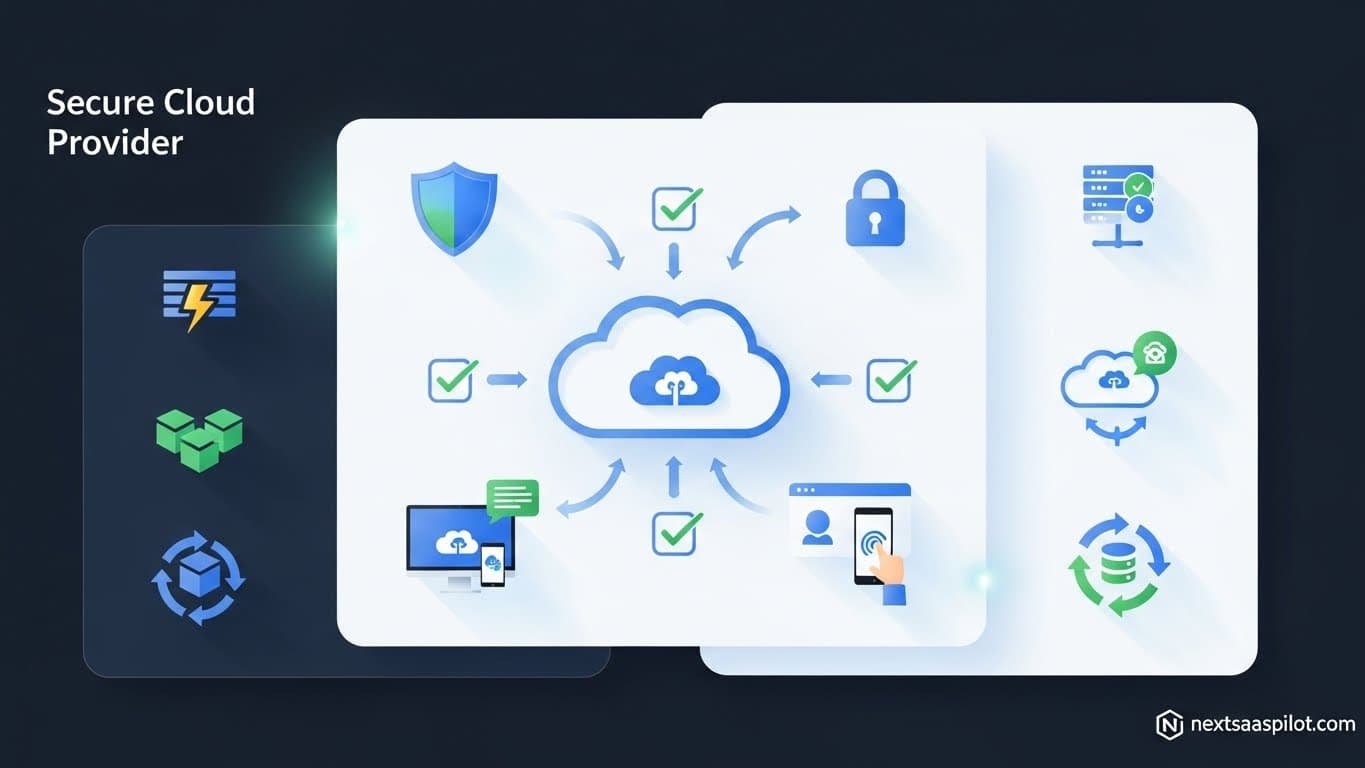
Choosing a secure cloud provider is the single most critical infrastructure decision for a SaaS founder. In an era where a single data breach can evaporate customer trust and bankrupt a company, your cloud provider is not just a vendor—they are your bank vault.
In 2025, the decision is no longer just about “AWS vs. Azure.” It is about sovereignty, liability, and specialized compliance. A healthcare SaaS might find Amazon too broad for their HIPAA needs, while a Fintech startup might find a niche provider lacks the global latency they require.
This guide moves beyond the marketing brochures to give you a forensic framework for selecting a partner that keeps your data—and your business—secure.
What Defines a “Secure” Cloud Provider for SaaS?
A secure cloud provider for SaaS is defined by three non-negotiable pillars: verified compliance certifications (SOC 2 Type II, ISO 27001), granular Identity and Access Management (IAM) capabilities, and legally binding Data Sovereignty guarantees. It is not enough for a provider to be “secure by default”; they must provide the tools for you to configure security at the application layer.
Most founders mistake “uptime” for “security.” They are unrelated. A server can be online 99.999% of the time and still have wide-open ports leaking customer data.
The “Security Trinity” Checklist:
- Physical Security: Do they have armed guards and biometric scanners at the data center? (You can’t check this, so you rely on SOC 2 reports).
- Network Security: Do they offer built-in DDoS protection and Web Application Firewalls (WAF)?
- Operational Security: Do they have a “Shared Responsibility Model” that clearly delineates who patches the OS and who encrypts the database?
The “Big Three” vs. Niche Providers: Which Is Safer?
The “Big Three” (AWS, Azure, Google Cloud) offer superior physical security and massive R&D budgets for threat detection, making them the safest bet for general-purpose SaaS. However, niche providers (like ClearDATA for healthcare or Atlantic.Net for HIPAA) often offer better compliance security because their entire infrastructure is pre-configured for specific regulatory frameworks.
1. Amazon Web Services (AWS)
- Best For: Mature SaaS teams with dedicated DevOps engineers.
- Security Edge: AWS IAM is the gold standard for granular permission control. You can define exactly which microservice can talk to which database down to the millisecond.
- The Risk: Complexity. It is famously easy to accidentally leave an S3 bucket public if you don’t know what you are doing.
2. Microsoft Azure
- Best For: B2B SaaS selling to the Enterprise.
- Security Edge: Active Directory (Entra ID) integration. If your customers use Microsoft, Azure makes Single Sign-On (SSO) and identity management seamless.
- The Risk: It is a prime target for state-sponsored attacks due to its ubiquity in government.
3. Google Cloud Platform (GCP)
- Best For: AI-driven SaaS and containerized apps (Kubernetes).
- Security Edge: Encryption by Default. Google encrypts data at rest and in transit without you having to toggle a setting.
- The Risk: Fewer legacy compliance certifications compared to Azure/AWS in obscure industries.
4. Niche Providers (The Specialists)
- Examples: Aptible (HIPAA/SOC2 PaaS), Wasabi (Secure Storage).
- Security Edge: “Compliance as Code.” They won’t let you deploy a server that violates HIPAA.
- The Risk: Smaller scale. If they go down, you go down, and they lack the redundancy of Amazon.
For a deeper look at the broader market, review our cloud applications list to see who the giants are using.
What Is Data Sovereignty and Why Does It Matter?
Data Sovereignty is the legal concept that digital data is subject to the laws of the country in which it is processed. For SaaS providers, this matters because storing German customer data on a US server violates GDPR, potentially leading to fines of 4% of global revenue. You must choose a provider with data centers physically located in your target markets.
Do not confuse Residency with Sovereignty.
- Data Residency: You choose to store data in Dublin because it’s fast.
- Data Sovereignty: You must store data in Dublin because the law says it cannot leave the EU.
The “Patriot Act” Problem:
Even if a US cloud provider (like AWS) stores data in Europe, the US CLOUD Act allows the US government to subpoena that data. This is why many European SaaS companies are looking at “Sovereign Cloud” providers based entirely within the EU, like OVHcloud or T-Systems.
How to Audit a Cloud Provider’s Certifications?
To audit a cloud provider, request their “Artifacts” package, specifically looking for the SOC 2 Type II report (not Type I) and the ISO 27001 certificate. Verify the dates are current (within the last 12 months) and check the “Scope” section of the report to ensure the specific services you plan to use (e.g., their new AI engine) are actually covered by the audit.
A common trick: A provider will say they are “SOC 2 Compliant,” but the audit only covers their physical data center, not the managed database service you are actually buying.
The “Must-Have” Certs:
- SOC 2 Type II: Proves they follow their own security rules over a period of time (6-12 months).
- ISO 27001: International standard for information security management.
- FedRAMP: (If selling to US Gov) The highest standard of civilian security.
- PCI-DSS Level 1: (If touching credit cards) Mandatory for fintech.
Reference industry benchmarks in our saas industry report to see what certifications your competitors are boasting about.
What Hidden Contract Risks Should You Look For?
Hidden contract risks include “Limitation of Liability” clauses that cap the provider’s payout at 12 months of fees even in a massive breach, and “Data Exit” fees that charge exorbitant rates to retrieve your data if you switch providers. You must negotiate a Business Associate Agreement (BAA) if you handle healthcare data, as standard contracts rarely cover HIPAA liability.
The “No-Liability” Clause:
Most standard cloud contracts state they are not liable for consequential damages (i.e., the money you lose because your customers quit). If AWS goes down and you lose $1M, they might give you a $500 service credit.
Vendor Lock-In (The Roach Motel):
Clouds are easy to get into and hard to leave.
- The Trap: Using proprietary services like AWS DynamoDB or Azure Functions.
- The Fix: Build on open standards like Kubernetes or PostgreSQL. This allows you to lift and shift your SaaS to another provider if security or pricing goes south.
How Does the “Shared Responsibility Model” Affect You?
The “Shared Responsibility Model” dictates that the cloud provider is responsible for the security of the cloud (hardware, network), while you are responsible for security in the cloud (customer data, passwords, encryption). Failing to understand this line is the #1 cause of SaaS data breaches; Amazon will not stop you from making a database public.
Your Responsibilities:
- IAM: Creating strong passwords and MFA policies.
- Encryption: Managing the keys to your data.
- Patching: (If using IaaS) Updating the Linux OS on your virtual machines.
Provider Responsibilities:
- Physical Access: Keeping bad guys out of the server room.
- Hypervisor: Ensuring one customer’s data doesn’t bleed into another’s.
Summary: The Decision Matrix
| Feature | AWS / Azure / GCP | Niche / Managed Cloud |
| Scalability | Infinite | Limited |
| Compliance | Do-It-Yourself | “Compliance-as-a-Service” |
| Support | Expensive / Automated | Human / Consultative |
| Cost | Low start, high scaling | Higher start, predictable |
| Best For | Tech-heavy startups | Healthcare / Fintech |
Final Thoughts
Choosing a secure cloud provider is not a one-time checkbox; it is a continuous relationship. The best provider for you is the one that aligns with your specific threat model.
If you are building a photo-sharing app, AWS is perfect. If you are building a bank, you might need a dedicated private cloud. Don’t let the “default choice” become your single point of failure.
For further reading on the fundamental concepts of cloud architecture, Cloud Computing offers a solid technical baseline.