
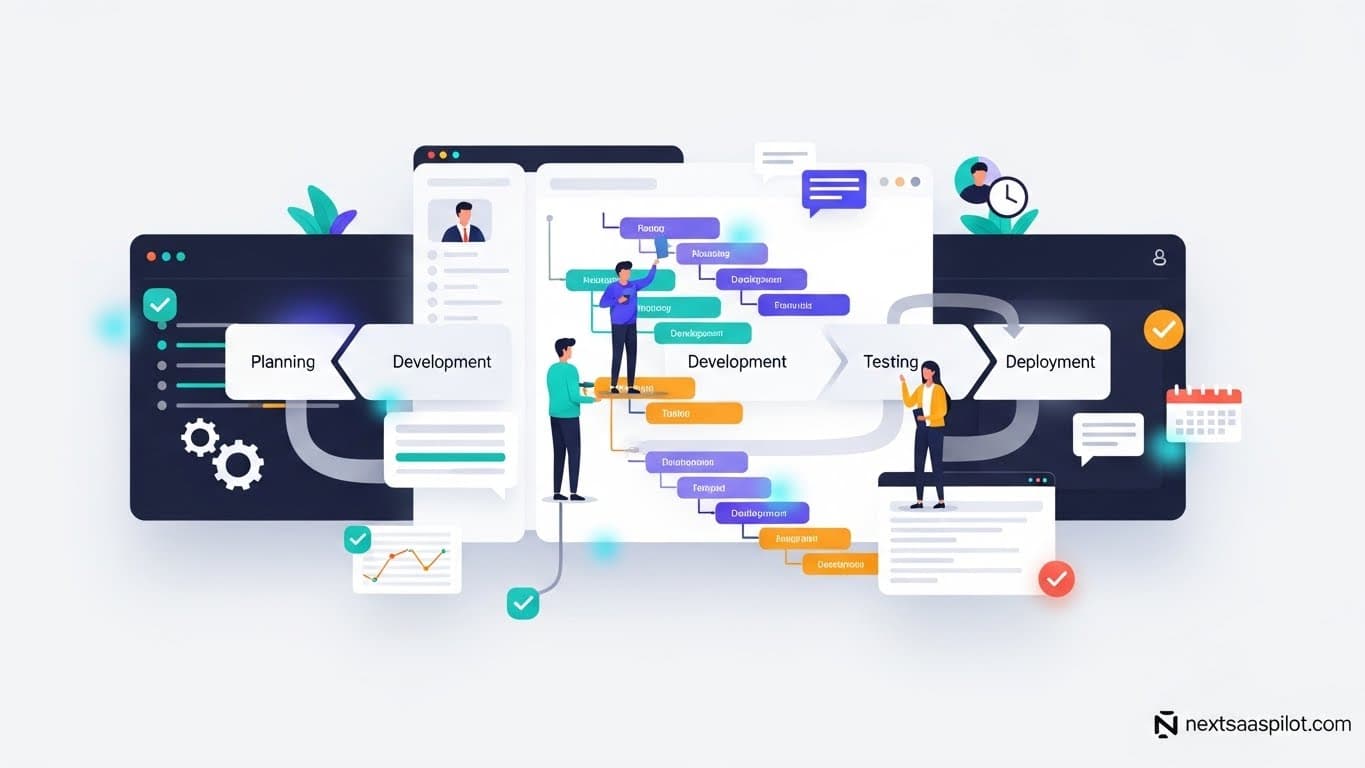
Effective software project management is the invisible infrastructure that prevents a SaaS product from collapsing under its own weight. In the fast-paced world of recurring revenue, code is never truly “finished,” and deadlines are constant. Without a rigid management framework, even the most brilliant engineering teams devolve into chaos, shipping bugs instead of features.
This guide serves as the definitive playbook for modern SaaS leaders. It moves beyond textbook definitions to explore the gritty reality of managing distributed teams, handling technical debt, and shipping scalable software that customers actually pay for.
What Is Software Project Management in a SaaS Context?
Software project management involves planning, executing, monitoring, and closing software projects. In a SaaS context, it shifts from a “one-time delivery” model to a “continuous delivery” model, focusing on iterative updates, rapid deployment cycles (CI/CD), and balancing new feature development with ongoing maintenance and bug fixes.
To understand the stakes, you must look at the failure rate. Industry data suggests that nearly 70% of software projects fail to meet their original objectives. In SaaS, failure doesn’t just mean a late project; it means churn.

The SaaS Difference:
I once managed a project for a legacy enterprise client moving to the cloud. Their mindset was “Build it, ship it, forget it.” That works for bridges, not for software. In SaaS, the launch is just the starting line.
- Continuous Integration: You are merging code daily.
- Feedback Loops: User complaints today become tickets tomorrow.
- Subscription Pressure: You must constantly add value to justify the monthly fee.
Agile vs. Waterfall: Which Methodology Wins for SaaS?
Agile is the undisputed winner for SaaS development because it allows for flexibility and rapid iteration based on user feedback. Waterfall, while useful for hardware or strict regulatory environments, is too rigid for SaaS, often leading to products that are obsolete by the time they are finally released.
Waterfall: The Relay Race
Waterfall requires you to define every single requirement before writing a line of code.
- Pros: predictable budget.
- Cons: If the market changes during development (and it will), you are stuck building the wrong thing.
Agile (Scrum/Kanban): The Sprints
Agile breaks the project into 2-week “Sprints.” You build a little, ship it, learn, and repeat.
- Pros: You can pivot quickly.
- Cons: Scope creep is harder to manage if you aren’t disciplined.
Comparison Table: Agile vs. Waterfall
| Feature | Agile (SaaS Standard) | Waterfall (Legacy) |
| Flexibility | High (Change is expected) | Low (Change is expensive) |
| Delivery | Continuous / Incremental | “Big Bang” Launch |
| Feedback | Immediate (Every sprint) | Late (After launch) |
| Risk | Distributed | Concentrated at the end |
| Best For | Web Apps, Mobile Apps, Startups | Firmware, Construction, Medical Devices |

How Does the SaaS Development Lifecycle (SDLC) Impact Management?
The SaaS Development Lifecycle (SDLC) impacts management by enforcing a loop of planning, coding, testing, and deploying. Unlike traditional software that ends at “maintenance,” SaaS SDLC is infinite; once a feature is deployed, it immediately enters a feedback cycle that informs the planning phase of the next update.
Understanding the SaaS lifecycle is critical. You are managing a living organism, not a static asset.
The 6 Phases of SaaS SDLC:
- Planning: Defining the “User Stories” (What does the user need?).
- Design: UI/UX wireframing. Check SaaS website inspiration to ensure your interface meets modern standards.
- Implementation: The actual coding.
- Testing (QA): Automated and manual bug hunting.
- Deployment: Pushing to production (AWS/Azure).
- Maintenance: Monitoring uptime and fixing bugs.
Anecdote: I worked with a team that skipped the “Design” phase to save time. They spent 4 weeks coding a feature, only to realize the user interface was unusable. They had to throw away the code and start over. The “shortcut” cost them a month.
What Are the Essential Roles in a Modern SaaS Team?
The essential roles in a modern SaaS team are the Product Manager (defines the “what”), the Engineering Lead (defines the “how”), and the Scrum Master (removes obstacles). Additionally, specialized roles like QA Engineers and UI/UX Designers act as quality gates to ensure the software is bug-free and intuitive.
It is vital to separate concerns. If the developer is also the QA tester, they will miss their own bugs.
Key Roles Breakdown:
- Product Manager (PM): The “CEO of the Feature.” They own the roadmap.
- Project Manager / Scrum Master: The “Shepherd.” They ensure the team hits deadlines and isn’t blocked by dependencies.
- Tech Lead: The “Architect.” They ensure the code is scalable.
- Individual Contributors (ICs): The developers writing the code.
If you are learning how to start a software company, you might wear all these hats initially. But to scale, you must delegate.

How Do You Manage Scope Creep and Technical Debt?
You manage scope creep by enforcing a strict “definition of done” and using a backlog to prioritize new ideas rather than adding them mid-sprint. You manage technical debt by dedicating 20% of every sprint to refactoring code, ensuring that shortcuts taken today do not crash the system tomorrow.
Scope Creep (The Feature Bloat) This happens when stakeholders say, “Can we just add this one little thing?”
-
- The Fix:* “Yes, we can add that, but it goes into the next sprint, not this one.”
Technical Debt (The Interest Payments) Every time you write “quick and dirty” code to hit a deadline, you incur debt.
- The Fix: If you don’t pay it down (refactor), your development speed will grind to a halt because the codebase becomes too fragile to touch.
This balance is a core component of SaaS platform development. If you ignore debt, your platform will eventually fail to scale.
Which Tools Are Best for SaaS Project Management?
The best tools for SaaS project management are Jira for enterprise-grade tracking, Linear for high-velocity engineering teams, and Monday.com for generalist visual management. The choice depends on your team’s size and workflow; engineering-heavy teams prefer Linear, while cross-functional teams often prefer the flexibility of Notion or Monday.
Your tool is your source of truth.
- Jira (Atlassian): The industry standard.
- Pros: Highly customizable, integrates with everything.
- Cons: Slow, complex, can feel like “work about work.”
- Linear: The modern favorite.
- Pros: Blazing fast, keyboard-driven, built for hackers.
- Cons: Less flexible for non-engineering tasks.
- Trello/Asana: The visual options.
- Pros: Great for Kanban boards.
- Cons: Hard to manage complex dependencies.
When selecting your SaaS tech stack, ensure your project management tool integrates with your code repository (GitHub/GitLab). You want the ticket to move to “Done” automatically when the code is merged.
How Do You Measure Team Performance?
Measure team performance using metrics like Sprint Velocity (work completed per cycle), Cycle Time (time from start to finish of a task), and Deployment Frequency. Avoid using “Lines of Code” or “Hours Worked” as metrics, as these encourage inefficiency and bad coding practices.
The DORA Metrics (DevOps Research and Assessment):
- Deployment Frequency: How often do you ship? (Elite teams ship daily).
- Lead Time for Changes: How long does it take for a commit to go live?
- Change Failure Rate: How often do deployments break things?
- Time to Restore Service: How fast can you fix a crash?
These metrics are the dashboard for your engineering engine.
In-House vs. Outsourced: Managing External Teams
Managing external teams requires over-communication and strict documentation; you cannot rely on “water cooler” chats to align priorities. When working with a SaaS development company, treat them as a remote extension of your team by inviting them to daily standups and giving them access to the same project management tools your internal team uses.
Many founders make the mistake of “throwing specs over the wall” to an agency. That fails.
- Internal Team: Best for core IP and long-term architecture.
- External Team: Best for MVPs, specific integrations, or temporary scaling.
If you hire a SaaS development company, ensure their contract structure supports Agile (Time & Materials) rather than Fixed Scope, or you will fight over every change request.
How Does “The Iron Triangle” Apply to SaaS?
The Iron Triangle dictates that you can only optimize for two of the three constraints: Scope, Time, and Cost. In SaaS, “Time” is usually fixed (deadlines) and “Cost” is fixed (salaries), so “Scope” must be flexible; you must be willing to cut features to hit the deadline.

- Fast + Cheap = Low Quality (Buggy)
- Fast + Good = Expensive (Senior Devs)
- Good + Cheap = Slow (Hobby Project)
You cannot have all three. As a project manager, your job is to tell stakeholders which one is being sacrificed.
Final Thoughts
Software project management is not about charts and tickets; it is about people and focus. It is the art of removing distractions so that brilliant engineers can solve hard problems.
Whether you are building a simple MVP or an enterprise platform, the principles remain the same: iterate fast, trust the data, and never stop shipping.