
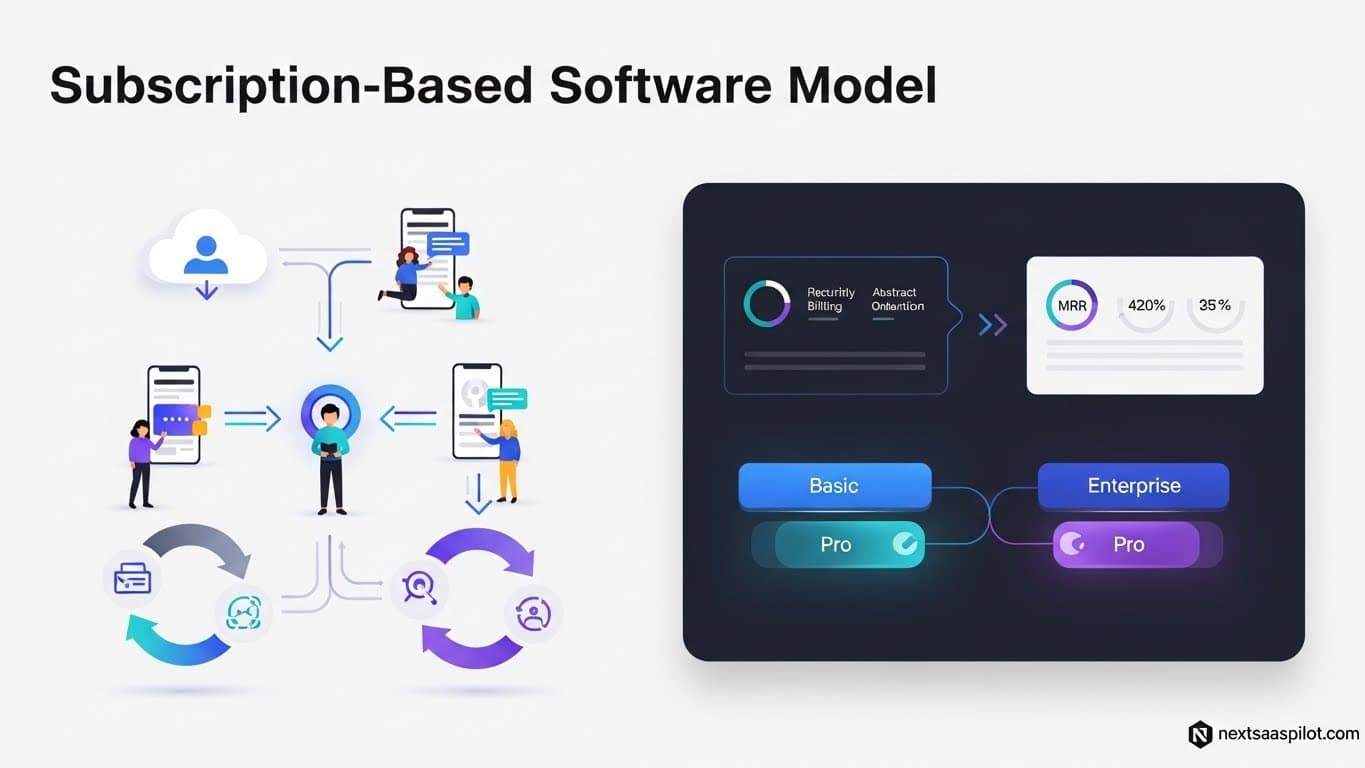
The subscription based software model has become the dominant economic force in the technology sector, replacing one-time purchases with recurring revenue streams. This shift has transformed software from a static product you own into a dynamic service you rent.
I have consulted for legacy software companies attempting to “cross the chasm” from perpetual licensing to subscriptions. The transition is rarely just about changing how you bill; it requires a complete cultural overhaul. You stop building features to sell a box and start building features to prevent cancellation. This guide deconstructs the economics, metrics, and operational realities of running a successful subscription software business.
What Is the Subscription-Based Software Model?
The subscription-based software model is a business strategy where customers pay a recurring fee (monthly or annually) to access software, rather than paying a one-time upfront price for a perpetual license. This model shifts the focus from ownership to access, ensuring users always have the latest updates and support.
In the past, you bought a CD-ROM of Adobe Photoshop for $700. You owned it forever, but it became obsolete in two years. Today, you pay Adobe $20 a month. You never “own” it, but you always have the cutting-edge version.
This model aligns the incentives of the developer and the user. If the developer stops improving the product, the user stops paying. It creates a relationship rather than a transaction. This alignment is the core engine behind the modern saas business model.
Perpetual License vs. Subscription: What Changed?
Perpetual licensing involves a large capital expenditure (CapEx) for software that degrades over time, whereas the subscription model treats software as an operating expense (OpEx) that improves over time. The industry shifted because subscriptions offer predictable revenue for vendors and lower barriers to entry for customers.
The death of the perpetual license was driven by the cloud. When software moved from on-premise servers to the cloud, the vendor took on the hosting costs. It became impossible to sell a one-time license while incurring ongoing server bills.
Comparison: Ownership vs. Access
| Feature | Perpetual License | Subscription Model |
| Payment | Large Upfront (One-time) | Small Recurring (Monthly/Yearly) |
| Updates | Paid Upgrades (v1 to v2) | Included Automatically |
| Hosting | On-Premise (Customer managed) | Cloud (Vendor managed) |
| Revenue | Spiky / Unpredictable | Smooth / Predictable (MRR) |
| Lock-in | High (Sunk Cost) | Low (Data Lock-in only) |
Why Are Companies Pivoting to Subscriptions?
Companies pivot to subscriptions to stabilize cash flow through Annual Recurring Revenue (ARR), which increases company valuation and creates a predictable financial baseline for reinvestment into R&D. Investors value subscription revenue significantly higher than one-time sales revenue.
I have seen valuations triple simply because a company proved it could switch its revenue from transactional to recurring. Why? Because you start the year knowing you have 80% of your revenue already secured.
This financial stability allows for better long-term planning. You aren’t starting from zero sales every quarter. This predictability is the foundation of a healthy saas financial model, allowing for aggressive spending on customer acquisition.
Core Pricing Strategies in Subscription Software
Successful subscription pricing strategies include Flat-Rate pricing for simplicity, Tiered pricing to capture different market segments, Per-User pricing for scalability, and Usage-Based pricing to align cost with value. Choosing the right strategy is the most powerful lever for growth.
Your pricing strategy is your product’s packaging.
- Freemium: Free entry tier to capture leads, paid tier for power features.
- Tiered: Good/Better/Best (e.g., Bronze, Silver, Gold).
- Per-Seat: The standard for B2B tools like Slack or Salesforce.
- Usage-Based: Pay for what you use (e.g., API calls, storage).
Understanding your saas revenue model is crucial here. If you pick a per-seat model but your software is only used by one admin, you cap your growth. If you pick usage-based but usage is unpredictable, customers will churn out of fear of overage charges.
Key Metrics: How Do You Measure Success?
The vital metrics for any subscription business are Monthly Recurring Revenue (MRR), Customer Acquisition Cost (CAC), Lifetime Value (LTV), and Churn Rate; managing the ratio between LTV and CAC determines the long-term viability of the company.
You cannot run a subscription business with a “retail” mindset.
- Churn: The percentage of customers who cancel. If this is high, you have a leaky bucket.
- CAC: How much marketing money you spend to get one customer.
- LTV: How much that customer pays you before they churn.
- CAC Payback Period: How many months it takes to earn back the money you spent getting the customer.
A robust saas subscription model usually targets an LTV:CAC ratio of 3:1. If you spend $100 to get a customer, they should pay you $300 over their lifetime.
The Importance of “Dunning” and Retention
Dunning management is the automated process of retrying failed payments and notifying customers of expiring credit cards to prevent involuntary churn. Involuntary churn—losing customers who actually wanted to stay—is the silent killer of subscription businesses.
I once audited a SaaS company that was losing 5% of its revenue monthly simply because they didn’t have logic to retry credit cards that failed due to temporary network issues.
Implementing a billing engine that handles dunning is part of a sound saas architecture. You must treat billing failures as a customer success touchpoint, not just a technical error.
How Does Architecture Support the Subscription Model?
A subscription-ready architecture requires a centralized identity provider to manage access rights, a flexible billing engine integrated into the product logic, and automated provisioning to instantly unlock features when a user upgrades.
You cannot hardcode “Pro Features.” Your codebase must check the user’s subscription status in real-time.
- Feature Flagging: Wrapping code in checks like
if (user.plan == 'premium'). - Tenant Isolation: Ensuring that data is secure, especially if offering tiered security features.
- Integration: The payment gateway (Stripe) must talk to the App Database instantly.
This is where cloud application management becomes vital. You are managing a live environment where a credit card swipe triggers infrastructure changes (like provisioning more storage).
The Shift from Support to Customer Success
In a subscription model, the “Customer Success” function replaces traditional support by proactively helping users achieve their goals with the software, thereby ensuring renewal and expansion. “Support” fixes bugs; “Success” prevents cancellation.
Because the switching costs are low, customers can leave the moment they stop seeing value. Your saas organizational structure must reflect this. The Success team is a revenue-generating arm, not a cost center. They are responsible for “Net Revenue Retention”—growing the revenue from existing cohorts through upsells.
Usage-Based Pricing: The Future of Subscriptions?
Usage-based (or consumption-based) pricing charges customers based on metrics like gigabytes stored or API requests made, aligning the price directly with the value received and allowing for “land and expand” growth without friction.
This is the model popularized by Snowflake and AWS. It is technically a subset of the subscription world but operates differently. It removes the “shelfware” problem—where companies pay for seats they don’t use.
However, it makes revenue forecasting harder. This shift is part of the broader what is xaas (Everything as a Service) trend, where granular metering becomes the standard.
Infrastructure Costs and Margins
The subscription model demands strict control over infrastructure costs (COGS) because a fixed-price subscription can become unprofitable if a user consumes excessive resources. You must monitor “Cost Per Tenant” to ensure your gross margins remain healthy.
If you sell a plan for $20/month, but that user consumes $15/month in cloud compute, your business is unviable.
Understanding caas vs paas is critical here. Using a cheaper, more controlled container architecture (CaaS) might be necessary to protect margins compared to an expensive Platform as a Service (PaaS).
Conclusion
The subscription based software model is not just a billing method; it is a commitment to continuous innovation. It forces companies to earn their customers’ business every single month.
For founders and product leaders, the challenge is maintaining the velocity of value delivery. If you stop shipping, they stop paying. But if you get it right, you build a resilient, predictable revenue engine that can weather economic downturns better than any transactional business. For historical context on this economic shift, take a look at the Subscription business model.