
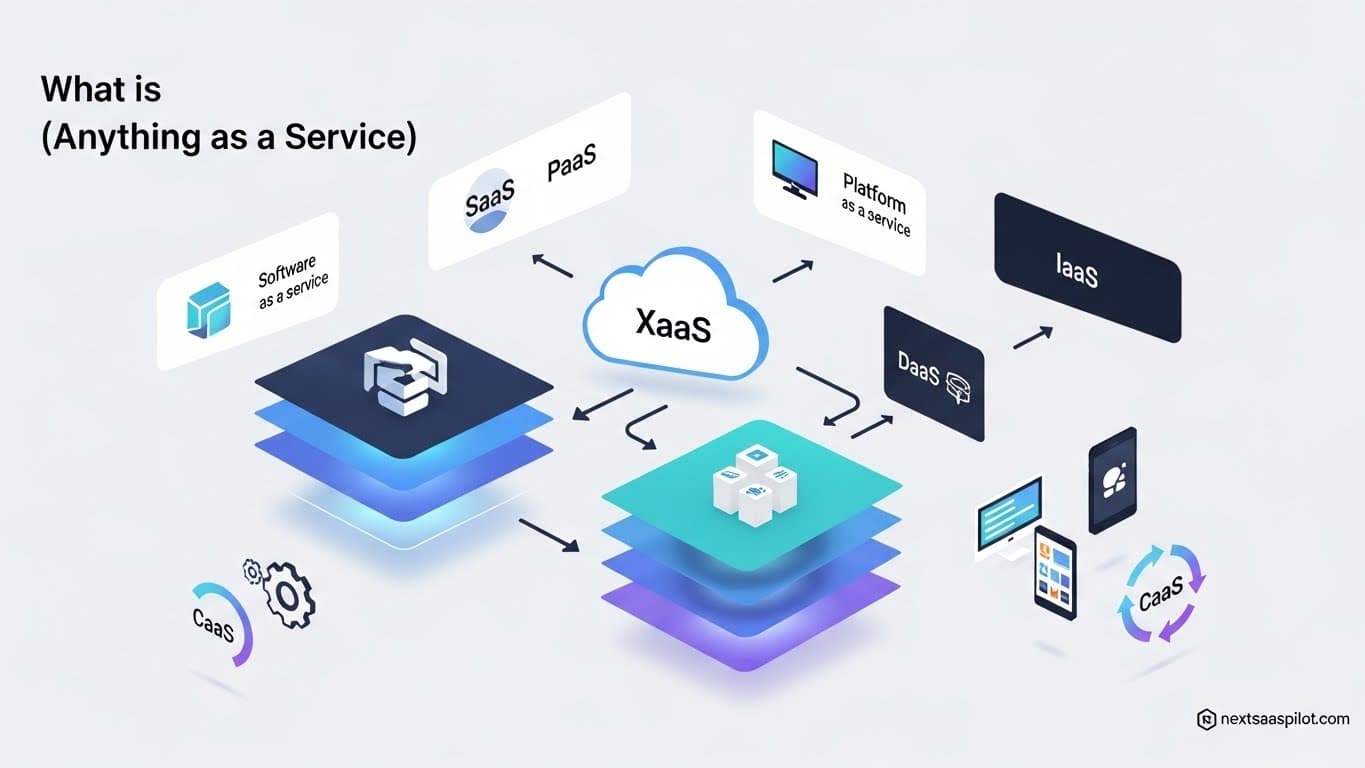
Understanding what is xaas is essential for modern business leaders, as it represents the complete shift from owning physical infrastructure to consuming digital services on demand. The “Everything as a Service” model has dismantled the traditional IT barrier to entry, allowing startups to access enterprise-grade technology without massive capital expenditure.
I have witnessed the transformation of the software landscape firsthand. Ten years ago, launching a secure tech company required buying servers, hiring security guards for a data center, and purchasing perpetual software licenses. Today, a founder with a laptop and a credit card can replicate that same infrastructure in minutes using XaaS. This guide deconstructs the layers, benefits, and economic realities of this cloud revolution.
What Is XaaS and How Does It Work?
XaaS (Everything as a Service) is a collective term that refers to the delivery of anything as a service via the cloud, rather than as a product installed on-premise. It encompasses the vast variety of products, tools, and technologies that vendors deliver to users over a network—typically the internet—on a subscription or usage basis.
XaaS is not a single technology; it is an operating model. It treats technology like a utility. Just as you plug a lamp into a wall socket to get electricity without owning a power plant, XaaS allows you to plug into computing power, storage, software, or AI capabilities without owning the underlying hardware.
This shift is driven by the maturity of high-speed internet and virtualization. Because we can now transmit data instantly, the physical location of the computer doing the work no longer matters. This has given rise to the saas business model, which is the most visible layer of the XaaS pyramid.
Why Is the Shift to XaaS Happening Now?
The shift to XaaS is driven by the need for business agility, cost efficiency, and the desire to convert Capital Expenditure (CapEx) into Operational Expenditure (OpEx). Companies prefer to pay for what they use rather than betting millions on hardware that depreciates and becomes obsolete within three years.
I’ve consulted for enterprises that were stuck with millions of dollars in “Shelfware”—servers and software licenses they bought but never used. XaaS eliminates this waste.
In the modern economy, speed is the ultimate competitive advantage. If you need to test a new AI feature, you can subscribe to an AI service today. If it fails, you cancel tomorrow. In the old model, you would have spent six months building the infrastructure just to run the test. This agility is supported by advanced cloud application management tools that orchestrate these services seamlessly.
What Are the Core Pillars of the XaaS Model?
The XaaS ecosystem is built upon three foundational pillars: Infrastructure as a Service (IaaS), Platform as a Service (PaaS), and Software as a Service (SaaS). These three layers stack on top of each other to provide the complete spectrum of cloud computing needs, from raw metal to finished applications.
To visualize this, think of a house:
- IaaS: The foundation and the land (Raw Compute).
- PaaS: The walls, plumbing, and electrical wiring (Development Environment).
- SaaS: The furniture and appliances (Finished Software).
However, the lines are blurring. We are seeing the rise of Containers as a Service (CaaS), which sits between IaaS and PaaS. Understanding the nuance of caas vs paas is critical for architects deciding how much control they need versus how much convenience they want.
Examples of Emerging XaaS Categories
Beyond the core three, XaaS has expanded to include specialized services like Database as a Service (DBaaS), Disaster Recovery as a Service (DRaaS), and Storage as a Service (STaaS). This granularity allowing businesses to outsource specific, painful parts of their IT stack to specialized vendors.
The alphabet soup of XaaS is growing. Here are the key emerging categories:
| Service Type | Acronym | Function | Example |
| Database | DBaaS | Managed SQL/NoSQL databases. | AWS RDS, MongoDB Atlas |
| Containers | CaaS | Orchestration of Docker containers. | Google Kubernetes Engine |
| Storage | STaaS | Scalable cloud storage. | Amazon S3, Dropbox |
| Disaster Recovery | DRaaS | Backup and failover hosting. | Azure Site Recovery |
| Function | FaaS | Serverless code execution. | AWS Lambda |
This modularity is essential for modern saas architecture. You don’t build a database anymore; you rent a DBaaS. You don’t build a login system; you rent Identity as a Service (IDaaS) like Auth0.
How Does XaaS Impact Business Finance?
XaaS fundamentally changes a company’s financial structure by shifting costs from fixed assets to variable expenses, requiring a robust financial model that tracks unit economics and usage metrics. It democratizes access to technology, allowing small startups to compete with global enterprises on a level playing field.
In a saas financial model, the concept of “Cost of Goods Sold” (COGS) changes. You aren’t amortizing the cost of a server over five years. You are paying a monthly bill based on consumption.
This creates a need for “FinOps”—the practice of managing cloud costs. Because it is so easy to spin up a service, it is easy to lose track of spending. I once saw a startup accidentally spend $10,000 in a weekend because a developer left a high-performance database cluster running.
What Are the Main Benefits of Adopting XaaS?
The primary benefits of XaaS are scalability, accessibility, and the ability to focus internal resources on core business logic rather than IT maintenance. It allows organizations to “fail fast” and pivot without the weight of sunk infrastructure costs dragging them down.
- Scalability: You can scale up to millions of users during a Black Friday sale and scale down on Tuesday.
- Access: Your team can access tools from anywhere in the world, supporting the remote work revolution.
- Focus: Your engineers stop fixing printers and patching servers. They focus on building the product.
This ties directly into the saas revenue model. By lowering your upfront costs, you can achieve profitability faster, even with lower initial revenue.
What Risks Should You Consider with XaaS?
The significant risks of XaaS include vendor lock-in, data security concerns, and potential performance latency due to internet dependence. Relying entirely on third-party providers means that if their service goes down (e.g., an AWS outage), your business goes down with it.
Vendor Lock-In: If you build your entire application using proprietary Google Cloud tools, moving to Azure later is incredibly difficult. You are effectively married to your vendor.
Security: In a subscription based software model, you are entrusting your customer data to another company. You must ensure they have SOC 2 compliance and robust encryption.
Cost Creep: Usage-based pricing is great until you go viral, and your bill explodes.
The Role of AI in XaaS Evolution
Artificial Intelligence is becoming the newest layer of XaaS (AIaaS), where companies access massive Large Language Models (LLMs) via API rather than training their own models. This lowers the barrier to entry for implementing advanced machine learning features in standard software.
We are seeing a shift where AI is embedded into every layer.
- Infrastructure: AI optimizing server loads.
- Platform: AI coding assistants.
- Software: AI chatbots inside CRMs.
This evolution demands a flexible saas organizational structure. You might need an “AI Ops” team to manage these specific service integrations.
Integrating XaaS into Your Architecture
Successful integration requires a “Servicized” architecture (often Microservices) where different components of your application connect via APIs to various XaaS providers. This requires a strong API Gateway and robust error handling to manage the dependencies between external services.
You are essentially building a Lego castle.
- Your payments are handled by Stripe (Fintech as a Service).
- Your text is stored in Atlas (DBaaS).
- Your images are in S3 (STaaS).
- Your emails are sent via SendGrid (CaaS – Communication as a Service).
Your job is to be the glue. This creates dependencies. If Stripe goes down, you can’t take money. This is why the saas subscription model relies heavily on redundancy and graceful degradation strategies.
Conclusion
What is XaaS? It is the realization of computing as a utility. Just as factories stopped building their own water wheels and connected to the electric grid, modern businesses are unplugging their server rooms and connecting to the cloud.
For the SaaS founder, XaaS is the ultimate lever. It allows you to punch above your weight class. But with great power comes great responsibility—specifically, the responsibility to manage costs, secure data, and architect for resilience. The companies that master XaaS don’t just save money; they move faster than the competition can comprehend.
For a broader definition and history, refer to Everything as a Service